

Modern sports facility design demands structural solutions that transcend basic environmental enclosure. The implementation of tensile membrane architecture in gymnasiums and athletic centers establishes a dynamic interplay between structural efficiency and spatial fluidity. By utilizing sophisticated form-finding computational algorithms, we engineer roof profiles that achieve complete structural equilibrium. This methodology generates expansive, clear-span interiors that integrate seamlessly with the surrounding landscape while meeting rigorous regional wind and snow load parameters.
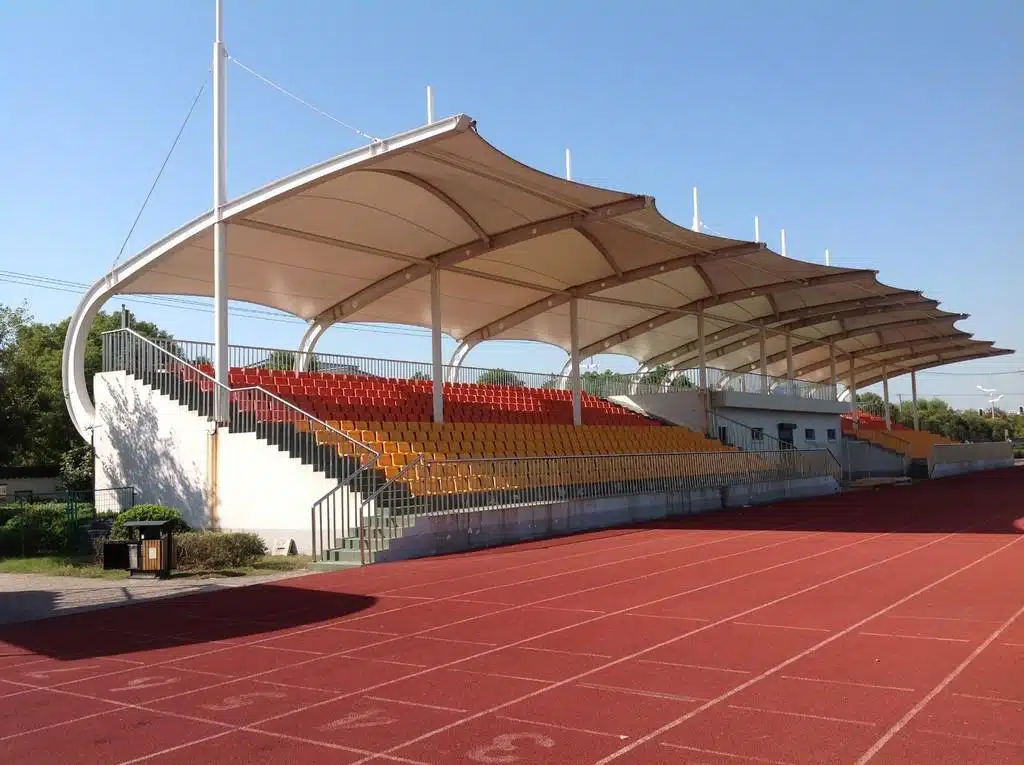
Engineering Structural Form and Spatial Dynamics
The foundation of a permanent tensile gymnasium relies on the precise integration of flexible architectural membranes with primary load-bearing structural skeletons. Utilizing high-strength framing—typically engineered from premium Q355B structural steel—architects can bridge expansive athletic courts without the need for intermediate vertical supports. The prestressed membrane, fabricated from advanced PVDF-coated composites or highly durable PTFE fiberglass, works in tandem with localized cable-net systems to transfer environmental and dynamic loads efficiently to the foundational footings.
This synergy of rigid steel and tensioned fabric allows for highly complex geometric profiles, such as hypar or conic roof lines. These specific geometries are not merely aesthetic; they actively disperse aerodynamic pressure during high-velocity wind events, ensuring the long-term stability and safety of the sports arena.
Pneumatic Air-Supported Enclosures
For massive volume requirements and versatile site applications, pneumatic or air-supported membrane enclosures present a highly engineered structural solution. Rather than relying on a solid steel truss system, these envelopes are sustained entirely by a calibrated internal air pressure differential. Specialized mechanical systems continuously maintain the precise inflation levels necessary to transform the membrane skin into a rigid, load-bearing shell.
This configuration completely eliminates internal obstructions. The resulting architectural envelope provides an uninterrupted, continuous space that is perfectly suited for multi-sport configurations, indoor track and field facilities, and large-scale athletic training centers requiring immediate deployment.
Climatic Response and Daylighting Strategies
A fundamental characteristic of tensile architecture is its capacity to modulate the internal microclimate through passive environmental strategies. The inherent translucency of structural membranes allows for calibrated natural daylight to penetrate the sports arena. This drastically reduces the reliance on artificial lighting grids during daytime operations, transforming the visual quality of the interior space.
Simultaneously, the specified membrane coatings are formulated to reflect intense ultraviolet radiation, minimizing thermal heat gain and mitigating problematic glare across playing surfaces. This calculated balance of light transmission, acoustic damping, and thermal resistance results in a highly functional athletic environment optimized for both athletes and spectators.
- Precision Form-Finding: Advanced computational modeling guarantees optimal tension distribution across the entire surface geometry.
- Engineered Load Capacity: Tensioned cables and Q355B steel frameworks seamlessly handle dynamic environmental forces.
- Optimized Illumination: Calibrated light transmission delivers uniform, glare-free daylighting essential for high-performance sports.


