
Beyond Aesthetics: The Business Case for Membrane Landscapes
For urban developers and municipal planners, investing in a commercial sunshade structure is about more than just visual appeal. Public spaces—such as commercial plazas, tourist attractions, and pedestrian corridors—require durable, weather-resistant solutions that can withstand heavy public use without demanding constant upkeep.
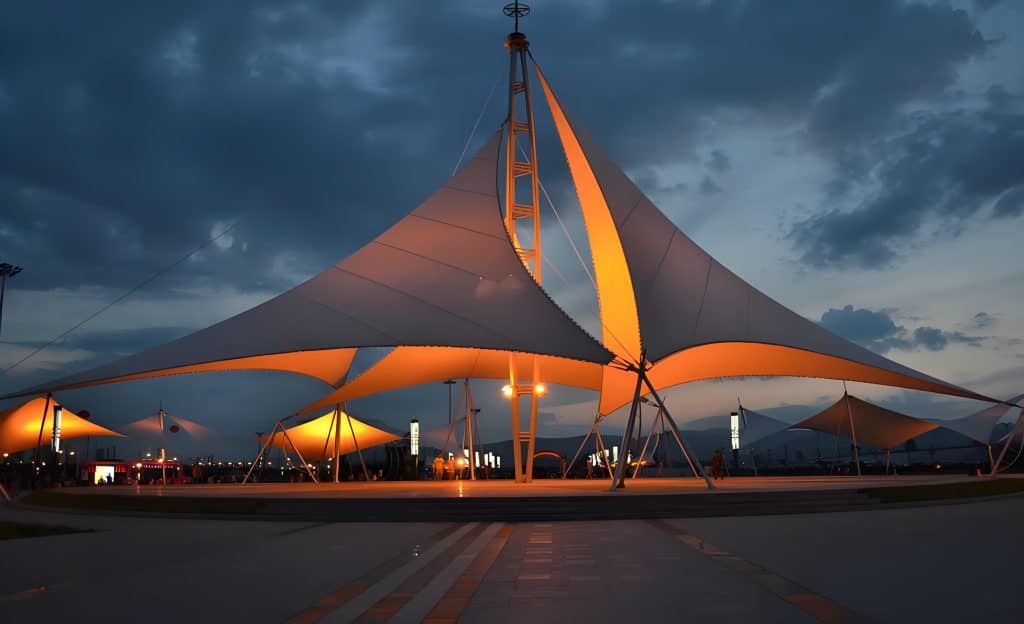
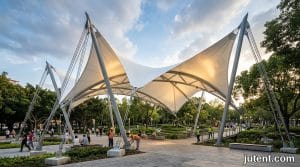
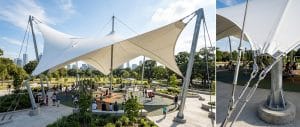
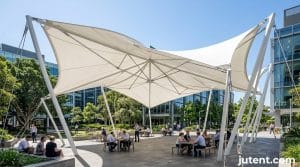
A well-engineered tensile landscape awning offers a superior alternative to traditional steel-and-glass or wood canopies. By utilizing high-strength flexible membranes, these structures deliver expansive, column-free shading that significantly enhances the usability and commercial value of outdoor environments, regardless of the season.
Evaluating the Landscape Shade Structure Price
When budgeting for a park canopy structure, procurement teams must look beyond the initial material quote. The true landscape shade structure price is determined by the total cost of ownership (TCO), which includes foundation works, installation speed, and long-term maintenance.
| Membrane Type | CAPEX (Initial Cost) | Best Application Scenario | |
|---|---|---|---|
| High-Grade PVDF | Moderate | 15–20 Years (Low Maintenance) | Commercial plazas, standard park canopies, pedestrian walkways. |
| PTFE Fiberglass | High | 30+ Years (Self-Cleaning) | Landmark urban projects, high-end resorts, heavy-pollution areas. |
| HDPE Mesh | Low | 7–10 Years (Higher Replacement Rate) | Playgrounds, temporary event spaces, budget-restricted shade sails. |
Common Mistakes in Sourcing Architectural Shade Sails
Procuring large-span outdoor structures involves strict safety and engineering standards. Avoiding these common B2B purchasing mistakes will protect your investment and prevent project delays:
- Underestimating Wind Loads: A beautiful design is useless if it fails during a storm. Architectural shade sails must be engineered using strict computational fluid dynamics (CFD) to handle local wind uplift and snow load requirements. Never accept a "one-size-fits-all" pre-packaged kit for commercial applications.
- Ignoring Water Ponding Risks: Flat or poorly tensioned membranes will collect rainwater. Over time, this weight stretches the fabric, leading to irreversible structural damage. Professional 3D form-finding is required to guarantee optimal slopes for automatic rainwater runoff.
- Poor Steel Corrosion Protection: For coastal resorts or highly polluted urban centers, standard spray paint on the steel frame will rust rapidly. Always specify hot-dip galvanization and marine-grade epoxy coatings to eliminate future structural deterioration.
Partner with an Engineering Manufacturer
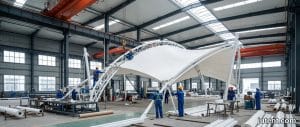
To ensure your landscape project is both stunning and structurally sound, it is crucial to partner with a manufacturer that handles design, fabrication, and installation guidance in-house. Jutent provides turnkey B2B solutions tailored strictly to your commercial environment and budget constraints.