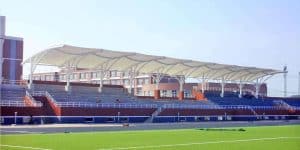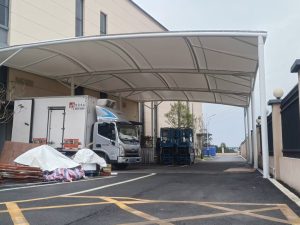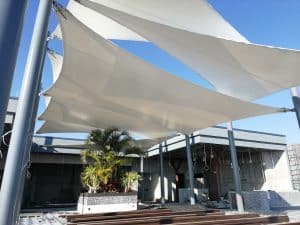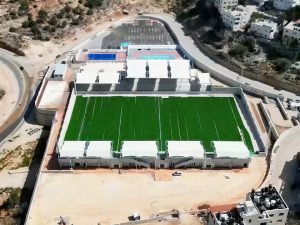

The successful delivery of a high-performance Tensile Structure relies on a rigorous engineering lifecycle. By integrating advanced Finite Element Analysis (FEA) with specialized Fabric engineering, we ensure every project maintains structural integrity under extreme conditions, including 150km/h wind loads and seismic variables.
Site Assessment & Environmental Load Calibration
Engineering begins with the precise definition of site-specific environmental parameters. Our structural engineers establish the core design criteria required to secure large-scale commercial space shading systems.
Computational Form-Finding & FEA Modeling
Unlike rigid buildings, a tensile system gains its stiffness from the pre-stress applied to the membrane. We utilize non-linear algorithms to determine the optimal "Form-Found" equilibrium of the structural membrane.
- Geometric form-finding using Large Displacement Analysis.
- Warp and Weft biaxial compensation calculations for 2D patterning.
- Extraction of reaction forces for connection and foundation design.
Industrial Fabrication & Protective Coating
Components are manufactured in a controlled environment to ensure precision. We utilize high-strength Q345B steel sections, treated with professional-grade protective finishes to withstand atmospheric degradation.
Membrane panels are joined using fusion technology, ensuring that seam tensile strength exceeds the base material rating of the architectural membrane.
Foundation Engineering & Uplift Management
Lightweight structures often generate significant uplift forces rather than just gravity loads. Foundations must be engineered with reinforced concrete footings and heavy-duty anchor bolt systems, cast to a tolerance of ±2mm.
Logistics & Structural Skeleton Erection
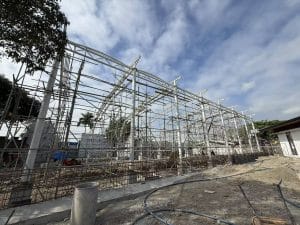
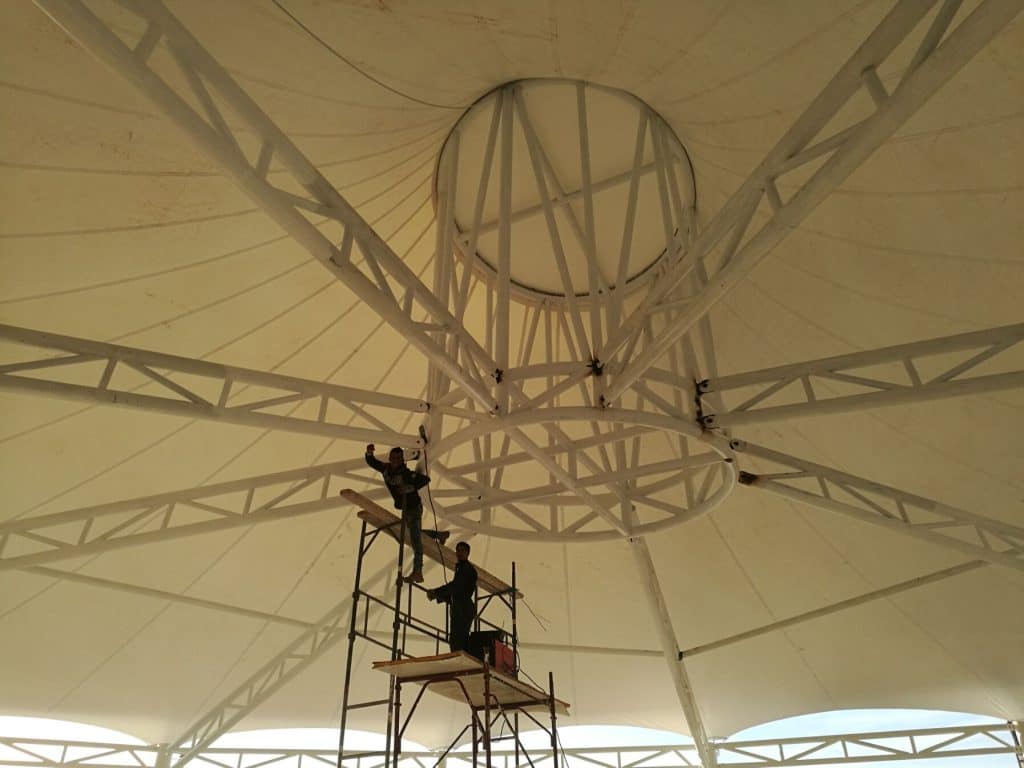
Modular steel components are transported to the site for assembly. The steel skeleton serves as the primary support for the fabric roofing system. During this phase, all connection nodes are inspected for smooth transitions to prevent membrane abrasion.
Hydraulic Tensioning & Commissioning
The final phase defines the longevity of the structure. Using hydraulic jacks and calibrated torque tools, we apply the design pre-stress across the membrane surface to achieve a perfect double-curvature form.
- Biaxial tensioning to reach calculated equilibrium.
- Torque verification of all mechanical fasteners.
- Ultrasonic tension measurement of edge cables and tie-backs.