

The shift from traditional heavy steel and concrete to lightweight architectural membrane structures is fundamentally redesigning industrial logistics. As facility operators face increasing pressure to maximize cubic storage volume while accelerating deployment times, the warehouse tensioned fabric structure has emerged as a premier engineering solution. By utilizing advanced tensile mechanics and combining them with robust steel sub-structures, architects are eliminating the physical limitations of legacy industrial buildings.
Standard warehouse construction is often hindered by restrictive internal column grids, extended curing times, and inflexible load-bearing walls. In contrast, modern tensile membrane architecture leverages high-strength materials—such as PVDF-coated PVC or fiberglass-reinforced PTFE membranes—stretched over precision-engineered Q355B steel frames or intricate cable nets. The result is a highly efficient, clear-span environment optimized for modern supply chain operations, wastewater treatment coverage, and heavy equipment storage.
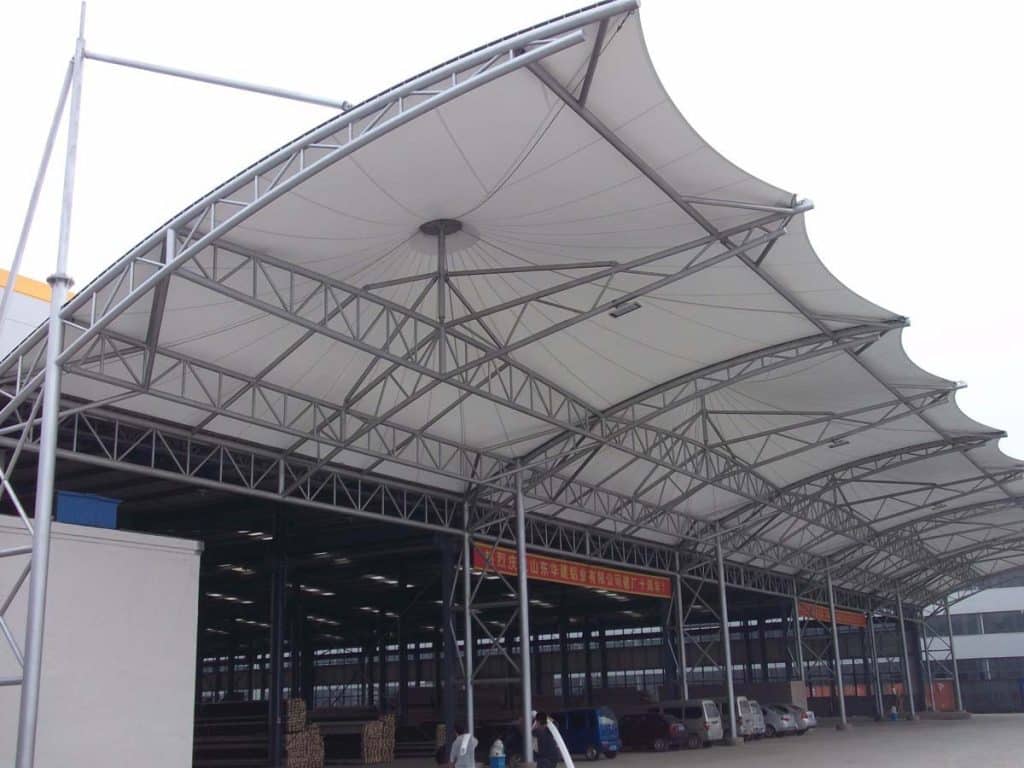
Structural Integrity and Clear-Span Economics
The core architectural advantage of a tensioned fabric warehouse lies in its unparalleled space efficiency. Because tensile membrane materials weigh a fraction of traditional metal decking or built-up roofing systems, the dead load on the primary structure is drastically reduced. This allows structural engineers to design expansive clear spans without the necessity of interior support columns.
Through precise form-finding processes, loads are primarily transferred as axial tension rather than bending moments. This structural purity translates directly into operational freedom. Inside, forklifts, autonomous mobile robots (AMRs), and heavy haulers navigate without obstruction. The elimination of columns increases the usable storage footprint by up to 15%, a critical metric for high-density racking configurations.
Engineering Insight: Adaptive Load Management
Unlike rigid concrete structures that must resist kinetic forces through sheer mass, tensile structures exhibit dynamic resilience. Under extreme wind uplift or heavy snow loads, the double-curvature of the membrane surface deflects and dissipates energy, channeling loads efficiently into the foundation anchors. This controlled flexibility vastly improves the structure's overall seismic performance.
Material Science: Daylighting and Durability
The selection of the architectural fabric is critical to the performance of an industrial canopy. High-quality PVC membranes treated with PVDF (Polyvinylidene fluoride) lacquers are typically deployed for these structures. This specific coating not only extends the membrane's lifespan by protecting against UV degradation but also provides a low-friction surface, enabling the fabric to self-clean during rainfall.
Furthermore, one of the most significant operational benefits is light transmission. Standard architectural membranes can offer 10% to 15% natural light translucency. This diffused, glare-free daylighting illuminates the massive warehouse interior during daytime operations, drastically cutting electrical loads for artificial lighting and creating a safer, more visually comfortable environment for workers.
Rapid Prefabrication and Deployment
In the commercial sector, time to market dictates profitability. Tensioned fabric structures drastically compress the construction timeline compared to conventional building methods.
- Off-Site Prefabrication: The Q355B steel framework and the architectural membrane are concurrently manufactured and precision-cut in the factory, minimizing on-site fabrication.
- Reduced Foundation Requirements: Because the superstructure is exceptionally lightweight, foundation engineering requires significantly less concrete mass, overcoming poor soil bearing capacities without costly ground reinforcement.
- Escalabilidad Modular: The bolted connections of the steel frame allow for future expansion or complete relocation of the structural fabric facility as logistics strategies evolve.
From industrial park aesthetics to sheer operational utility, warehouse tensioned fabric structures provide long-term structural viability. They represent a sophisticated synthesis of material science and structural engineering, delivering a high-performance envelope that meets the rigorous demands of global logistics.
 English
  Français
  Español de México
  Bahasa Melayu
  Tiếng Việt
  Português do Brasil
  Русский
  ไทย
ไทย  العربية