

Abu Dhabi, July. Ambient temperatures peak at 48°C, but the exposed steel framework of a highway structure absorbs and radiates solar energy, pushing surface temperatures well past 65°C. When engineering a toll station canopy, Middle East contractors quickly discover that standard European or North American specifications fail rapidly under these extreme thermal loads. Surviving the unforgiving Gulf climate requires specialized PTFE or TiO2-coated membrane grades, dynamic tensioning systems, and localized load calculations to withstand abrasive shamal winds. Regional infrastructure demands leave zero margin for UV-induced material fatigue or structural deflection. This guide details exactly what engineering teams in the UAE, Saudi Arabia, and Qatar must specify to meet stringent municipal codes, manage severe thermal expansion, and prevent premature degradation. Establishing these precise specifications before tender prevents costly re-engineering and ensures the structure maintains its tensile integrity through decades of intense solar exposure and high-velocity sandstorms.
Gulf Climate: Why Standard Toll Station Canopy Specs Don't Apply
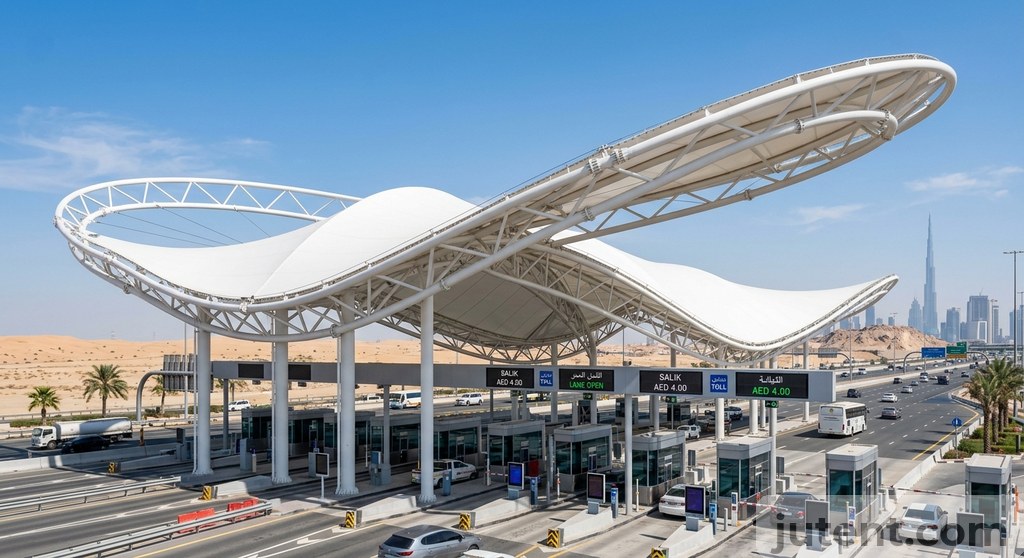
Standard tensile structures rely on baseline assumptions for thermal expansion and UV exposure that Gulf climates routinely exceed. A toll station canopy in the Middle East faces extreme solar radiation, 50°C+ ambient temperatures, and abrasive sandstorms that strip standard protective coatings.
When a standard 650g/㎡ PVC membrane is deployed in Gulf highway environments, plasticizers degrade rapidly under high UV loads. Within 36 months, the material embrittles, discolors, and loses pre-stress tension. This tension loss causes dangerous water ponding during heavy winter rains and risks structural failure under high wind loads.
La experiencia de la empresa debe describirse a través de experiencia de exportación verificada y capacidad de soporte del proyecto, en lugar de anécdotas de proyectos no respaldadas.
La protección contra la corrosión y la vida útil deben describirse según el sistema de protección seleccionado, el entorno del proyecto y las condiciones de mantenimiento, en lugar de como una garantía de vida útil incondicional.
Protección UV y contra el Calor: Grado de Membrana para Proyectos del Golfo
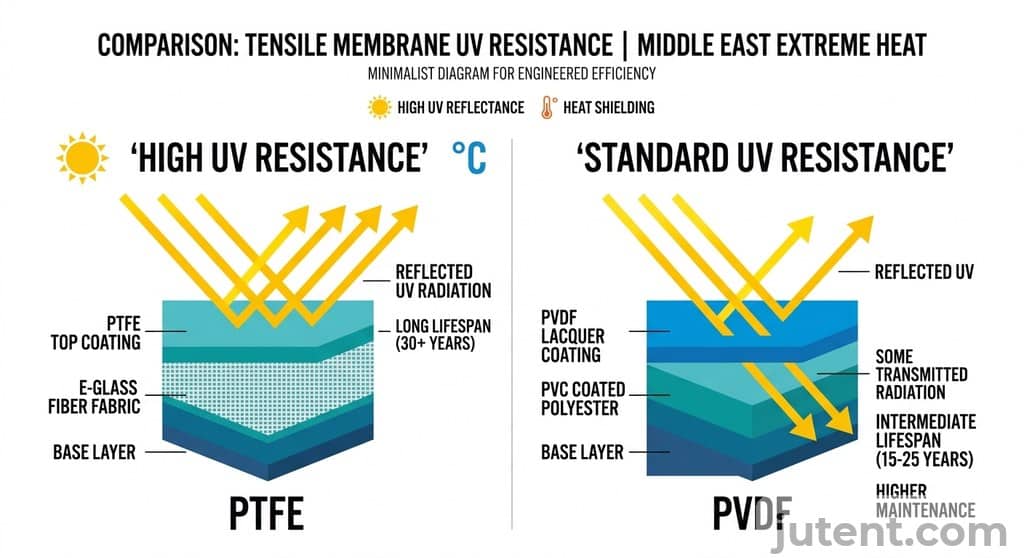
PVDF at 1050g/㎡ is the minimum viable specification for a toll station canopy Qatar project or any installation in the wider Gulf. Lower-grade materials simply cannot withstand the UV Index 11+ conditions typical of the region without suffering rapid chemical breakdown.
The primary function of the membrane in this environment is reflecting solar radiation before it transfers heat to the toll booths and personnel below. A high-grade PVDF membrane with a specialized topcoat reflects up to 73% of solar energy. This creates a shaded environment that is significantly cooler than the ambient temperature, drastically reducing the HVAC load on the enclosed toll booths and protecting sensitive electronic toll collection (ETC) sensors from thermal failure.
The reason PVDF outperforms standard PVC in high-UV environments is the fluorocarbon surface layer, which reflects UV radiation rather than absorbing it. At UV Index 11-12, a 1050g/㎡ PVDF membrane maintains tensile strength within 10% of its original specification after 15 years. A standard 650g/㎡ PVC membrane in the same environment typically requires replacement at 5-7 years.
Contractors reviewing a Toll Station Canopy Guide should ensure the specification mandates a weldable PVDF lacquer finish. This prevents the accumulation of fine desert dust, allowing the structure to self-clean during occasional rainfall or scheduled maintenance washing. Without this specific finish, particulate matter embeds into the membrane, degrading its reflective properties and increasing the heat load on the structure beneath.
Carga de viento: Estándares de EAU y Arabia Saudita
A toll station canopy Saudi Arabia installation or a UAE project must be engineered to resist specific regional wind loads, not just thermal stress. The open-sided nature of highway toll plazas creates significant uplift forces during high wind events, turning the canopy into a massive sail if improperly designed.
Los valores técnicos finales deben confirmarse con los requisitos de ingeniería específicos del proyecto y las condiciones del código local.
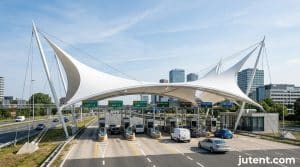
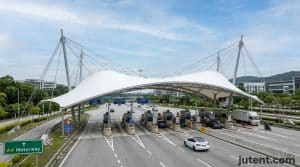
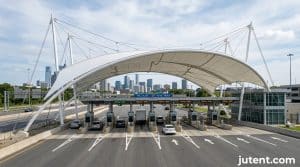
To manage these uplift forces, the primary steel framework requires heavy-duty column profiles. A typical 6-lane toll plaza spanning 30 meters will utilize 400x400x12mm Square Hollow Section (SHS) columns, anchored with moment-resisting base plates and M30 high-tensile anchor bolts embedded deep into the concrete footings. The membrane itself is engineered with a double-curvature hyperbolic paraboloid or conic form. This geometry mechanically transfers wind loads into the steel frame through continuous tension, preventing the membrane from fluttering and tearing under 160 km/h gusts. Contractors must ensure that the engineering submittal includes localized computational fluid dynamics (CFD) analysis to verify that the canopy geometry will not create wind tunnels that disrupt vehicle flow or damage sensitive tolling equipment.
Referencia de Caso: Proyectos en la Región del Golfo
La planificación del presupuesto debe basarse en el tipo de estructura, la luz libre, la clasificación de viento, el grado de membrana, el tonelaje de acero y el alcance del proyecto. Para una cotización precisa EXW, FOB, CIP o DDU, las dimensiones del proyecto y los requisitos de ingeniería deben revisarse primero.
When executing a toll station canopy UAE project, the logistics of installation are as critical as the materials. Highway closures are strictly regulated by transport authorities, meaning the structure must be erected rapidly with a minimal footprint. We engineer these canopies for modular assembly. The primary steel components are pre-cut, pre-drilled, and hot-dip galvanized off-site to eliminate field modifications.
Los valores técnicos finales deben confirmarse con los requisitos de ingeniería específicos del proyecto y las condiciones del código local.
Si desea una referencia presupuestaria precisa para este proyecto, comparta las dimensiones, la zona de viento y el tipo de membrana preferido con nuestro equipo.
Preguntas Frecuentes
- What membrane grade is recommended for a toll station canopy in the UAE?
- While specific membrane grades must always be confirmed against project-specific engineering requirements and local code conditions, for a toll station canopy in the UAE, a high-performance architectural fabric with superior UV resistance and heat-reflecting properties is generally recommended. This typically involves materials designed to withstand extreme solar radiation and high ambient temperatures without significant degradation or loss of structural integrity, ensuring long-term durability and minimal maintenance in such demanding environments.
- Do toll station canopy structures in Saudi Arabia need to meet specific building codes?
- Yes, all toll station canopy structures in Saudi Arabia must comply with the Saudi Building Code (SBC). Specifically, SBC Chapter 7 addresses wind loads, which are a critical design consideration for tensile membrane structures due to the region's potential for high wind speeds. Adherence to these codes ensures structural integrity and safety, and project specifications will require documentation of compliance from the manufacturer and installer.
Si desea una referencia presupuestaria precisa para este proyecto, comparta las dimensiones, la zona de viento y el tipo de membrana preferido con nuestro equipo.
 English
  Français
  Español de México
  Bahasa Melayu
  Tiếng Việt
  Português do Brasil
  Русский
  ไทย
ไทย  العربية