

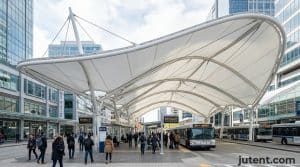
In the transition from traditional compressive structures to highly optimized lightweight systems, membrana arquitectónica technologies have fundamentally redefined load-bearing limits. Modern commercial and industrial infrastructure demands high span-to-weight ratios, precise form-finding, and uncompromising environmental resistance. Understanding the complex physics and material science behind a techo de membrana comercial is critical for specifying the correct composites in structural engineering.
Load Optimization: Tensile structures utilize biaxial tension to achieve ultimate structural stability, reducing dead loads by up to 80% compared to rigid steel/glass roofing.
Engineered to endure wind loads exceeding 150km/h and localized snow load deflections, utilizing non-linear elastic material properties.
Material Durability: The impact of UV on membrane longevity is mitigated via top-coat chemistry (PVDF, TiO2, PTFE), allowing lifespans to extend from 15 to over 30 years under constant environmental exposure.
Biaxial Mechanics and Form-Finding in Structural Membranes
Unlike conventional roofing materials that resist loads through bending stiffness, tensioned fabric relies entirely on pre-stress and double curvature (anticlastic geometry). Structural membrane design guidelines dictate that the material must continuously transfer applied loads (wind, snow, seismic) to the perimeter cables and supporting steel masts.
Engineers calculate the Young's Modulus y la Poisson's ratio of the woven base cloth (typically high-tenacity polyester or woven fiberglass). By meticulously controlling the warp and weft tension during installation, the architectural membrane avoids localized slackening or fatigue stress under fluctuating wind uplift pressures.
Advanced Material Composition: PTFE vs. PVC Membranes
The selection of the membrane is the most critical variable in determining the long-term structural integrity and maintenance cycle of a espacio comercial. While both primary categories act as flexible composites, their base yarns, coating chemistry, and ultimate tensile strengths differ vastly.
A membrana de PVC (Polyvinyl Chloride coated over polyester) is highly versatile, offering excellent tensile strength and weldability via high-frequency heat. For highly corrosive environments or high-tier architectural demands, a membrana de PTFE (Polytetrafluoroethylene coated over fiberglass) provides superior chemical inertness, total UV resistance, and an incredibly low coefficient of friction, rendering it effectively self-cleaning.
| Engineering Specification | PVC Membrane (w/ PVDF Topcoat) | PTFE Membrane (Fiberglass Base) |
|---|---|---|
| Base Material / Substrate | High-tenacity Polyester Yarns | Woven Fiberglass |
| Tensile Strength (Warp/Weft) | Approx. 4,000 – 6,000 N/5cm | Approx. 6,000 – 8,000+ N/5cm |
| Design Lifespan | 15 - 20 Years | 30+ Years |
| Rendimiento contra Incendios | B-s2, d0 (Self-extinguishing) | A2-s1, d0 (Non-combustible core) |
| Solar Transmission (Light) | 7% – 15% | 10% – 20% |
| Self-Cleaning Efficiency | Moderate (Relies on TiO2/PVDF) | Exceptional (Teflon™ surface) |
Structural Detailing and Anchorage Protection
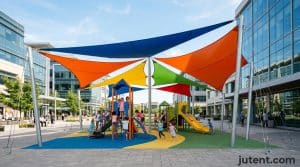
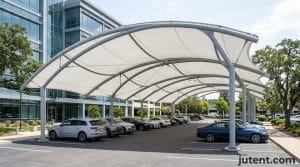
The intersection between the flexible membrane and the rigid steel framework is where peak shear forces occur. Perimeter catenary cables (usually hot-dip galvanized or stainless steel) are inserted into the membrane pockets to distribute tension evenly. For large-span plaza shading structures or shopping mall canopies, the foundational engineering must account for significant uplift forces.
Furthermore, steel components interfacing with the membrane must be treated to prevent galvanic corrosion and rust degradation. Industry best practices require C3 coatings (multi-layer epoxy and polyurethane systems) for steel members in coastal or highly polluted industrial environments. This ensures the structural steel matches the longevity of the advanced architectural fabric.
Evaluating Total Cost of Ownership (TCO)
When comparing membrane structure material costs against conventional steel and metal sheeting, the initial material expenditure is offset by drastic reductions in the required supporting substructure. The lightweight nature of tensioned fabric—often weighing less than 1.5 kg/m²—allows for smaller concrete foundations, thinner steel profiles, and rapid, dry-site installation processes.
 English
  Français
  Español de México
  Bahasa Melayu
  Tiếng Việt
  Português do Brasil
  Русский
  ไทย
ไทย  العربية