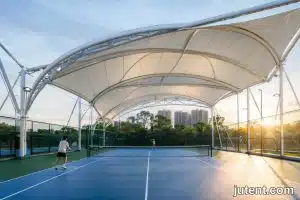

Cadre décisionnel
Ce guide résout cinq décisions critiques des entrepreneurs lors de la spécification d'un structure d'ombrage tensiles pour les terrains de sport : choisir la meilleure forme structurelle, sélectionner le bon matériau de tissu, déterminer le dimensionnement structurel pour la sécurité et la rentabilité, vérifier les fabricants avant l'approvisionnement et comprendre les responsabilités d'installation.
Couverture d'un espace extérieur terrain de sport avec une structure d'ombrage tendu ne consiste pas simplement à bloquer la lumière du soleil. Le choix de la portée, de la résistance au vent, du grade de membrane et de l'emplacement des piliers impacte directement la longévité et les performances de la structure. Les entrepreneurs doivent équilibrer le coût, la vitesse d'installation et la durabilité tout en répondant aux défis spécifiques du site. Basé sur l'expérience de Jutent dans plus de 420 projets de structures tendues dans plus de 30 pays, ce guide offre une feuille de route axée sur l'ingénierie pour l'approvisionnement en structures d'ombrage pour terrains de sport qui résistent à l'épreuve du temps.
Pourquoi les structures d'ombrage tendues sont devenues la norme pour les terrains de sport extérieurs
Les structures d'ombrage tendues ont éclipsé les auvents en acier traditionnels pour les terrains de sport en raison de trois facteurs décisifs : la rentabilité, l'installation rapide et les performances supérieures sous les charges environnementales.
- Efficacité des coûts : Les matériaux en membrane tendue réduisent généralement le tonnage d'acier de 40 à 60 %, diminuant ainsi les coûts de matières premières et de fabrication. Un structure d'ombrage commerciale pour sports les terrains de sport recouverts d'une toile tendue coûtent souvent 20 à 30 % de moins en investissement initial que les solutions de toiture entièrement en acier.
- Vitesse d'installation : Les panneaux de membrane préfabriqués et l'ossature modulaire permettent un assemblage sur site en 2 à 4 semaines, contre 8 à 12 semaines pour les auvents en acier nécessitant soudure et levage lourd. Cela accélère les délais du projet, crucial pour les entrepreneurs gérant plusieurs offres.
- Performances : Les structures d'ombrage en toile excellente dans la répartition dynamique des charges de vent. Leurs membranes flexibles absorbent l'énergie éolienne, réduisant les concentrations de contraintes sur les poteaux et les fondations. Cela les rend particulièrement adaptées aux zones de vents forts, où les toitures rigides en acier peuvent nécessiter un renforcement coûteux.
La structure d'ombrage tendue pour les terrains de sport intègre les principes de l'architecture légère, offrant une protection solaire efficace tout en minimisant la masse structurelle et les fondations. Ces facteurs font des solutions tendues le choix par défaut pour les espaces extérieurs modernes structure d'ombrage pour terrain de sport projets.
Types de structures d'ombrage pour terrains de sport : Voile d'ombrage, Cantilever, Multi-poteaux, Voûte en berceau
La sélection de la forme structurelle optimale dépend des contraintes du site, des exigences de portée et des objectifs esthétiques. Voici les principaux types de structures d'ombrage en toile utilisés pour les terrains de sport, avec leurs justifications techniques.
Structures en voile d'ombrage
Les membranes en forme de voile sont tendues entre 3 points hauts ou plus, créant des auvents dynamiques et sculpturaux. Elles sont idéales pour les petits terrains (portées inférieures à 12 m) où l'emplacement des poteaux doit minimiser les obstructions du terrain.
- Sens structurel : Efficace pour les configurations de terrain irrégulières nécessitant un minimum de colonnes.
- Limitations : Portée maximale limitée et moins de contrôle de la hauteur des poteaux.

Structures d'ombrage cantilever
Les conceptions cantilever comportent un poteau de support ou un cadre d'un côté, la membrane s'étendant au-dessus du terrain sans support de l'autre côté. Cela élimine les poteaux sur la zone de jeu.
- Sens structurel : Idéal pour les terrains nécessitant un espace au sol dégagé et sans obstacle.
- Capacité de portée : Efficace pour des portées allant jusqu'à 15 m avec une charpente en acier conçue.
- Considérations : Nécessite des fondations robustes et une analyse minutieuse des charges de vent.
Structures multi-poteaux
Les configurations multi-poteaux utilisent plusieurs poteaux autour du périmètre du terrain supportant une toiture en membrane. C'est la forme la plus courante pour la couverture complète d'un terrain sur des portées supérieures à 15 m.
- Sens structurel : Équilibre le placement des colonnes avec la redondance structurelle.
- Flexibilité : L'espacement des colonnes peut être ajusté pour répondre aux exigences de charge et de dégagement.
Structures d'ombrage en voûte en berceau
Les membranes en voûte en berceau créent des toits courbes soutenus par des arcs de cadre ou plusieurs colonnes. Elles offrent une hauteur libre élevée et des surfaces auto-drainantes.
- Sens structurel : Convient aux terrains longs et étroits nécessitant une protection contre les intempéries au-delà de l'ombrage.
- Capacité de portée : Peut couvrir des portées dépassant 20 m avec des arches techniques.

Fabric Shade Structure Materials: PVDF vs PTFE vs PVC
Le matériau de la membrane détermine la résistance aux UV, la durée de vie, l'entretien et les performances au feu. Comprendre les compromis permet une spécification précise.
| Propriété | PVDF (Polyfluorure de vinylidène) | PTFE (Polytétrafluoroéthylène) | PVC (Polychlorure de vinyle) |
|---|---|---|---|
| Résistance aux UV | Excellent (jusqu'à 25 ans) | Supérieure (30+ ans) | Modérée (10-15 ans) |
| Durée de vie | 20-25 ans | 30+ ans | 10-15 ans |
| Entretien | Faible (nécessite un nettoyage périodique) | Très faible | Modérée (sujette à la décoloration) |
| Classement au feu | Classe B ou A2 (varie selon les spécifications) | Classe A (hautement résistant au feu) | Classe B ou C (varie largement) |
| Poids par m² | 550-700 g | 600-750 g | 550-650 g |
| Coût | Milieu de gamme | Premium | Budget |

PVDF Les membranes offrent un bon équilibre entre coût, durabilité et stabilité aux UV. Elles sont idéales pour les entrepreneurs recherchant des structures d'ombrage commerciales pour les sports, avec une durée de vie solide et un entretien modéré.
PTFE Les membranes présentent la plus haute durabilité et résistance au feu, mais avec un prix premium. Elles conviennent aux projets où les coûts de cycle de vie à long terme et les certifications de sécurité sont prioritaires.
PVC Les membranes sont économiques mais ont une durée de vie plus courte et nécessitent plus d'entretien. Adaptées aux installations à court terme ou aux budgets serrés.
Dimensionnement structurel : comment la portée, la hauteur des colonnes et la zone de vent déterminent votre devis
La précision du devis quantitatif (BOQ) repose sur trois paramètres structurels clés : la portée de la membrane, la hauteur des colonnes et la zone de vent locale.
- Portée : La distance horizontale entre les colonnes de support. Des portées plus longues exigent une charpente plus solide et des membranes à plus haute tension. Les terrains de sport typiques ont des portées de 12 m à 24 m. Au-delà de 20 m, des arches en acier spécialisées ou des câbles de tension sont nécessaires.
- Column Height: Le dégagement minimum pour les terrains de sport est généralement de 7,5 m à 9 m pour permettre un jeu sûr des balles et les mouvements des joueurs. La hauteur des colonnes structurelles affecte la profondeur des fondations et les charges de vent sur la charpente.
- Zone de vent : Building codes classify wind pressure zones (e.g., ASCE 7 in the US). Higher wind zones increase membrane tension and column loading, requiring thicker steel sections and heavier foundations.
Exemple : Une structure d'ombrage tendue en porte-à-faux d'une portée de 20 m dans une zone de vent avec une vitesse de vent de conception de 120 km/h nécessitera environ 40 % de tonnage d'acier supplémentaire et 30 % de tension de membrane plus forte qu'une structure similaire dans des zones de vent de 90 km/h.
Les données précises sur le vent sur site et les exigences de dégagement doivent éclairer les calculs du BOQ pour éviter une sous-conception. Les équipes d'ingénierie de Jutent fournissent une analyse structurelle détaillée et des nomenclatures de matériaux après les relevés initiaux du site.
Liste de contrôle d'approvisionnement pour les entrepreneurs : quoi demander à un fabricant de structures d'ombrage avant de passer commande
- Certification structurelle : Demandez des rapports d'ingénierie confirmant la conformité aux charges de vent, de neige et sismiques pour votre site.
- Spécifications de la membrane : Confirmer le type de membrane, la classe de résistance au feu, la résistance aux UV et les conditions de garantie.
- Column and foundation details: Assurez-vous que la conception des fondations est incluse ou consultez des ingénieurs locaux pour une adaptation géotechnique.
- Options de personnalisation : Vérifiez la disponibilité des couleurs personnalisées, de l'impression de logos et de l'intégration de l'éclairage.
- Délais et livraison : Obtenez des délais clairs de la commande à la livraison sur site, y compris le fret et les douanes si applicable.
- Support d'installation : Clarifier les étapes d'installation que le fabricant gère à distance et ce que l'équipe de chantier de l'entrepreneur doit gérer.
- Plan d'entretien : Demandez les calendriers de nettoyage et d'inspection recommandés pour maintenir les performances de la membrane.
- Service après-vente : Confirmer la couverture de la garantie et la disponibilité des pièces de rechange ou des réparations de membrane.
Ces questions atténuent les risques d'approvisionnement et rationalisent le flux de travail du projet.
Aperçu de l'installation : ce que Jutent fournit à distance vs ce que votre équipe sur site gère
Jutent propose un modèle d'installation collaboratif maximisant le contrôle de l'entrepreneur tout en assurant la précision technique.

- Services à distance de Jutent :
- Plans d'atelier détaillés et modèles d'installation 3D.
- Panneaux de membrane préfabriqués avec numérotation et précision de coupe.
- Support technique lors de l'implantation des fondations et de l'assemblage de l'acier.
- Accompagnement technique via des appels vidéo et suivi de l'avancement.
- Responsabilités de l'équipe sur site :
- Excavation et coulage des fondations selon les spécifications techniques.
- Montage de la charpente métallique et ancrage des poteaux.
- Installation de la membrane, mise en tension et finition des bords sous la supervision à distance de Jutent.
- Inspections finales et mise en service.

FAQ
Quelle est la hauteur libre minimale pour un équipement sportif structure d'ombrage de tribunal?
La hauteur libre minimale est généralement de 7,5 mètres (environ 24,6 pieds) pour permettre un jeu sûr, y compris la trajectoire de la balle et les déplacements des joueurs. Certains sports ou réglementations locales peuvent exiger jusqu'à 9 mètres.
Une structure d'ombrage en toile tendue peut-elle résister aux tempêtes tropicales ?
Oui, à condition que la structure soit conçue pour la zone de vent du site avec une mise en tension appropriée de la membrane, un dimensionnement de l'acier et une conception des fondations. Les structures certifiées pour des vitesses de vent allant jusqu'à 150 km/h ou plus peuvent résister à la plupart des tempêtes tropicales.
Quel est le délai de livraison typique entre la commande et la livraison ?
Les délais varient selon la taille et la complexité du projet, mais se situent généralement entre 3 et 6 semaines pour la fabrication et l'expédition après l'approbation finale de la conception.