
Sports Court Shade Budgets: Avoiding Common Pricing Traps

Lecture de 15 minutes
Not all courts are priced equally. We provide an honest breakdown of how span complexity and wind-load upgrades impact your final site development costs.

Sports court canopy costs vary widely — from $15,000 for a small recreational court to over $120,000 for a multi-court complex. This guide breaks down what drives the price and what a realistic budget looks like for different project types.

Les entrepreneurs et les promoteurs sont souvent confrontés à un défi commun : budgétiser avec précision un auvent de terrain de sport. Le choc initial du prix ou un devis étonnamment bas peuvent tous deux entraîner des retards de projet ou des dépassements de budget si les facteurs de coût sous-jacents ne sont pas compris. Cet article démystifie les facteurs influençant le coût d’un auvent de terrain de sport, vous aidant à planifier en toute confiance.

The 5 Factors That Drive Sports Court Canopy Cost

Understanding the core elements that dictate the final sports court canopy cost is crucial for any project. These five factors are interconnected and collectively determine the overall price.

  1. Project Scope and Size: This is the most significant driver. A single basketball court canopy will naturally cost less than a multi-court complex covering several tennis or padel courts. Larger spans require more reliable steel structures and greater membrane surface area, increasing material and fabrication costs. The minimum project scope for a tensile membrane structure is typically 100 m².
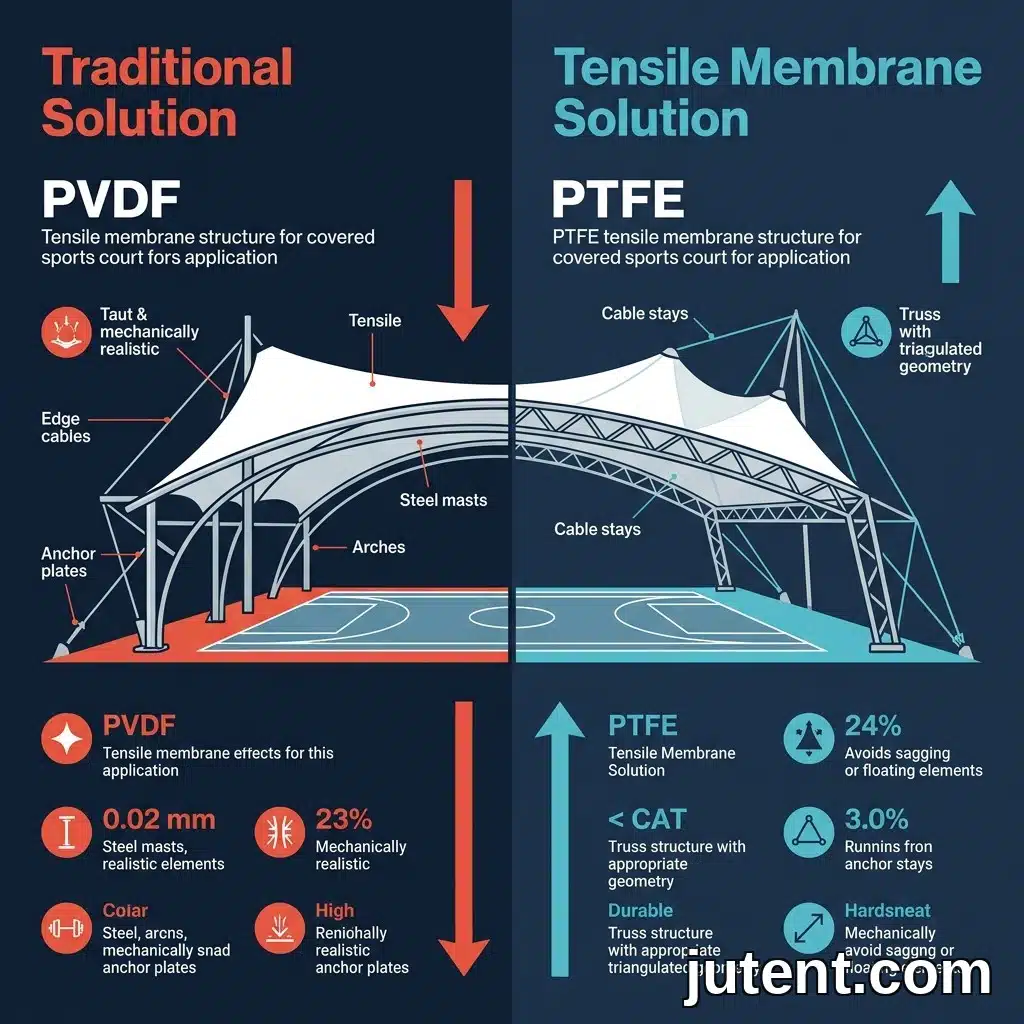
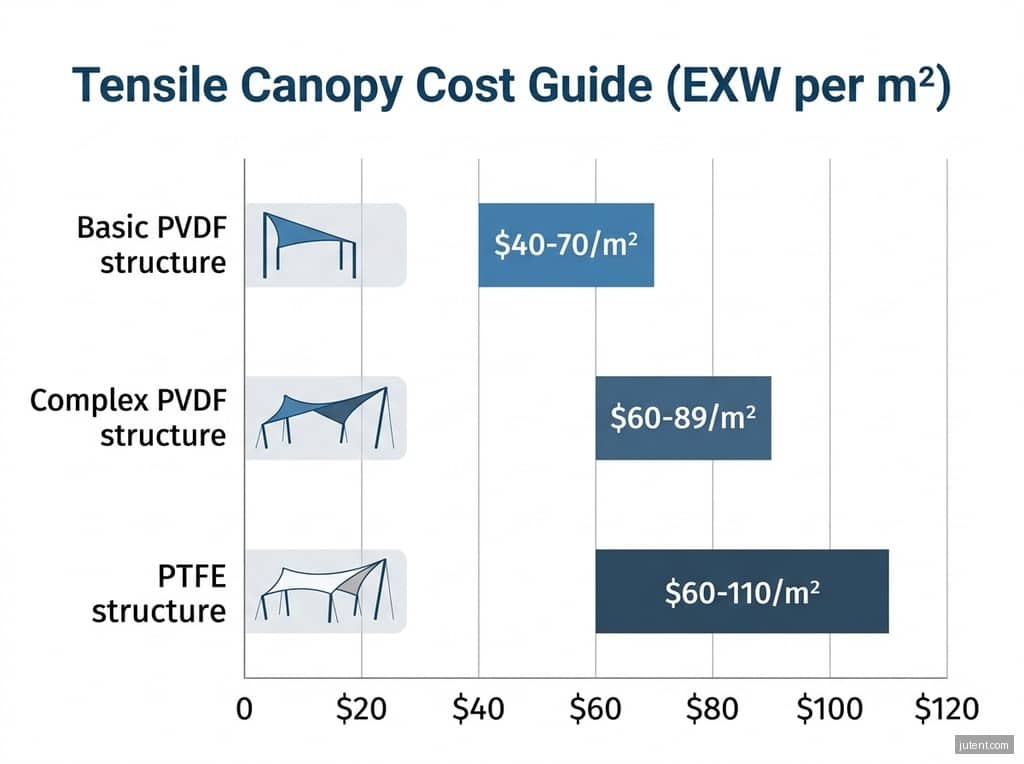
  2. Membrane Material: The choice between PVDF and PTFE membrane significantly impacts the tensile canopy budget. PVDF (Polyvinylidene Fluoride) is a common, cost-effective choice with a 10-year warranty and 15+ years service life. PTFE (Polytetrafluoroethylene) offers superior durability, a 15-year warranty, and 25+ years service life, but adds approximately $20/m² to the PVDF range.
  3. Steel Structure Design and Specification: The complexity of the steel frame, the grade of steel (Q235B or Q355B), and the surface treatment (epoxy zinc-rich primer + acrylic topcoat, epoxy zinc-rich primer + fluorocarbon topcoat, or hot-dip galvanizing) all influence cost. More intricate designs or higher wind load requirements necessitate heavier gauge steel and more complex fabrication.
  4. Location and Environmental Loads: Wind, snow, and seismic loads vary by geographical location. Structures in high-wind zones, for instance, require more substantial engineering and material specifications, directly impacting the sports court shade cost per sqm.
  5. Installation Complexity: Des facteurs tels que l'accessibilité du site, les conditions du sol et la nécessité d'équipements spécialisés ou d'une supervision sur site du fabricant peuvent augmenter le coût global d'installation de la canopée sportive. Bien que l'assistance à distance soit souvent gratuite, la supervision sur site est un service payant.
Sport Court Shade

Coût par type de court : basketball, tennis, futsal, padel
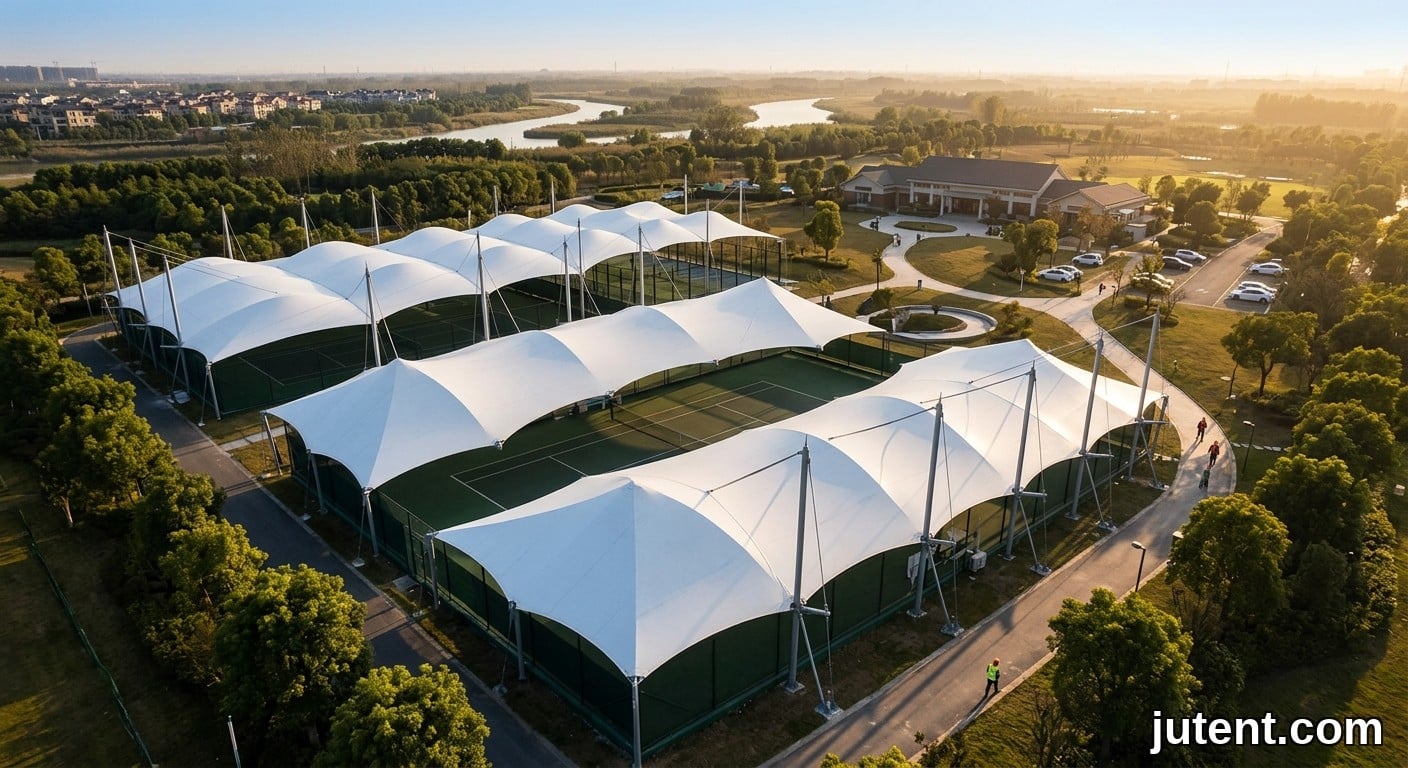
The specific sport dictates court dimensions and, consequently, the required canopy size and structural design. This directly influences the sports court canopy cost.

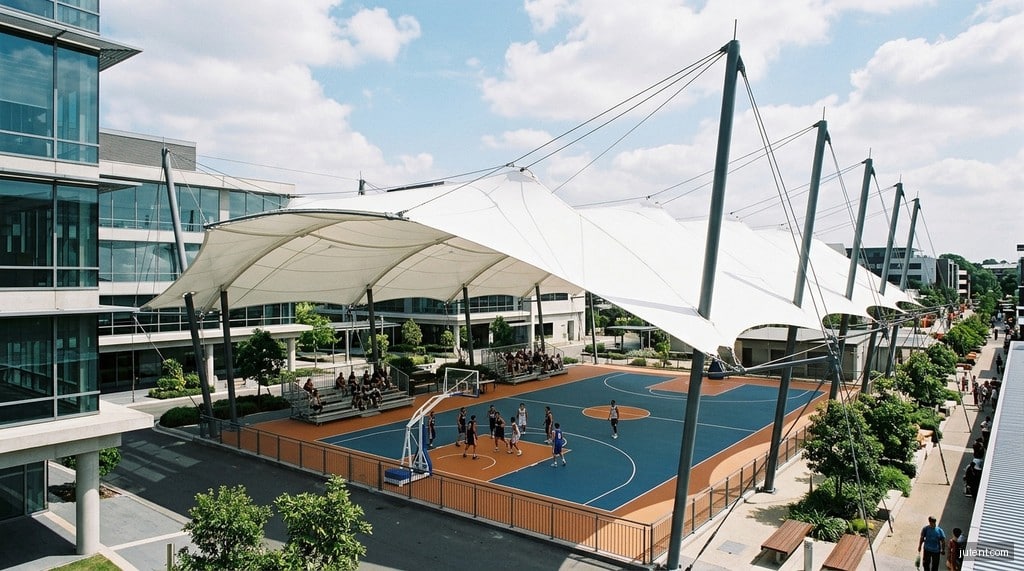
  • Auvent de terrain de basket : Un terrain de basket standard de taille normale (environ 28 m x 15 m) nécessite une toile d'environ 420 à 500 m². Pour une structure simple en membrane PVDF, les coûts d'approvisionnement peuvent varier de 40 à 70 $/m², plaçant le coût d'approvisionnement départ usine pour la membrane et la structure en acier dans la fourchette de 16 800 à 35 000 $.
  • : Un terrain de tennis simple (environ 23,77 m x 10,97 m de surface de jeu, plus les dégagements) nécessite généralement une verrière couvrant 600 à 800 m². En raison de la plus grande portée, la structure en acier pourrait être plus substantielle. Les coûts d'approvisionnement pour une structure en membrane PVDF pourraient être de 50 à 80 $/m², ce qui correspond à un coût départ usine de 30 000 à 64 000 $.
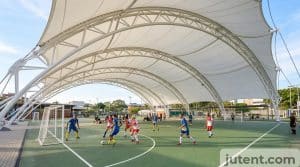
  • Futsal Court Canopy: Futsal courts are smaller than basketball courts (approx. 38m x 20m to 42m x 25m for international play, often smaller for recreational). A canopy for a typical futsal court might be 400-600 m². Supply costs for a PVDF membrane structure would be similar to basketball, around $40–$70/m², resulting in an ex-factory cost of $16,000–$42,000.
  • Padel Court Canopy: Padel courts are compact (10m x 20m). A canopy for a single padel court would be around 200-250 m². Given the smaller span, a simpler structure might be feasible, with supply costs for a PVDF membrane structure ranging from $35–$60/m², leading to an ex-factory cost of $7,000–$15,000. Multi-court padel complexes will scale these costs.

These figures represent ex-factory supply costs for the membrane and steel structure. Installation, shipping, and other local costs would be additional.

Tensile Shade Structures Sports Courts Guide

Supply-Only vs Supply-and-Install: Understanding the Price Difference

When budgeting for a sports court canopy, a critical decision is whether to opt for a supply-only package or a supply-and-install service. This choice significantly impacts the overall tensile shade structure price.

Supply-Only: This option means the manufacturer provides all the necessary components – the fabricated steel structure, the tensile membrane, connection hardware (typically SS304 standard, SS316 optional upgrade), and detailed installation manuals. The contractor is then responsible for all aspects of installation, including sourcing local labor, equipment, and managing the construction process.

  • Avantages pour les entrepreneurs : Greater control over the installation schedule, potential cost savings if local labor is cheaper, and the ability to integrate the canopy installation with other site works.
  • Implications financières : The ex-factory cost for the structure and membrane will be lower, as it excludes installation labor and equipment. However, contractors must factor in their own installation costs, which can vary widely based on local labor rates, equipment rental, and project management overhead. For export projects, Jutent can provide design drawings, calculations, material specifications, installation manuals, and free remote guidance, subject to project scope and contract terms.

Supply-and-Install: In this scenario, the manufacturer not only supplies the materials but also undertakes the installation of the canopy. This typically involves sending a specialized installation team or supervisor to the site.

  • Avantages pour les entrepreneurs/développeurs : Un point de contact unique, une charge de gestion de projet réduite et l'assurance que la verrière est installée par des professionnels expérimentés qui comprennent les exigences spécifiques des structures tendues. Cela peut minimiser les risques et garantir le respect des spécifications de conception.
  • Implications financières : The overall project cost will be higher than supply-only, as it includes the manufacturer's installation labor, travel, accommodation, and potentially equipment costs. This option is often preferred for complex designs or when local expertise in tensile structure installation is limited.

The price difference can be substantial. For example, while the supply cost per square meter might be $40–$70/m² ex-factory, adding installation services can increase the total project cost by 20-50% or more, depending on location and complexity.

What's Included in a Tensile Shade Structure Price from a Chinese Manufacturer

When you receive a quote for a tensile shade structure from a Chinese manufacturer like Jutent Engineering, it's important to understand what components and services are typically encompassed in the quoted sports court canopy cost. This clarity helps in comparing offers and avoiding surprises.

Un devis standard de fourniture uniquement de Jutent Engineering inclura généralement :

  1. Tensile Membrane Fabric: This is the core shading material. Quotes specify the type (e.g., 1050 g/m² PVDF or PTFE), color, and any specific coatings. The membrane is custom-fabricated to the project's design.
  2. Steel Structure: This includes all primary and secondary steel members, custom-fabricated according to the approved engineering drawings. The steel grade (Q235B or Q355B) and surface treatment (epoxy zinc-rich primer + acrylic topcoat, epoxy zinc-rich primer + fluorocarbon topcoat, or hot-dip galvanizing) will be clearly stated.
  3. Quincaillerie de raccordement : Tous les boulons, écrous, câbles, colliers de serrage et dispositifs de tension nécessaires à l'assemblage de la structure en acier et à la fixation de la membrane. Ceux-ci sont généralement en SS304 standard, avec du SS316 disponible en option pour une résistance à la corrosion améliorée.
  4. Conception technique et plans d'atelier : The quote includes the cost of structural analysis, detailed design drawings, and shop drawings for fabrication. These ensure the structure meets specified load requirements (wind, snow, seismic) for the project's location.
  5. Fabrication and Quality Control: The cost covers the manufacturing process, including cutting, welding, surface treatment, and rigorous quality checks at each stage. Jutent is ISO 9001 and SGS certified, ensuring adherence to international quality standards.
  6. Packaging: Les composants sont soigneusement emballés pour l'expédition internationale afin d'éviter tout dommage pendant le transport.
  7. Installation Manuals and Remote Guidance: Des instructions d'assemblage détaillées sont fournies. Pour les projets d'exportation, une assistance à distance gratuite de l'équipe d'ingénierie de Jutent est disponible pour aider votre équipe d'installation locale, sous réserve de la portée du projet et des conditions contractuelles.

What is typically not included in a supply-only ex-factory price:

  • Shipping costs (freight, insurance, customs duties)
  • Local taxes and import tariffs
  • Foundation work and civil engineering
  • On-site installation labor, equipment, or supervision (unless explicitly quoted as a separate service)
  • Local permits and approvals

Sur la base de l'expérience de Jutent dans plus de 400 projets dans 30+ pays, comprendre ces inclusions et exclusions est essentiel pour établir un budget précis pour les auvents tendus.

Hidden Costs Contractors Often Miss

Même avec un devis détaillé, les entrepreneurs peuvent rencontrer des dépenses imprévues qui gonflent le coût global de l'auvent de terrain de sport. Être conscient de ces coûts “cachés” potentiels est essentiel pour une budgétisation réaliste et la réussite du projet.

  1. Foundation and Civil Works: The tensile structure requires reliable foundations to anchor the steel columns and withstand uplift forces. The cost of excavation, concrete pouring, rebar, and any necessary ground preparation is often overlooked in the canopy budget itself. This can be a significant expense, especially on sites with challenging soil conditions or where extensive earthworks are required.
  2. Shipping, Customs, and Local Logistics: While the ex-factory price covers the product, the journey from the manufacturer to the site can be costly. This includes international freight, marine insurance, customs duties, import taxes, and local transportation from the port to the project site. These costs can vary significantly based on the country and current shipping rates.
  3. Local Permits and Approvals: Obtaining necessary building permits, zoning approvals, and environmental clearances can involve fees, engineering reviews, and potential delays. These administrative costs and associated timeframes must be factored into the project schedule and budget.
  4. Specialized Equipment Rental: Même pour les projets de fourniture uniquement, l'installation d'une grande structure tendue nécessite souvent des équipements spécialisés tels que des grues, des nacelles ciseaux et des outils de tension. Les coûts de location de ces articles, ainsi que les frais d'opérateur, peuvent s'accumuler rapidement.
  5. Site Preparation and Access: S'assurer que le site est dégagé, nivelé et accessible pour les machines lourdes et la livraison des matériaux est essentiel. Les coûts associés au défrichage du site, aux routes temporaires ou à la création de plates-formes de travail sécurisées peuvent être substantiels.
  6. Imprévu pour les problèmes imprévus : Unexpected site conditions, weather delays, or minor design adjustments can lead to additional costs. A contingency fund, typically 10-15% of the total project budget, is highly recommended to absorb these unforeseen expenses.
  7. Local Labor and Supervision (for supply-only): If you opt for supply-only, the cost of skilled labor for assembly and erection, along with your own project management and supervision, must be accurately estimated. This includes wages, benefits, and any necessary safety training or equipment.

By proactively identifying and accounting for these hidden costs, contractors can develop a more accurate and realistic tensile canopy budget, minimizing financial surprises down the line.

How to Get an Accurate Quote: What Information You Need to Provide

To receive a precise and competitive sports court canopy cost quote, providing thorough and accurate information to the manufacturer is paramount. The more detail you offer, the less guesswork is involved, leading to a more tailored and reliable price.

Here's a checklist of essential information to include in your inquiry:

  1. Project Location: This is critical for calculating environmental loads. Provide the full address, including city and country. This allows the manufacturer to determine specific wind load, snow load, and seismic requirements for structural design, which directly impacts the steel specification and overall sports court shade cost per sqm.
  2. Dimensions du terrain et nombre de terrains : Indiquer clairement la longueur et la largeur exactes de chaque terrain, et le nombre de terrains que la toile doit couvrir. Spécifier si les zones de dégagement doivent également être ombragées. Un simple croquis ou plan de site est extrêmement utile.
  3. Zone de couverture souhaitée : Au-delà des dimensions du court, indiquez la superficie totale (en mètres carrés) que vous souhaitez couvrir. Cela permet de confirmer l'échelle globale du projet.
  4. Preferred Membrane Material: Specify whether you prefer PVDF (10-year warranty, 15+ years service life) or PTFE (15-year warranty, 25+ years service life). If unsure, state your budget or performance priorities, and the manufacturer can recommend the most suitable option.
  5. Couleur de membrane souhaitée : While white is standard, other colors may be available and can sometimes influence cost.
  6. Steel Surface Treatment Preference: Indicate your preference for epoxy zinc-rich primer + acrylic topcoat, epoxy zinc-rich primer + fluorocarbon topcoat, or hot-dip galvanizing. Each has different cost and durability implications.
  7. Installation Requirements: Indiquer clairement si vous avez besoin d'un package fourniture uniquement avec assistance à distance, ou d'une supervision sur site de l'équipe du fabricant. Si une supervision sur site est nécessaire, précisez la durée.
  8. Project Timeline: Providing an estimated project start and completion date helps the manufacturer assess their capacity and provide realistic lead times.
  9. Toute préférence ou contrainte de conception spécifique : If you have a particular aesthetic in mind, or if there are site-specific constraints (e.g., existing structures, height restrictions), communicate these upfront.
  10. Fourchette de prix (optionnelle mais recommandée) : While not strictly necessary, providing a realistic budget range can help the manufacturer tailor their proposal to meet your financial parameters, suggesting appropriate material and design choices.

En fournissant ces détails, vous permettez à des fabricants comme Jutent Engineering de fournir un prix précis, détaillé et compétitif pour une structure d'ombrage en tension, rationalisant le processus de devis et garantissant que votre budget pour la toile de tension est conforme aux attentes.

FAQ

Q: What is the cost per square metre for a sports court tensile canopy?
A : Le coût d'approvisionnement d'un auvent tendu pour terrain de sport varie généralement de 35 à 75 $/m² départ usine. Cette variation dépend de plusieurs facteurs, notamment la qualité de la membrane tendue (PVDF vs PTFE), les spécifications et la complexité de la structure en acier (par exemple, Q235B vs Q355B, traitement de surface), ainsi que la portée globale de l'auvent. Par exemple, une structure simple en membrane PVDF avec un minimum d'acier se situerait dans la fourchette basse, tandis qu'une membrane PTFE avec une charpente en acier complexe pour une grande portée se situerait dans la fourchette haute. Le coût d'installation est supplémentaire ; en Asie du Sud-Est, il ajoute environ 15 à 30 $/m², tandis qu'au Moyen-Orient, il varie généralement de 20 à 40 $/m².
Q: What information do I need to get an accurate sports court canopy quote?
R : Pour recevoir un devis précis pour un auvent de terrain de sport, vous devez fournir les informations clés suivantes : les dimensions exactes du ou des terrains à couvrir (longueur et largeur), le nombre total de terrains, la situation géographique du projet (pour un calcul précis des charges de vent et autres paramètres environnementaux), le grade de membrane que vous préférez (PVDF ou PTFE), et si vous avez besoin d'un support d'installation (par exemple, une assistance à distance gratuite ou une supervision payante sur site). Toute préférence de conception spécifique ou contrainte de site doit également être communiquée. Les valeurs techniques typiques doivent toujours être écrites de manière conservative et décrites comme étant sujettes à la conception du projet.

Send us your court dimensions, location, and membrane preference and we'll provide a detailed cost breakdown within 48 hours.

Get a Free Cost Estimate

Besoin d'une proposition technique ?

Envoyez-nous les dimensions de votre site et nos ingénieurs vous fourniront une conception 3D et un devis gratuits.
Formulaire de demande Portfolio
Demandez un
Devis de projet

Partagez avec nous vos exigences en matière d'architecture tendue. Nos spécialistes en ingénierie examineront votre projet et vous fourniront une solution préliminaire sur mesure dans les 24 heures.

Parlez-nous de votre projet

Pop-up du formulaire de demande

100% Sécurisé & Confidentiel

×
Support
Équipe d'assistance
               

Bonjour ! 👋 Comment pouvons-nous vous aider aujourd'hui ?

WhatsApp
Appelez-nous maintenant
Assistance par e-mail
WhatsApp Appel Demande Email