
“`html
Remplacer le verre lourd par des puits de lumière tendus en atrium : Guide complet des toitures en membrane tendue
Lors de l'évaluation des solutions architecturales pour les espaces commerciaux et publics, la décision d'intégrer une structure de grande portée repose souvent sur un équilibre entre esthétique, lumière naturelle, rentabilité et performance à long terme. Pour les promoteurs et entrepreneurs recherchant un toit élégant, durable et translucide pour les atriums, cours ou grandes zones ouvertes, comprendre les spécificités d'un lanterneau tendu d'atrium est crucial. Ce guide fournit un cadre pour comprendre ce que sont ces structures, comment elles fonctionnent, leurs différents types, les considérations de coût et quand elles représentent le choix optimal pour votre projet.
Ce qu'est un puits de lumière en membrane tendue pour atrium et ce qu'il n'est pas
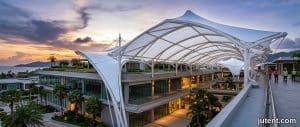
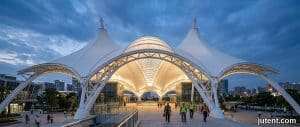
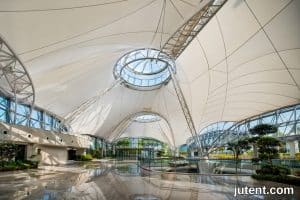
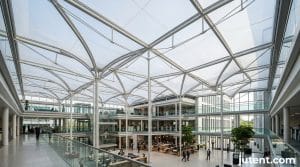
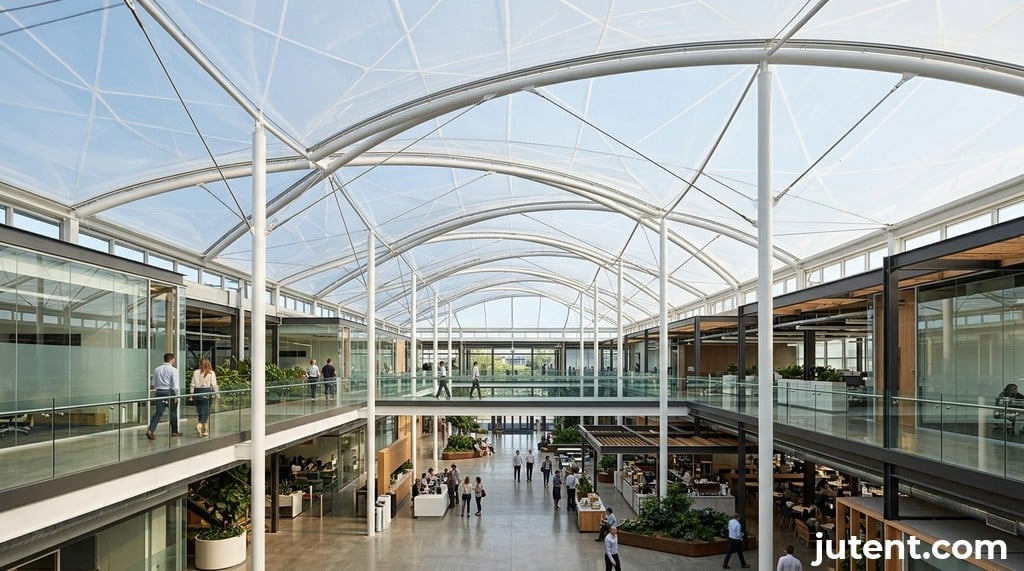
A lanterneau tendu d'atrium est une structure de membrane tendue permanente et conçue pour couvrir de grands espaces ouverts, principalement dans les bâtiments commerciaux, institutionnels et publics. Sa fonction principale est d'offrir une protection contre les intempéries tout en maximisant la pénétration de la lumière naturelle. Contrairement aux verrières traditionnelles en verre, qui reposent sur des panneaux rigides et une ossature lourde, les verrières tendues utilisent des membranes en tissu légères et à haute résistance, tendues sur une charpente en acier de support. Cette mise sous tension crée une forme stable et autoportante capable de couvrir de vastes zones sans poteaux intermédiaires, offrant une flexibilité de conception inégalée et une esthétique aérienne.
Il est important de distinguer un atrium puits de lumière tendu des structures en tissu temporaires ou des voiles d'ombrage simples. Un puits de lumière tendu est une solution architecturale permanente entièrement conçue, destinée à répondre à des codes du bâtiment stricts pour les charges de vent, de neige et sismiques. Ce n'est pas un store rétractable, ni un simple auvent en tissu sans un système structurel tendu robuste. Le matériau de la membrane, généralement PVC enduit de PVDF ou fibre de verre enduite de PTFE, est spécifiquement choisi pour sa durabilité, sa résistance aux UV, son ignifugation et sa translucidité. La structure en acier utilise du Q235B pour les portées standard (jusqu'à 30 m) et du Q355B pour les portées plus grandes ou des exigences de charge plus élevées, avec galvanisation à chaud ou apprêt riche en zinc époxy + couche de finition acrylique pour la résistance à la corrosion., est conçue pour une intégrité structurelle à long terme, avec des traitements de surface comme l'apprêt riche en zinc époxy + couche de finition acrylique ou la galvanisation à chaud assurant la résistance à la corrosion. Puits de Lumière pour Atrium
Comment fonctionnent les structures de verrière tendue pour atrium : Acier, Membrane et Drainage
Les principes de fonctionnement d'un atrium puits de lumière tendu reposent sur l'interaction entre ses composants principaux : la charpente en acier, la membrane haute performance et un système de drainage intégré. La charpente en acier fournit la forme initiale et les points d'ancrage, agissant comme élément de compression. Cette charpente est méticuleusement conçue pour résister aux forces extérieures, transférant efficacement les charges à la structure principale du bâtiment. La membrane, agissant comme élément de tension, est ensuite tendue et mise sous tension sur cette charpente. Cette tension est cruciale ; elle élimine les plis, crée une surface rigide et permet à la membrane de résister aux pressions de soulèvement et de descente dues au vent et à la neige.
La membrane elle-même est une merveille de la science des matériaux. Les options standard incluent le PVC enduit de PVDF de 1050 g/m² ou la fibre de verre enduite de PTFE. Les membranes en PVDF offrent une excellente translucidité, une résistance aux UV et une durée de vie typique de 15 à 20 ans, avec une période de garantie standard de 5 à 10 ans selon les spécifications du projet, tandis que les membranes en PTFE offrent une longévité supérieure (durée de vie typique de 25 à 30 ans, avec des périodes de garantie de 10 à 15 ans disponibles sur demande), une résistance extrême aux températures et des propriétés autonettoyantes. L'intégrité structurelle est maintenue grâce au modelage et à la découpe précis des panneaux de membrane, qui sont ensuite soudés ensemble pour former une surface monolithique.
Le drainage fait partie intégrante de la conception. La courbure inhérente des structures tendues, qu'elles soient anticlastiques (formes de selle) ou synclastiques (formes de dôme/cône), dirige naturellement l'eau de pluie vers les points bas. Ces points bas sont conçus stratégiquement avec des gouttières et des descentes d'eau intégrées, souvent dissimulées dans la charpente métallique ou les poteaux, pour évacuer l'eau efficacement. Cela évite la formation de flaques et garantit la longévité de la membrane et de la structure de support. Basé sur l'expérience de Jutent sur plus de 400 projets dans plus de 30 pays, un drainage efficace est un aspect non négociable de tout atrium réussi puits de lumière tendu , en particulier dans les environnements à fortes précipitations. Verrière tendue d'atrium Guide
Types de lanterneaux tendus en atrium : Formes structurelles courantes
Les lanterneaux tendus d'atrium se manifestent sous plusieurs formes structurelles courantes, chacune offrant des caractéristiques esthétiques et fonctionnelles distinctes. Le choix du type dépend souvent de la portée requise, de l'expression architecturale souhaitée et des contraintes spécifiques du projet.
-
Structures coniques (Cône) : Ces formes s'élèvent vers un point central élevé, souvent soutenu par un mât central ou une série de câbles rayonnants, la membrane descendant en pente vers une poutre de ceinture périphérique. Les conceptions coniques excellent pour l'évacuation des eaux de pluie et sont visuellement frappantes, créant un effet de tente ou de flèche. Elles sont particulièrement efficaces pour les atriums circulaires ou carrés.
-
Structures Hypar (Paraboloïde Hyperbolique) : Caractérisées par leur forme de selle, les structures hypar présentent des courbures opposées – une concave, une c
Quand il est judicieux de choisir une verrière tendue pour atrium
…transformer un espace ordinaire en un point de repère emblématique. Pour les projets privilégiant la rentabilité, une installation rapide et une durabilité à long terme par rapport au vitrage traditionnel, une verrière tendue pour atrium est souvent le choix supérieur.
Considérations de coût pour les verrières tendues d'atrium
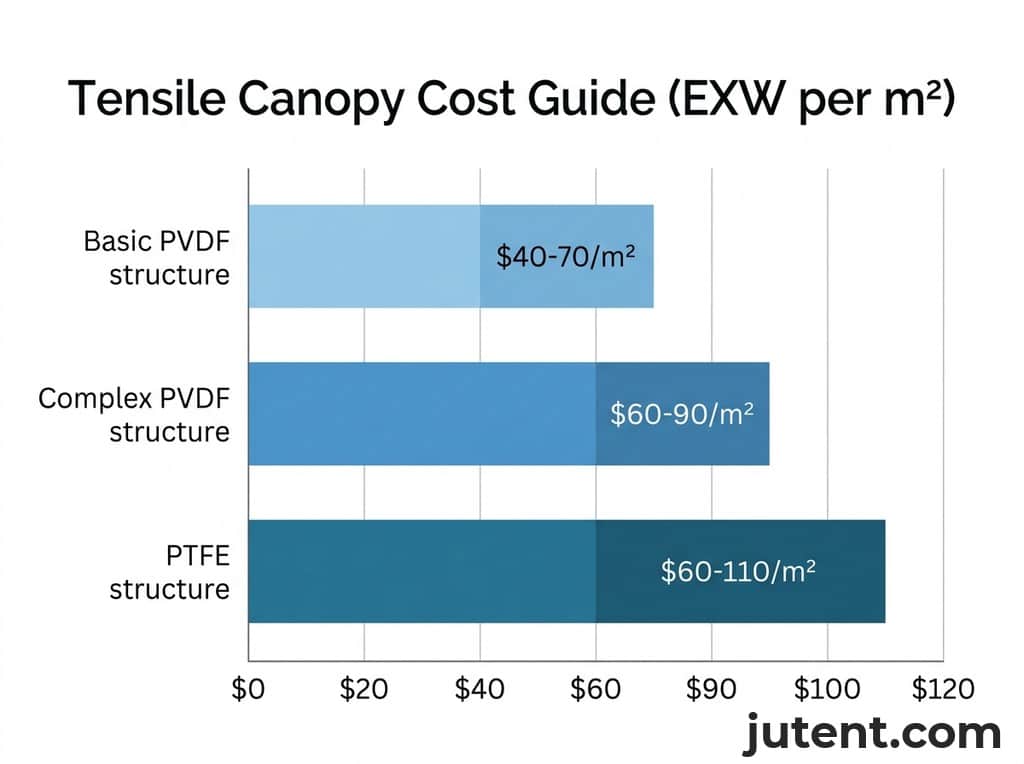
Membrane PVDF, forme simple (p. ex., petit cône ou arche basique supportée) : 40–60 $/m². Membrane PVDF, forme complexe (p. ex., grand hypar, multi-cône complexe) : 60–90 $/m². Remarque : ces fourchettes sont indicatives ; le prix exact dépend de la portée, de la complexité de l'acier et du type de membrane. Contactez Jutent pour un devis spécifique à votre projet.
Foire Aux Questions
- How long does a tensile membrane structure last?
- La durée de vie dépend du matériau de la membrane. Les membranes en PVC enduit de PVDF durent généralement 15 à 20 ans, tandis que les membranes en fibre de verre enduit de PTFE peuvent durer 25 à 30 ans. Les périodes de garantie sont généralement de 5 à 10 ans pour le PVDF et de 10 à 15 ans pour le PTFE, selon les spécifications du projet.
- Comment installer une structure de membrane tendue ?
- L'installation implique le montage de la charpente en acier, puis le déploiement, le positionnement et la mise en tension minutieux des panneaux de membrane. Le processus nécessite des équipements spécialisés et des équipes formées pour garantir une tension et un alignement corrects. Jutent fournit des conseils à distance gratuits et une supervision sur site pour les projets complexes.
- Quelle est la différence entre les membranes PVDF et PTFE ?
- Les membranes PVDF offrent une bonne translucidité et une bonne résistance aux UV avec une durée de vie typique de 15 à 20 ans. Les membranes PTFE offrent une longévité supérieure (25 à 30 ans), une résistance à la température plus élevée et des propriétés autonettoyantes, mais à un coût initial plus élevé.
- Un puits de lumière en atrium tendu peut-il remplacer un puits de lumière en verre existant ?
- Oui, dans de nombreux cas. Les toits en membrane tendue sont nettement plus légers que le verre, nécessitant souvent moins de renforcement structurel. Ils offrent également une meilleure diffusion de la lumière et des coûts de cycle de vie globaux plus faibles. Une évaluation structurelle est recommandée pour confirmer la faisabilité.
Obtenez votre devis de puits de lumière pour atrium aujourd’hui
“`