
A canopy de grandstand in the Middle East faces 45°C+ ambient temperatures, UV indices consistently exceeding 11, and abrasive sand-laden winds—environmental loads that standard European or North American specifications simply do not cover. When contractors import generic structural designs for regional stadium and spectator facilities, the results often include premature tensile membrane degradation, inadequate wind uplift resistance, and catastrophic drainage failures during sudden winter downpours. This guide details exactly what engineering teams in hot, arid desert climates must specify differently to ensure structural integrity and longevity in extreme environments. Establishing these critical parameters before the tender stage prevents costly re-engineering, eliminates supply chain delays, and ensures the facility secures local municipal approval on the first submission.
Climat du Golfe : Pourquoi les spécifications standard des auvents de gradins ne s'appliquent pas
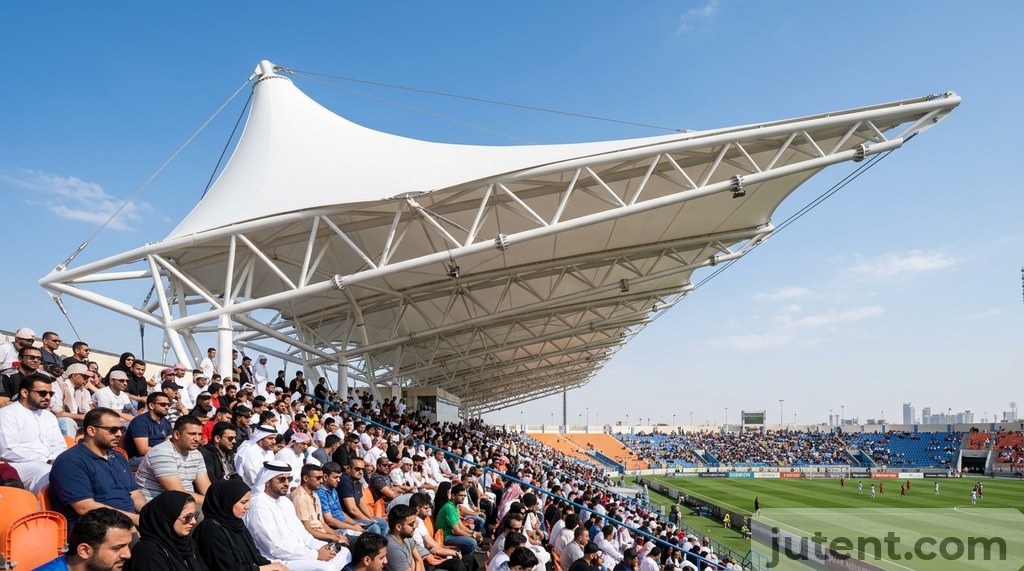
Les spécifications standard échouent dans le Golfe car elles supposent une dilatation thermique modérée et des pluies occasionnelles. Au Moyen-Orient, les charges environnementales principales sont les cycles thermiques extrêmes et la poussière abrasive. Un Canopy de grandstand conçu pour un climat tempéré spécifie généralement une membrane de 700g/㎡ à 900g/㎡ et de l'acier galvanisé standard. À Doha ou Dubaï, les températures de surface de la membrane peuvent dépasser 70°C pendant les mois d'été les plus chauds. Cette charge thermique provoque la plastification du PVC standard, entraînant un affaissement irréversible et une perte de précontrainte.
La protection contre la corrosion et la durée de vie doivent être décrites en fonction du système de protection choisi, de l'environnement du projet et des conditions de maintenance, et non comme une garantie de durée de vie inconditionnelle.
Résistance aux UV et à la chaleur : Exigences de qualité de membrane pour le Moyen-Orient
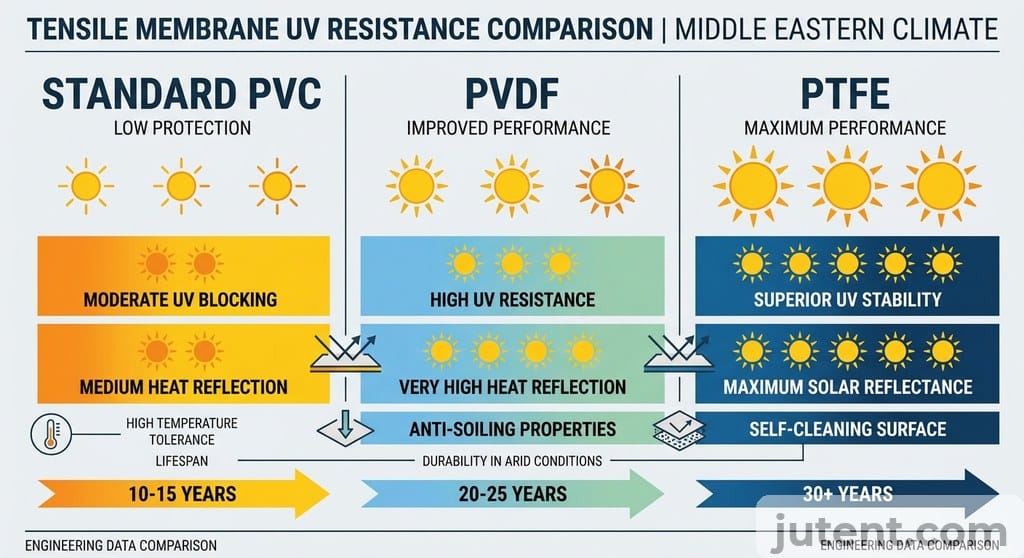
Le PVDF ou le PTFE de haute qualité est obligatoire pour tout projet de membrane tendue de tribune au Moyen-Orient. Le PVC standard se dégrade rapidement sous l'indice UV soutenu de 11+ du Golfe. Pour le PVDF, la spécification doit imposer un poids de membrane minimum de 900g/㎡ avec une laque de surface fluorocarbonée à haute concentration. Pour le PTFE, un minimum de 1050g/㎡ est standard.
La raison pour laquelle le PVDF surpasse le PVC standard dans les environnements à fort UV est cette couche de surface fluorocarbonée, qui réfléchit le rayonnement UV plutôt que de l'absorber. À un indice UV de 11+, une membrane en PVDF de 1050 g/㎡ maintient sa résistance à la traction à moins de 10 % de la spécification d'origine après 15 ans. Une membrane en PVC standard de 650 g/㎡ dans le même environnement nécessite généralement un remplacement après 5 à 7 ans en raison de la migration des plastifiants et de la fragilisation.
La planification budgétaire doit être basée sur le type de structure, la portée libre, la résistance au vent, le grade de membrane, le tonnage d'acier et la portée du projet. Pour un devis précis EXW, FOB, CIP ou DDU, les dimensions du projet et les exigences d'ingénierie doivent être examinées en premier.
Sable et poussière : conception du drainage et exigences de surface de la membrane
L'accumulation de sable est une charge structurelle, pas seulement un problème esthétique. Un canopy de grandstand La spécification pour l'Arabie Saoudite doit tenir compte de la fine poussière du désert qui se mélange à de fortes pluies occasionnelles ou à une humidité élevée, créant une boue lourde semblable à du ciment. Si la pente de l'auvent est trop faible, cette boue s'accumule, dépassant la capacité de charge permanente de la membrane et menaçant l'intégrité structurelle de l'ensemble du cadre en acier.
Pour éviter cela, la forme architecturale doit maintenir une pente minimale de 15 degrés sur tous les panneaux de membrane. Les conceptions plates ou à faible pente sont garanties d'échouer dans le Golfe. La surface de la membrane elle-même doit comporter une couche de finition en PVDF soudable avec une faible énergie de surface, permettant au vent et aux pluies occasionnelles de nettoyer efficacement la structure.
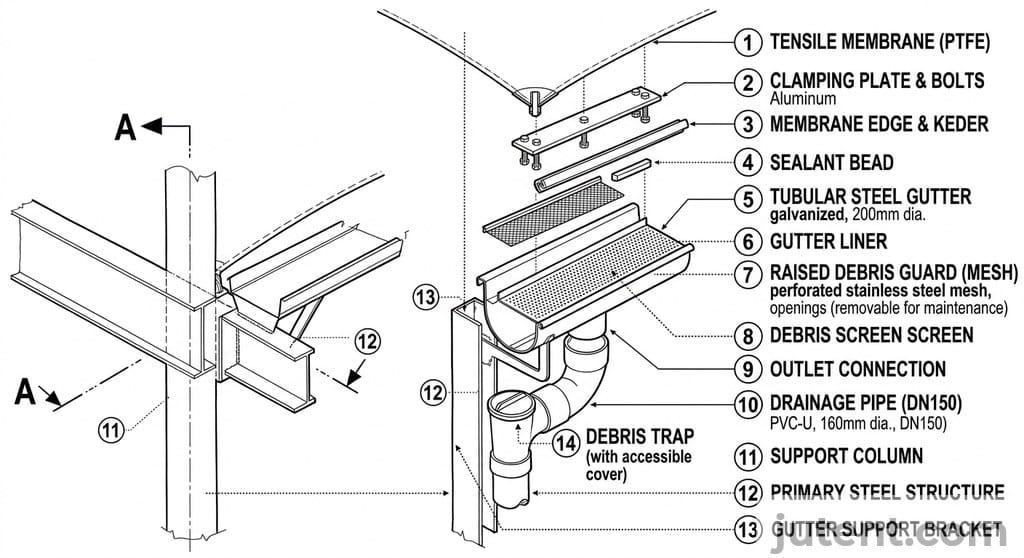
Les détails de drainage nécessitent des modifications spécifiques. Les profilés de gouttière européens standard de 75 mm se boucheront avec du sable en quelques mois. Les spécifications du Moyen-Orient exigent un drainage périphérique surdimensionné à canal ouvert ou un système de descente d'un diamètre minimum de 150 mm avec des regards de nettoyage accessibles au niveau du sol. Le détail du bord de la membrane doit utiliser une extrusion continue en aluminium de type keder plutôt que des bords festonnés intermittents, empêchant le sable d'être poussé sous l'auvent et de s'accumuler dans les jonctions de la charpente en acier, ce qui accélère la corrosion localisée.
Charge de vent : Code du bâtiment saoudien et normes des Émirats arabes unis pour les structures de tribunes
Les valeurs techniques finales doivent être confirmées par rapport aux exigences d'ingénierie spécifiques au projet et aux conditions du code local.
Aux Émirats arabes unis, la municipalité de Dubaï et le département des municipalités et des transports d'Abou Dhabi exigent que les structures résistent à des rafales de vent de 3 secondes de 45 m/s (160 km/h). Comme les auvents de tribunes sont des structures ouvertes, ils subissent d'importantes forces de soulèvement. Le modèle d'ingénierie doit prendre en compte la pression du vent agissant simultanément sur les surfaces supérieure et inférieure de la membrane.
galvanisation à chaud ou autre système de protection contre la corrosion spécifié pour le projet, selon la conception du projet
Référence de Projet : Projets d’Auvent de Tribune dans la Région du Golfe
Sur la base de l'expérience de Jutent dans plus de 400 projets dans plus de 30 pays, des problèmes de spécification similaires apparaissent souvent lorsque des hypothèses de stade précoce sont faites avant que les conditions d'ingénierie soient confirmées.
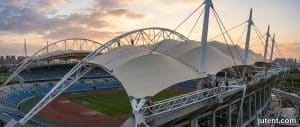
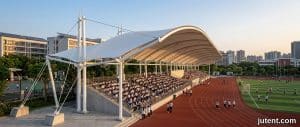
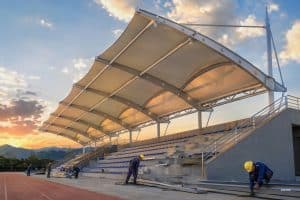
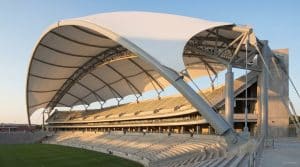
Dans le cadre d'un récent projet d'ombrage de stade aux Émirats Arabes Unis, le client exigeait un toit en porte-à-faux de 30 mètres au-dessus du gradin principal sans obstruer les lignes de vue. Cette configuration nécessitait un système de ferme primaire soutenu par câbles plutôt que des portiques standard. Nous avons spécifié une membrane PTFE de 1200 g/㎡ tendue sur une charpente en acier de 350 tonnes.
La prise en compte des exigences de charge de vent dès la phase de conception a évité à l’entrepreneur un cycle complet de réingénierie après la soumission du permis. En détaillant exactement les connexions de moment de la plaque de base et en spécifiant un protocole d’inspection de soudure de type 4 pour tous les nœuds primaires, la structure a passé l’approbation municipale dès la première soumission. L’auvent fournit désormais une ombre continue pour 5 000 spectateurs tout en résistant au cycle thermique extrême de la région et aux tempêtes de sable abrasives sans fatigue structurelle, prouvant la valeur d’une ingénierie spécifique au climat.
Si vous souhaitez une référence budgétaire précise pour ce projet, partagez vos dimensions, votre zone de vent et votre type de membrane préféré avec notre équipe.
Obtenez votre devis pour une canopy de tribune dans le désert
FAQ
- Quel grade de membrane est recommandé pour un canopy de grandstand aux Émirats Arabes Unis ?
- Pour les auvents de tribunes aux Émirats Arabes Unis, une membrane PVDF de haute qualité, spécifiquement un grade architectural d'un poids de 1050 g/m², est la recommandation standard en raison de son excellente résistance aux UV et de sa durabilité dans la chaleur extrême. Pour les projets dont la durée de vie dépasse 25 ans ou ceux nécessitant des indices de résistance au feu supérieurs, la membrane PTFE est le choix privilégié, offrant une longévité et des performances accrues essentielles pour ces environnements exigeants.
- Les auvents de tribune en Arabie Saoudite doivent-ils répondre à des codes de construction spécifiques ?
- Oui, les auvents de tribune en Arabie Saoudite sont soumis à des codes du bâtiment spécifiques, principalement le Code du Bâtiment Saoudien (SBC). Le chapitre 7 du SBC traite spécifiquement des charges de vent, qui sont une considération critique pour les structures de membrane tendue à grande portée. La plupart des canopy de grandstand projets en Arabie Saoudite sont conçus pour être conformes au SBC 301, qui impose des vitesses de vent de conception allant généralement de 45 à 55 m/s. Cela garantit l'intégrité structurelle et la sécurité de l'auvent face aux vents forts de la région, un facteur clé pour les architectes, ingénieurs et entrepreneurs lors des phases de conception et d'approvisionnement.