
L'expérience de l'entreprise doit être décrite par une expérience d'exportation vérifiée et une capacité de soutien de projet, plutôt que par des anecdotes de projet non étayées.
Spécifier une toiture pour un environnement tropical ne se résume pas à simplement améliorer le tissu. Cela nécessite un recalcul complet du dimensionnement de l'acier primaire, des réactions des fondations et des systèmes de protection contre la corrosion. Ne pas prendre en compte ces réalités locales au stade de l'appel d'offres conduit inévitablement à des permis rejetés, des installations retardées ou une défaillance structurelle prématurée. Voici les paramètres d'ingénierie exacts requis pour construire une toiture conforme et durable canopy de grandstand en Asie du Sud-Est.
Exigences de charge de vent de typhon pour les toitures de gradins en Asie du Sud-Est
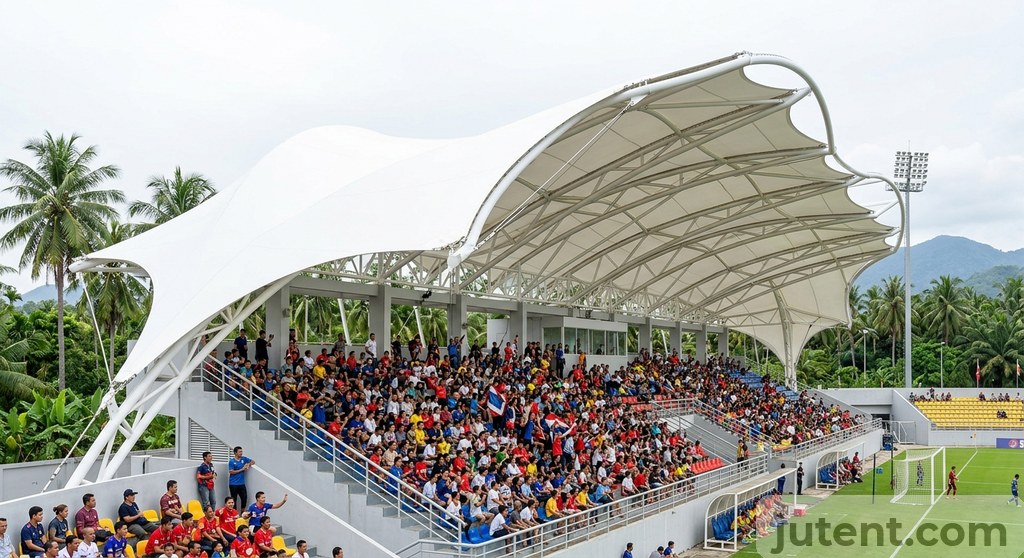
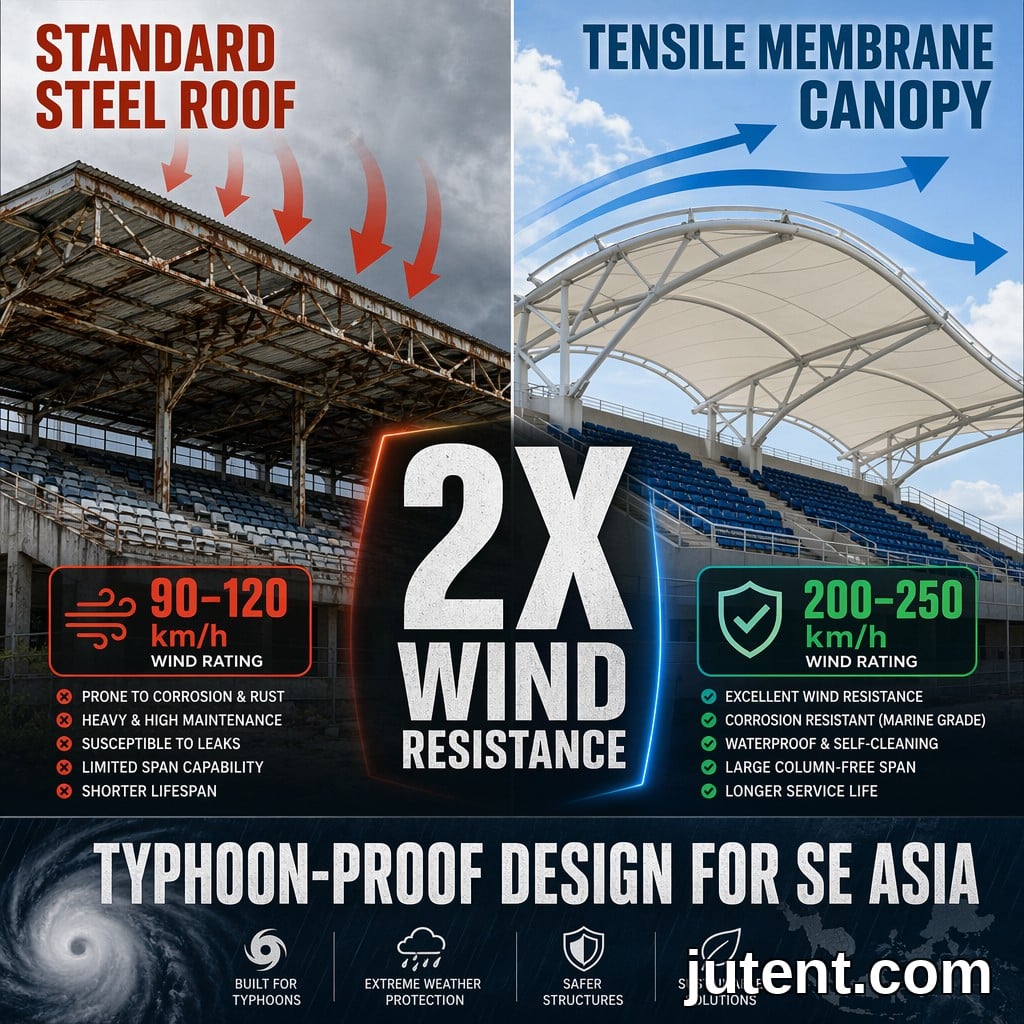
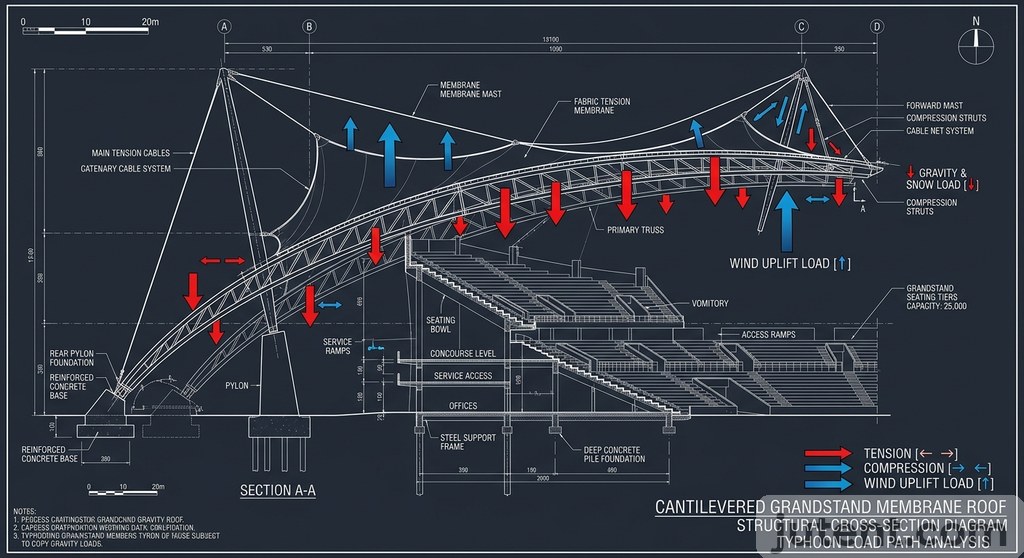
La charge de vent dicte le dimensionnement de l'acier primaire et les exigences de fondation pour tout Canopy de grandstand. En Asie du Sud-Est, la conception selon les codes de vent locaux est le facteur le plus important qui sépare une structure conforme d'un risque de défaillance.
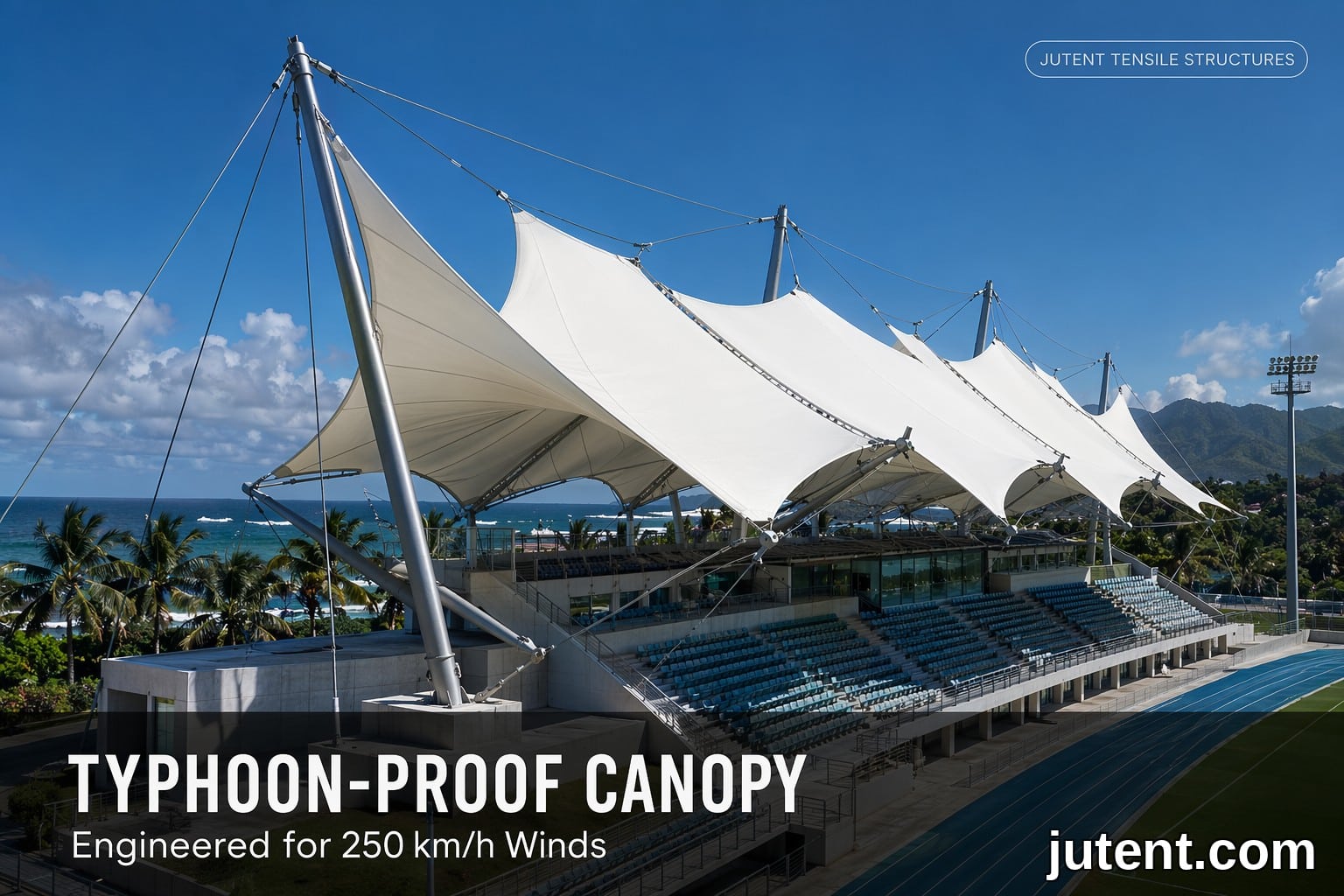
De nombreux auvents standards sont conçus pour des vitesses de vent de 90 à 120 km/h, ce qui est insuffisant pour les régions sujettes aux typhons en Asie du Sud-Est. Ceci est insuffisant pour une classification typhon canopy de grandstand. Le Code national des structures des Philippines (NSCP) impose des vitesses de vent de calcul de 200 km/h à 250 km/h selon la zone spécifique. Comme une tribune en porte-à-faux agit comme une voile, les forces de soulèvement générées à ces vitesses sont massives.
Les spécifications typiques utilisent de l'acier Q235B ou Q355B, une membrane PVDF ou PTFE de 1050 g/㎡ comme standard, et des accessoires en acier inoxydable SS304, avec des qualités supérieures disponibles lorsque le projet l'exige.
Les entrepreneurs doivent s'assurer que le fournisseur fournit des calculs d'ingénierie spécifiques au site, basés sur les codes de vent locaux. Se fier à des plans structurels génériques entraînera un rejet du permis par les autorités locales.
UV et humidité : comment les conditions tropicales affectent la longévité de la membrane des tribunes
La membrane architecturale en PVDF à 1050 g/m² est la spécification minimale viable pour un ombrage de tribune tropical. Les matériaux de qualité inférieure se dégradent rapidement sous l'indice UV élevé et l'humidité constante typiques de la région.
La raison pour laquelle le PVDF surpasse le PVC standard dans les environnements à fort UV est la couche de surface fluorocarbonée, qui réfléchit le rayonnement UV plutôt que de l'absorber. À un indice UV de 12 à 13 — une réalité quotidienne pour une ombrage pour spectateurs Installation en Malaisie — une membrane PVDF de 1050 g/㎡ conserve sa résistance à la traction à moins de 10 % de la spécification d'origine après 15 ans. Une membrane PVC standard de 650 g/㎡ dans le même environnement nécessite généralement un remplacement entre 8 et 10 ans en raison de la migration des plastifiants et du vieillissement dû aux UV.
L'humidité dicte également les exigences anti-mèche du fil de polyester de base. Dans les climats tropicaux, l'humidité pénètre les bords exposés des tissus standard, provoquant une croissance de moisissures internes qui se manifeste par des traînées noires à l'intérieur de la membrane. Un Canopy de grandstand cahier des charges conforme au Structures Guide doit imposer des fils à faible mèche ou anti-mèche traités avec des additifs antifongiques. La différence de prix entre 950g/㎡ et 1050g/㎡ de PVDF est d'environ 8 à 15 $/㎡, selon le fournisseur et le volume de commande, mais la différence de durée de vie est de 5 à 8 ans. Le calcul ne justifie pas l'économie.
Protection contre la corrosion de l'acier dans les climats côtiers et humides
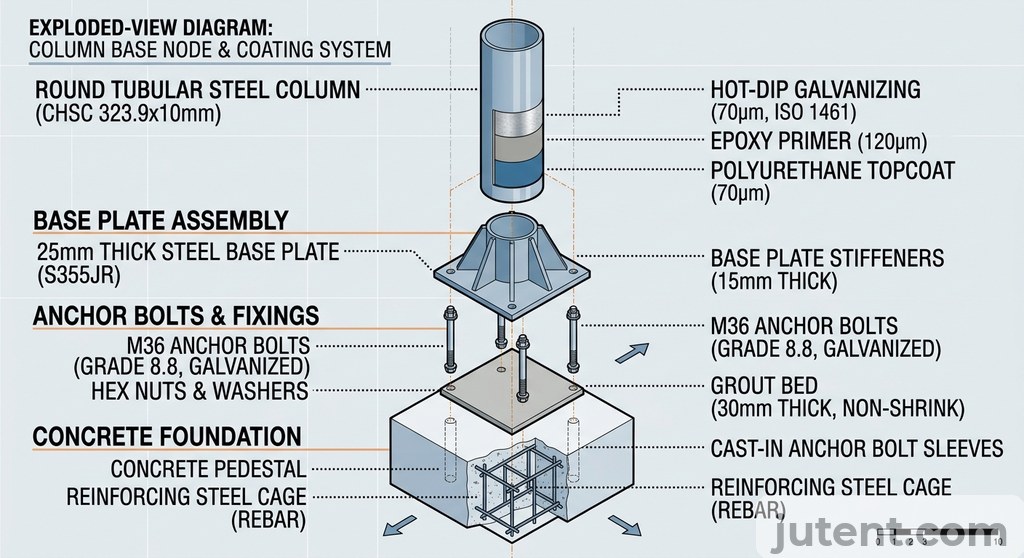
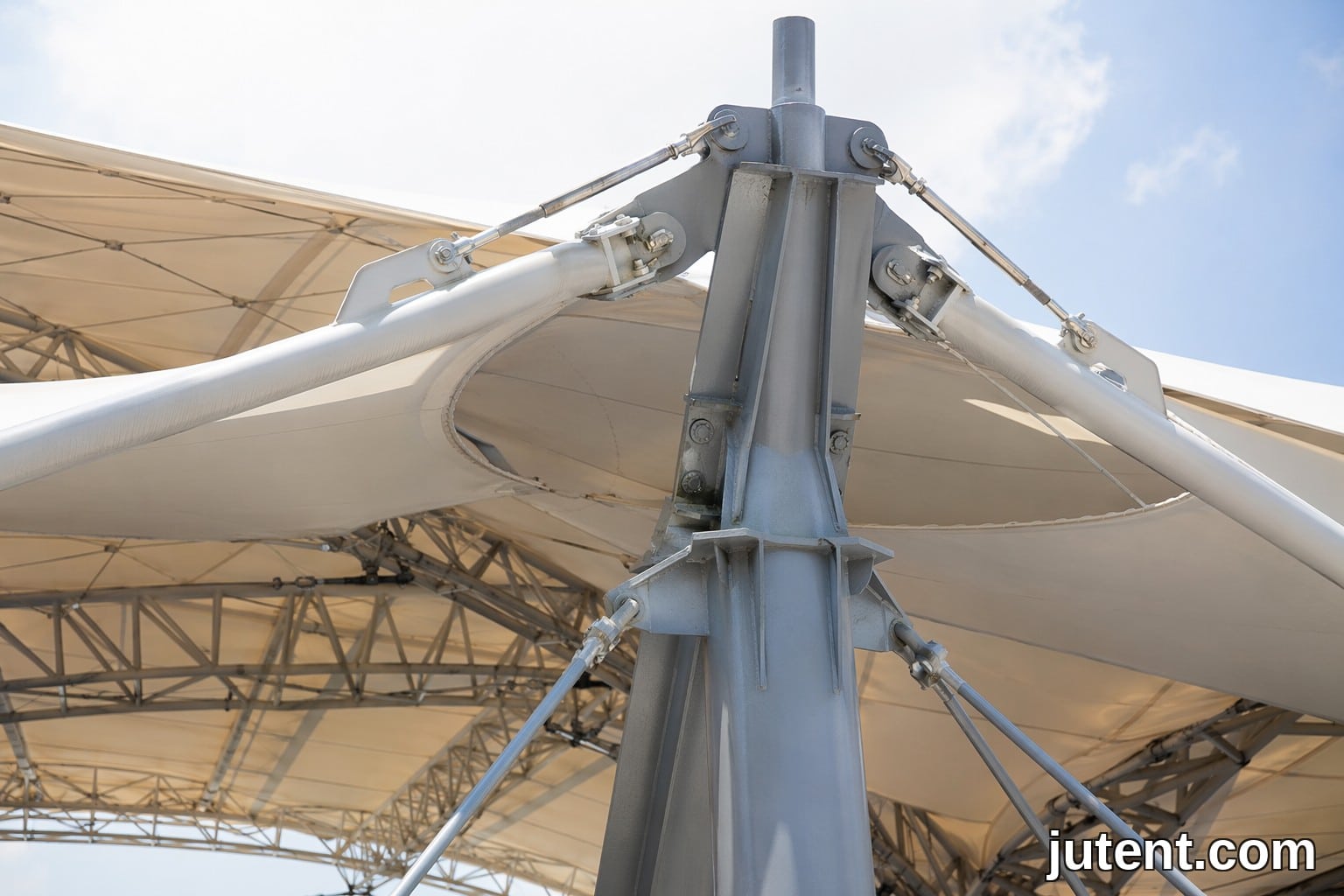
La galvanisation à chaud d'une épaisseur minimale de 85 microns est obligatoire pour tout structure d'auvent de tribune projet en Indonésie ou sur les côtes d'Asie du Sud-Est. Les cadres en acier peints standard montreront des signes visibles de rouille dans les 36 mois dans ces environnements très humides et très salins.
architectural fluorocarbon topcoat
La quincaillerie de raccordement est tout aussi critique. Une erreur d'installation courante consiste à utiliser des boulons zingués sur un cadre HDG. La corrosion galvanique éliminera le placage de zinc en quelques mois. Tous les boulons, écrous et rondelles structurels doivent être spécifiés comme étant galvanisés à chaud (classe 8.8 minimum) ou en acier inoxydable de grade 316. Les systèmes de tension de câbles et les plaques de membrane doivent également être en acier inoxydable 316 pour éviter les coulures de rouille localisées.
Approbation des autorités locales : ce que les entrepreneurs aux Philippines et en Malaisie doivent savoir
Obtention de permis de construction pour un canopy de grandstand nécessite une documentation d'ingénierie spécifique au site. Les autorités locales du bâtiment aux Philippines et en Malaisie rejettent les plans structurels génériques ou les spécifications marketing fournies par le fournisseur.
Le dossier de documentation doit inclure des rapports de calculs structurels détaillant les réactions exactes de charge de vent au niveau des plaques de base. Pour un auvent conçu pour résister à des vents de typhon de 250 km/h, la conception des fondations nécessite généralement des semelles en béton armé mesurant au moins 1,5 m × 1,5 m × 1,2 m par colonne. Ce dimensionnement dépend strictement de la capacité portante locale du sol indiquée dans le rapport géotechnique du site.
Les entrepreneurs doivent demander un tableau complet des réactions de charge au fabricant de la toile avant de couler les fondations. Étant donné que le périmètre du fournisseur s'arrête généralement à la plaque de base, l'entrepreneur local assume l'entière responsabilité des boulons d'ancrage, des cages d'armature et des travaux en béton.
Les autorités locales exigent également des certificats d'essai des matériaux. La soumission doit inclure des rapports de laboratoire tiers vérifiant la résistance à la traction, la résistance à la déchirure et l'ignifugation de la membrane architecturale. Les responsables du bâtiment exigent généralement la conformité aux normes NFPA 701 ou BS 476 Partie 7. Sans ces documents spécifiques, le processus d'approbation stagne, retardant l'ensemble de la remise de l'installation.
Référence de cas : Projets de toiture de tribune en Asie du Sud-Est
Sur la base de l'expérience de Jutent dans plus de 400 projets dans 30+ pays, l'erreur de spécification que nous voyons le plus souvent dans les climats tropicaux est de sous-dimensionner l'acier primaire pour atteindre un objectif budgétaire plus bas. Cette approche échoue inévitablement lors du premier événement météorologique majeur.
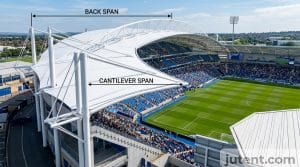
Un complexe sportif municipal dans une ville côtière d'Asie du Sud-Est nécessitait une portée libre de 40 m × 12 m canopy de grandstand pour couvrir 500 places de spectateurs. La zone de vent du site imposait une charge de conception stricte de 250 km/h. Cette combinaison d'une profondeur de porte-à-faux de 12 m et d'une charge de vent extrême excluait les cadres tubulaires légers standard.
L'expérience de l'entreprise doit être décrite par une expérience d'exportation vérifiée et une capacité de soutien de projet, plutôt que par des anecdotes de projet non étayées.
Si vous examinez des options techniques, demandez à notre équipe la dernière fiche technique et les détails standard des matériaux pour ce type de structure.
Obtenez votre fiche technique d’auvent de tribune
FAQ
- À quelle vitesse de vent un canopy de grandstand aux Philippines doit-il être conçu ?
- Le NSCP exige des vitesses de vent de calcul de 200 à 250 km/h dans la plupart des régions des Philippines. Jutent conçoit les auvents de tribune pour résister à ces charges en standard pour les projets philippins. Le non-respect de ces codes locaux spécifiques entraîne un rejet immédiat du permis. Pour une classification à 250 km/h, l'ingénierie nécessite un acier primaire plus lourd—passant souvent de profilés carrés de 150 mm à 250 mm—et des semelles en béton considérablement plus grandes pour contrer les forces de soulèvement massives générées par la conception de l'auvent en porte-à-faux.
- Comment l'humidité côtière affecte-t-elle la structure en acier d'une toiture de gradins ?
- La galvanisation à chaud (minimum 85 microns) avec une couche de finition fluorocarbonée est standard pour les projets côtiers en Asie du Sud-Est. La quincaillerie de connexion doit être en acier inoxydable ou galvanisée à chaud. L'humidité côtière et la forte salinité accélèrent l'oxydation, ce qui signifie que les cadres peints standard présenteront de la rouille structurelle en trois ans. En utilisant un système de protection multicouche—galvanisation à chaud suivie d'un apprêt époxy et d'une couche de finition polyuréthane résistante aux UV—la structure en acier est complètement isolée de l'atmosphère tropicale corrosive, garantissant une durée de vie de conception de 20 ans avec un entretien minimal.