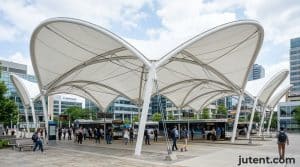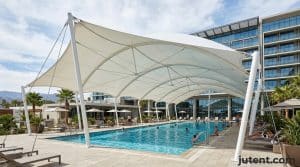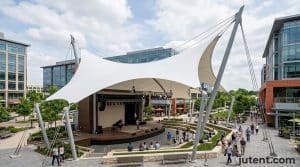

Dans la transition des structures compressives traditionnelles vers des systèmes légers hautement optimisés, membrane architecturale les technologies ont fondamentalement redéfini les limites de charge. Les infrastructures commerciales et industrielles modernes exigent des rapports portée/poids élevés, un form-finding précis et une résistance environnementale sans compromis. Comprendre la physique complexe et la science des matériaux derrière un toit commercial en membrane est essentiel pour spécifier les composites corrects en ingénierie structurelle.
Load Optimization: Les structures tendues utilisent la tension biaxiale pour atteindre une stabilité structurelle ultime, réduisant les charges permanentes jusqu'à 80 % par rapport aux toitures rigides en acier/verre.
Conçu pour résister à des charges de vent dépassant 150 km/h et les déformations dues à la charge de neige localisée, en utilisant des propriétés matérielles élastiques non linéaires.
Material Durability: L'impact des UV sur la longévité de la membrane est atténué grâce à la chimie de la couche de finition (PVDF, TiO2, PTFE), permettant d'étendre la durée de vie de 15 à plus de 30 ans sous une exposition environnementale constante.
Mécanique biaxiale et recherche de forme dans les membranes structurelles
Contrairement aux matériaux de toiture conventionnels qui résistent aux charges par rigidité en flexion, le tissu tendu repose entièrement sur la précontrainte et double courbure (géométrie anticlastique). Les directives de conception des membranes structurelles imposent que le matériau transfère en continu les charges appliquées (vent, neige, sismique) aux câbles périphériques et aux mâts en acier de support.
Les ingénieurs calculent les le module d'Young et le coefficient de Poisson du tissu de base tissé (généralement en polyester haute ténacité ou en fibre de verre tissée). En contrôlant méticuleusement la tension de chaîne et de trame lors de l'installation, la membrane architecturale évite tout relâchement localisé ou fatigue sous des pressions de soulèvement dues au vent fluctuantes.
Composition avancée des matériaux : membranes PTFE vs PVC
Le choix de la membrane est la variable la plus critique pour déterminer l'intégrité structurelle à long terme et le cycle de maintenance d'un espace commercial. Bien que les deux catégories principales agissent comme des composites flexibles, leurs fils de base, la chimie de leur revêtement et leurs résistances ultimes à la traction diffèrent considérablement.
A membrane en PVC (Chlorure de polyvinyle enduit sur polyester) est très polyvalent, offrant une excellente résistance à la traction et une soudabilité par haute fréquence. Pour les environnements hautement corrosifs ou les exigences architecturales haut de gamme, un membrane PTFE (Polytétrafluoroéthylène enduit sur fibre de verre) offre une inertie chimique supérieure, une résistance totale aux UV et un coefficient de friction extrêmement bas, le rendant effectivement autonettoyant.
| Spécification technique | Membrane PVC (avec couche de finition PVDF) | Membrane PTFE (base en fibre de verre) |
|---|---|---|
| Matériau de base / Substrat | Fils de polyester haute ténacité | Fibre de verre tissée |
| Résistance à la traction (chaîne/trame) | Environ 4 000 – 6 000 N/5cm | Environ 6 000 – 8 000+ N/5cm |
| Durée de vie de conception | 15 - 20 ans | 30+ ans |
| Comportement au feu | B-s2, d0 (Auto-extinguible) | A2-s1, d0 (Âme incombustible) |
| Transmission solaire (lumière) | 7% – 15% | 10 % – 20 % |
| Efficacité autonettoyante | Modérée (dépend du TiO2/PVDF) | Exceptionnel (surface Teflon™) |
Détails structurels et protection des ancrages
L'intersection entre la membrane flexible et le cadre en acier rigide est l'endroit où se produisent les forces de cisaillement maximales. Les câbles de rive périphériques (généralement en acier galvanisé à chaud ou en acier inoxydable) sont insérés dans les poches de la membrane pour répartir la tension uniformément. Pour les structures d'ombrage de grandes places ou les auvents de centres commerciaux, l'ingénierie des fondations doit tenir compte des forces de soulèvement importantes.
De plus, les composants en acier en contact avec la membrane doivent être traités pour prévenir la corrosion galvanique et la dégradation par rouille. Les bonnes pratiques de l'industrie exigent Revêtements C3 (systèmes multicouches époxy et polyuréthane) pour les éléments en acier dans les environnements côtiers ou fortement pollués par l'industrie. Cela garantit que l'acier de structure correspond à la longévité de la toile architecturale avancée.
Évaluation du coût total de possession (TCO)
Lorsque l'on compare les coûts des matériaux de structure membranaire avec ceux de l'acier conventionnel et du bardage métallique, la dépense initiale en matériaux est compensée par des réductions drastiques de la sous-structure de support nécessaire. La légèreté du tissu tendu — pesant souvent moins de 1,5 kg/m² — permet des fondations en béton plus petites, des profilés en acier plus fins et des processus d'installation rapides et à sec.