

Perancangan belanjawan harus berdasarkan jenis struktur, rentang jelas, penarafan angin, gred membran, tan keluli, dan skop projek. Untuk sebut harga EXW, FOB, CIP, atau DDU yang tepat, dimensi projek dan keperluan kejuruteraan harus disemak terlebih dahulu.
The financial variables of membrane structures differ significantly from traditional rigid-clad steel buildings, primarily due to the lightweight nature of the roof covering and the subsequent reduction in primary steel tonnage. This guide breaks down the key cost factors, compares material grades, and provides realistic price ranges to help project managers evaluate initial feasibility before moving into detailed engineering.
The 5 Factors That Drive Warehouse Tensile Canopy Cost
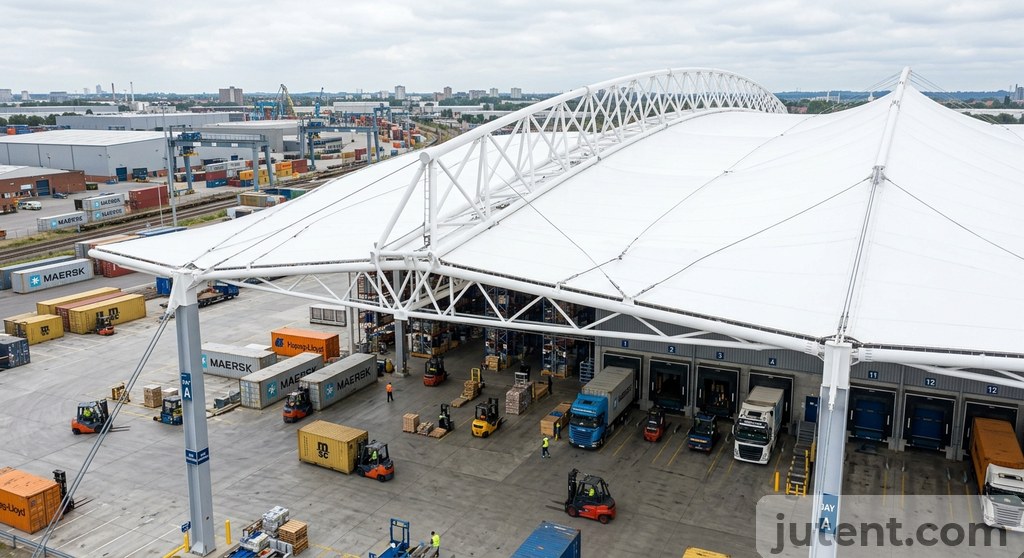
Five primary variables dictate the final warehouse tensile canopy price: project scale, membrane grade, structural steel weight, foundation requirements, and procurement scope.
Nilai teknikal akhir harus disahkan berdasarkan keperluan kejuruteraan khusus projek dan keadaan kod tempatan.
Perlindungan kakisan dan hayat perkhidmatan hendaklah diterangkan mengikut sistem perlindungan yang dipilih, persekitaran projek, dan keadaan penyelenggaraan, bukannya sebagai jaminan hayat tanpa syarat.
Clearance height also drives up the steel tonnage exponentially. A standard 5-metre eave height uses significantly less steel than an 8-metre clearance required for high-rack Warehousing. Foundation requirements also play a critical role. A site with poor soil bearing capacity (under 100 kPa) requires larger concrete footings to resist the significant uplift forces generated by the tensile membrane, adding hidden costs. Finally, the choice between supply-only and full installation shifts the budget from pure material capital expenditure to a blended material and specialized labor cost.
Kos mengikut Skala Projek: Aplikasi Kecil vs Besar
The warehouse tensile canopy cost per sqm decreases as the total footprint increases. This economy of scale occurs because the engineering, design, and perimeter structural costs are distributed over a much larger area.
For a small application—such as a 300m² loading bay cover or temporary transit shelter—the supply cost often sits at the higher end of the spectrum, typically $50–$70/m². In these smaller footprints, the perimeter steel, tensioning hardware, and foundation requirements represent a disproportionately large percentage of the total build cost.
Conversely, a large-scale structure exceeding 2,000m² benefits heavily from structural repetition. Once the primary portal frames or truss systems are engineered, duplicating them across a 100-metre length optimizes material usage and fabrication time. For these large spans, the supply-only cost frequently drops to $25–$40/m².
Contractors should note that clear-span requirements alter this pricing curve. A 40-metre clear span without internal columns requires heavy truss engineering, which increases the steel cost compared to a multi-span structure with intermediate columns. For a deeper dive into span configurations, refer to our Warehouse Tensile Canopy Guide.
Gred Membran: Bagaimana Pilihan Bahan Mempengaruhi Belanjawan
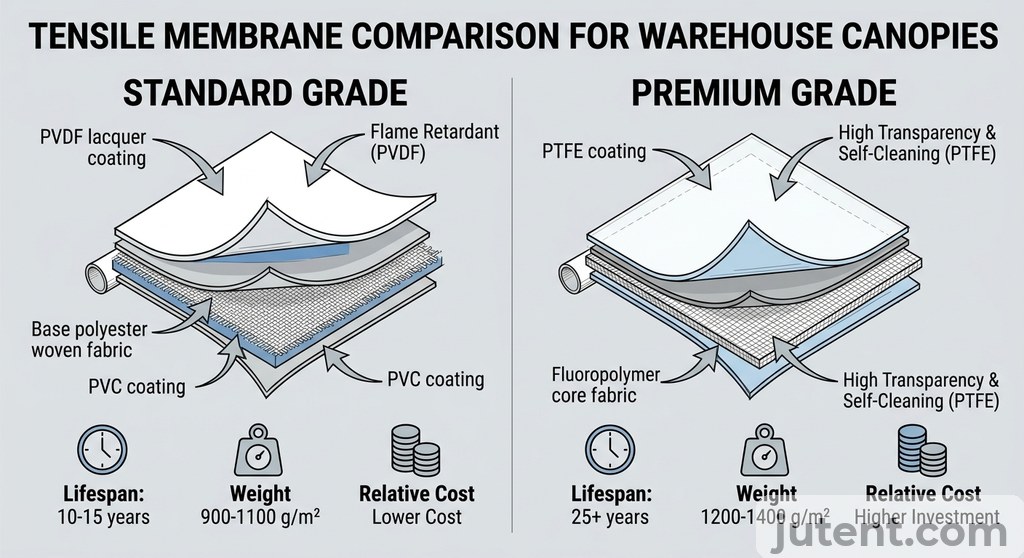
Membrane specification accounts for 15% to 30% of the total warehouse tensile canopy budget. The decision comes down to required design life versus initial capital outlay.
Standard PVC (typically 850g/㎡ to 900g/㎡) is the baseline option. It provides a 7–10 year lifespan and keeps the initial material cost low. This specification is ideal for temporary logistics hubs, leased sites, or emergency storage where long-term durability is not the primary financial driver.
PVDF-coated membranes (1050g/㎡ to 1250g/㎡) represent the industry standard for permanent gudang. The fluorocarbon surface layer reflects UV radiation, preventing the base polyester mesh from degrading and maintaining tensile strength over decades. This self-cleaning property also reduces ongoing maintenance costs, as rainwater easily washes away accumulated dirt and industrial particulate matter.
Berdasarkan pengalaman Jutent merentasi 400+ projek di 30+ negara, isu spesifikasi yang serupa sering timbul apabila andaian peringkat awal dibuat sebelum keadaan kejuruteraan disahkan.
For specialized applications requiring high fire resistance or extreme longevity, PTFE is available, though it typically doubles the membrane budget compared to PVDF and requires specialized handling during installation.
Bekalan Sahaja vs Bekalan dan Pemasangan: Memahami Perbezaan Harga
Contractors and developers must define their procurement model early, as it fundamentally changes the pricing structure. The two standard models are supply-only and supply-and-install.
Harga harus disemak mengikut kategori produk dan skop projek, bukannya dianggap sebagai angka tetap yang diterbitkan. Untuk sebut harga yang tepat, saiz struktur, penarafan angin, gred membran, dan syarat penghantaran perlu disahkan terlebih dahulu.
Pengalaman syarikat harus diterangkan melalui pengalaman eksport yang disahkan dan keupayaan sokongan projek, bukannya anekdot projek yang tidak disokong.
Supply-and-install includes the manufacturer deploying a specialized crew to erect the structure. This increases the total contract value significantly due to travel, accommodation, and specialized labor rates, but transfers the installation risk entirely to the supplier.
Cara Mendapatkan Sebut Harga yang Tepat
Requesting a quote with only a rough square meterage will result in a generic estimate, not a binding price. To secure an accurate, actionable quote for a commercial warehouse tensile canopy cost, contractors must provide four specific data points to the engineering team.
First, provide exact dimensions: length, width, and required eave clearance height. A 5-metre clearance requires a vastly different steel profile than an 8-metre clearance designed for heavy machinery access and vertical racking systems.
Second, specify the exact site location. Location dictates the local wind and snow load codes. A structure engineered for a 120km/h inland wind zone will fail permit checks and physical stress tests in a 200km/h coastal typhoon zone.
Third, state the clear-span requirement. Indicate whether intermediate columns are acceptable inside the warehouse or if a 100% clear-span is mandatory for forklift maneuverability.
Fourth, define the target design life to guide the membrane grade selection. Stating “we need a 15-year lifespan” immediately directs the engineering team to specify a 1050g/㎡ PVDF membrane rather than a baseline PVC, ensuring the initial quote aligns with the project's operational reality. Providing these four metrics upfront eliminates guesswork and accelerates the tendering process.
Jika anda mahukan rujukan belanjawan yang tepat untuk projek ini, kongsikan dimensi, zon angin, dan jenis membran pilihan anda dengan pasukan kami.
Soalan Lazim
- What is the cost per square metre for a warehouse tensile canopy?
- The supply-only cost for a warehouse tensile canopy typically ranges from $25–$70/m² ex-factory, depending on the structural form and specified membrane grade. This figure covers the complete structural kit, including steel frames, membrane panels, cables, and tensioning hardware, with the buyer managing site preparation and erection. Factors such as a clear-span requirement, which necessitates heavier truss engineering, will increase steel costs compared to multi-span structures. Additionally, membrane choice, accounting for 15% to 30% of the budget, significantly impacts the final price, with PVDF or PTFE options costing more than standard PVC due to enhanced durability and longevity.
- What information do I need to get an accurate warehouse tensile canopy quote?
- To obtain an accurate warehouse tensile canopy quote, it is essential to provide specific project dimensions, the exact site location for load calculations, the preferred structural form, and the target membrane grade preference. Exact dimensions, including length, width, and eave clearance height, are critical as they dictate the required steel profile. The site location determines local wind and snow load codes, ensuring the structure meets regional engineering standards. Specifying the clear-span requirement, whether intermediate columns are acceptable or a 100% clear-span is mandatory, impacts structural design. Finally, defining the target design life guides the selection of the appropriate membrane grade, aligning the quote with the project's operational reality and accelerating the tendering process.
 English
  Français
  Español de México
  Bahasa Melayu
  Tiếng Việt
  Português do Brasil
  Русский
  ไทย
ไทย  العربية