

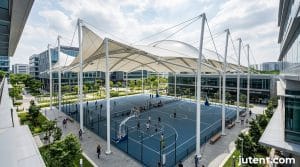
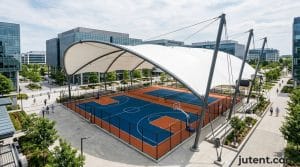
Manila, 2023. A private tennis club developer needed a tennis court shade structure over three adjacent hard courts—a 54m × 36m total footprint—without placing intermediate columns between the courts. The site's tropical climate required maximum UV protection, but the players needed even light distribution without blinding glare during serves. That combination of clear span, high UV index, and strict playability requirements ruled out standard metal roofing and pushed the specification toward a tensile membrane structure with a custom light-transmitting canopy. The engineering drawings and membrane patterning were completed in 14 days to meet a strict tournament deadline.
Why Tennis Court Shade Is Different: Glare, Contrast, and UV
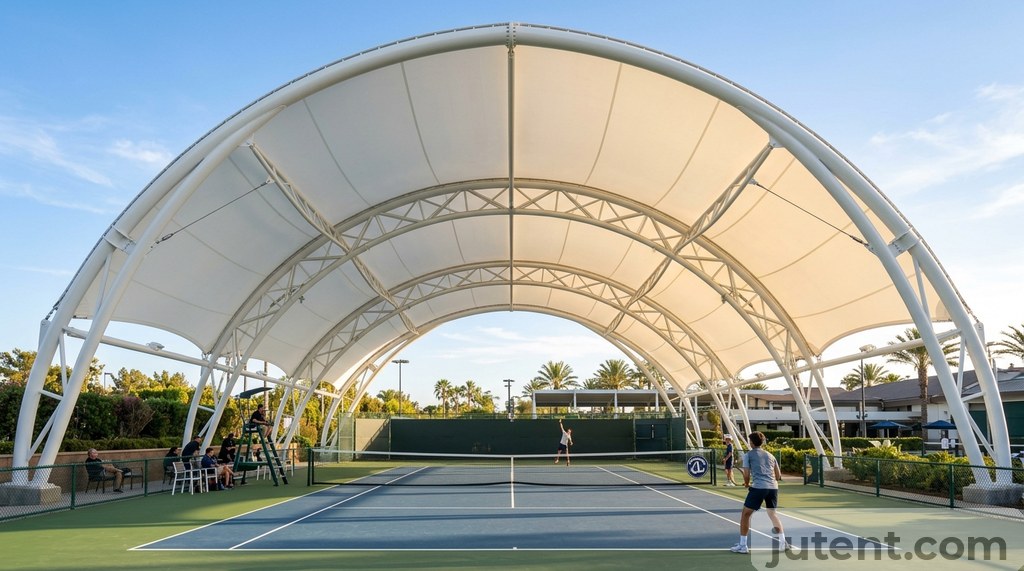
A tennis court shade structure has to balance UV protection with visibility. Too much shade reduces contrast; too little defeats the purpose. Unlike a basketball court where play is concentrated under the hoop, tennis requires players to track a 65mm yellow ball traveling at high speeds across a 23.77m long court, often looking directly upward during a serve.
The primary engineering challenge is managing glare and shadow lines. A solid steel roof blocks 100% of UV rays but creates a dark cavern that requires artificial lighting even at noon. It also creates harsh shadow lines at the court perimeter, causing the ball to visually disappear as it crosses from sunlight into shade.
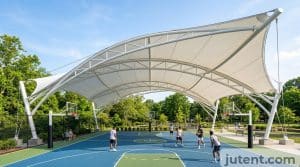
Tensile membrane structures solve this by providing diffused natural light. A properly specified Sport Court Shade blocks 100% of harmful UV radiation while allowing 10–15% of visible light to pass through. This creates an evenly illuminated playing surface without the harsh contrast lines that disrupt player tracking. The structural design must also avoid placing primary steel members directly over the baseline, where they can cast distracting linear shadows during peak afternoon sun.
Net Clearance Requirements and How Canopy Height Affects Play
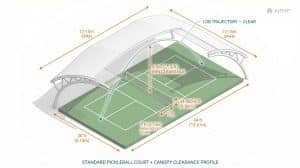
Clearance height directly dictates the structural steel sizing and the playability of the court. A tennis kanopi gelanggang bola keranjang luar must accommodate high lob shots while maintaining structural stability under wind loads.
The International Tennis Federation (ITF) requires a minimum clearance of 9.14m above the net for international competition. For recreational clubs and private courts, a clearance of 6.5m to 7.5m at the lowest point over the playing area is the standard specification. Dropping the canopy below 6m interferes with standard baseline lobs and traps heat at the court level, creating an uncomfortable microclimate for players.
Increasing the height improves playability and heat dissipation but exponentially increases the wind load on the primary steel. Raising a canopy from 6m to 9m typically requires a 30–40% increase in the cross-sectional area of the main columns. For a standard 36m × 18m single court footprint, moving to a 9m clearance often shifts the column specification from a 250mm circular hollow section (CHS) to a 350mm CHS. Contractors must confirm the intended level of play with the facility operator before finalizing the height in the Tensile Shade Structures Sports Courts Guide.
Membrane Colour and Light Transmission: What Actually Works on a Tennis Court
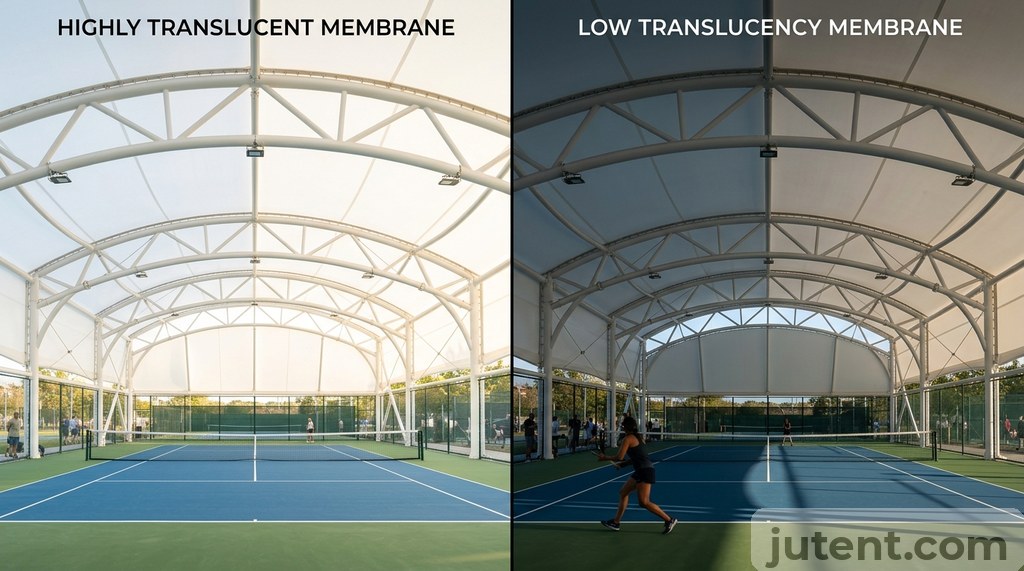
White or light grey PVDF membranes handle 95% of outdoor tennis court shade projects. Darker colours are the right choice only when local planning authorities mandate them to blend with surrounding foliage.
The reason white PVDF dominates is its light transmission profile. A 1050g/㎡ white PVDF membrane typically offers 10–12% light transmission. This specific range diffuses sunlight perfectly, eliminating glare while keeping the court bright enough for daytime play without artificial lights.
Berdasarkan pengalaman Jutent merentasi 400+ projek di 30+ negara, isu spesifikasi yang serupa sering timbul apabila andaian peringkat awal dibuat sebelum keadaan kejuruteraan disahkan.
Tennis Court Tensile Canopy Configurations: Side Cover vs Full Overhead
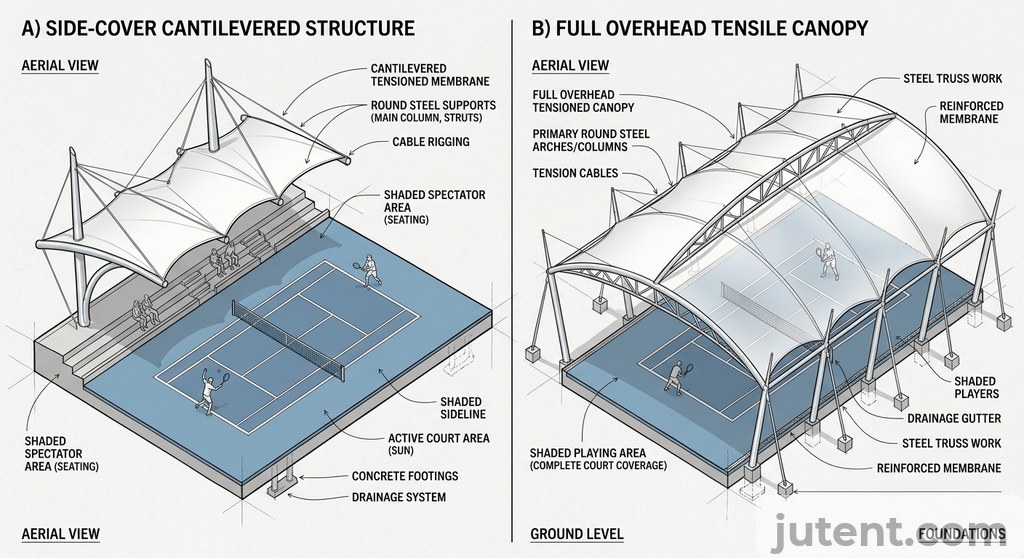
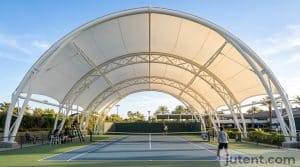
The structural configuration of a tennis court cover depends entirely on the site's budget and the specific sun path. The two standard approaches are full overhead clear-span canopies and cantilevered side covers.
A full overhead canopy provides total coverage of the 36m × 18m playing enclosure. To avoid columns in the run-off zones, this requires a clear span of at least 18m for a single court, or 36m for two adjacent courts. This is typically achieved using a barrel vault or a double-conic tensile structure supported by perimeter columns. This configuration guarantees all-day shade and rain protection, ensuring the facility can operate regardless of weather conditions.
Cantilevered side covers are specified when the budget does not support a full clear span. These structures use a single row of heavy columns placed outside the fence line, projecting a 5m to 8m shade sail over the baseline or the spectator seating. While a side cover costs approximately 40% less than a full canopy, it only provides shade during specific hours of the day. The structural challenge with cantilevers is the overturning moment; an 8m projection requires substantial concrete footings, often exceeding 2.5m³ per column, to resist uplift forces.
Wind Load Considerations for Tennis Court Structures
A full tennis court canopy acts as a massive sail. A standard single-court structure covers over 640 square metres. Managing the uplift and lateral forces on that surface area dictates the entire steel specification.
Standard designs are engineered for a basic wind speed of 120km/h (33m/s). However, coastal or typhoon-prone regions require significantly heavier primary frames. In a recent sports facility project in the Philippines, the structure had to meet NSCP 250km/h wind loading. We specified 300×300×10mm square hollow section (SHS) primary columns with moment-connected base plates, utilizing 8-bolt configurations per column. Catching this requirement at the design stage saved the project a complete re-engineering after permit submission.
The membrane tensioning system must also match the wind rating. High-wind zones require continuous aluminum keder tracks rather than point-fixed catenary cables along the perimeter. The keder system locks the membrane continuously to the steel frame, preventing the fabric from fluttering and tearing under extreme dynamic loads. Proper pre-stressing during installation—typically 2.5 to 3.0 kN/m—ensures the canopy remains rigid, sheds wind efficiently, and prevents water ponding during heavy rain events.
Cost Benchmarks: What a Tennis Court Cover Costs to Supply and Install
Perancangan belanjawan harus berdasarkan jenis struktur, rentang jelas, penarafan angin, gred membran, tan keluli, dan skop projek. Untuk sebut harga EXW, FOB, CIP, atau DDU yang tepat, dimensi projek dan keperluan kejuruteraan harus disemak terlebih dahulu.
Perlindungan kakisan dan hayat perkhidmatan hendaklah diterangkan mengikut sistem perlindungan yang dipilih, persekitaran projek, dan keadaan penyelenggaraan, bukannya sebagai jaminan hayat tanpa syarat.
Nilai teknikal akhir harus disahkan berdasarkan keperluan kejuruteraan khusus projek dan keadaan kod tempatan.
Installation costs vary by region, but contractors should budget 25–35% of the supply cost for erection. A standard single-court structure requires a 50-tonne crane, two boom lifts, and a crew of six riggers for approximately 10 to 14 days.
Jika anda sedang membangunkan konsep projek dan memerlukan panduan susun atur atau struktur, kongsi maklumat projek anda dan pasukan kami boleh menyemak hala tuju reka bentuk dengan anda.
Soalan Lazim
- What membrane colour works best for a tennis court shade structure?
- For optimal playability and longevity, light grey or white PVDF membranes are most common for tennis court shade structures. These colours, typically with 10–15% light transmission, effectively reduce harmful UV radiation without creating excessive glare or harsh visual contrast against the court surface. This balance is crucial for player comfort and visibility. Darker colours like black or dark blue should be avoided as they absorb significantly more solar heat, leading to higher under-structure temperatures and potentially accelerating material degradation. They also reduce overall visibility, impacting the perception of the ball.
- What clearance height is required above the net for a tennis court canopy?
- For optimal playability and adherence to official standards, the International Tennis Federation (ITF) mandates a minimum clearance height of 9.14 meters (30 feet) above the net for courts hosting international tournaments. For club, recreational, or private courts, a height between 6 to 7 meters (20-23 feet) is generally considered acceptable, balancing UV protection with practical construction limits. However, project managers and architects should always confirm specific height requirements with the facility operator or client early in the design phase to avoid costly revisions and ensure the structure meets all intended uses.
 English
  Français
  Español de México
  Bahasa Melayu
  Tiếng Việt
  Português do Brasil
  Русский
  ไทย
ไทย  العربية