

Dubai, July. Ambient temperatures hit 48°C, surface temperatures on exposed steel exceed 65°C, and the UV index stays at 11+ for six months of the year. Specifying a cobertura tensionada para hotel Middle East contractors can actually warrant requires abandoning standard European or North American material assumptions. A heat resistant hotel tensile canopy in this region is not merely about architectural aesthetics; it is about preventing rapid thermal degradation, managing membrane pre-stress loss under extreme heat, and ensuring wind load compliance across open coastal or desert exposures.
When a hospitality client invests in outdoor shading for pool decks, dining areas, or entrance drop-offs, they expect a structure that maintains its structural integrity and pristine appearance for decades, not just a few seasons. Standard specifications often fail to account for the aggressive combination of high salinity, blowing sand, and relentless solar radiation unique to the Gulf. This guide details the exact engineering specifications required for a hotel tensile canopy UAE, Saudi Arabia, and Qatari projects demand to prevent premature failure. We will cover membrane selection, structural steel protection, and the specific municipal wind load codes that dictate foundation sizing, giving contractors the exact numbers needed to get the specification right before going to tender.
Gulf Climate: Why Standard Hotel Tensile Canopy Specs Don't Apply
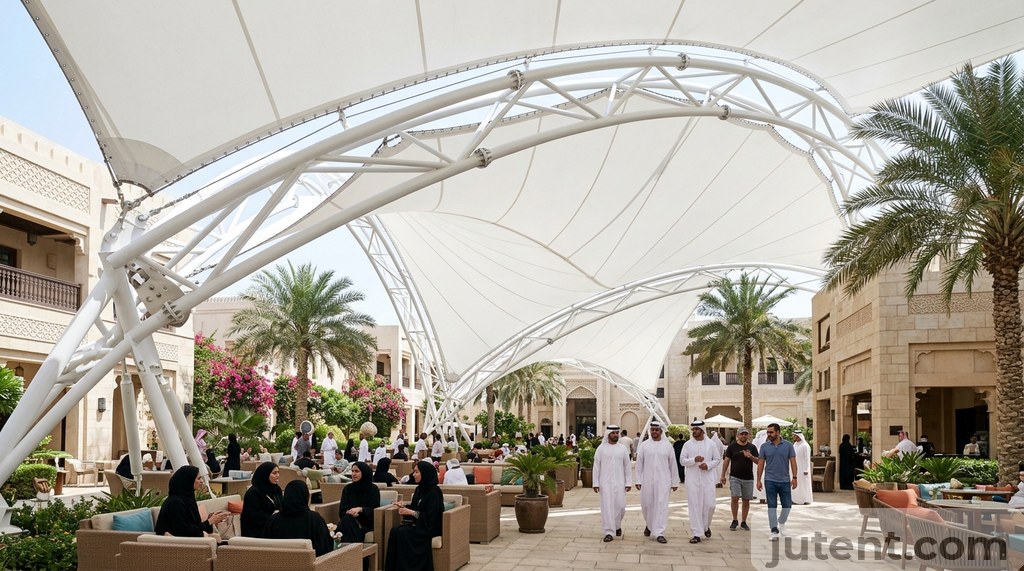
The operating environment in the Gulf Cooperation Council (GCC) dictates structural and material decisions that go far beyond standard shade requirements. When a contractor specifies a Hotel Leisure structure for a luxury resort in Doha or Abu Dhabi, the primary failure mode is rarely mechanical wear—it is severe thermal degradation.
Standard 700g/㎡ to 900g/㎡ PVC membranes, which perform perfectly well in temperate climates, fail rapidly in the Gulf. At 45°C ambient temperatures, the plasticizers in lower-grade PVC migrate to the surface. Within 24 to 36 months, the membrane becomes brittle, loses its self-cleaning properties, and begins to discolor from accumulated dust and sand. The extreme diurnal temperature shift—dropping from 45°C during the day to 25°C at night—causes constant expansion and contraction. If the steel frame and tensioning hardware are not engineered for this daily thermal cycling, the membrane loses its pre-stress, leading to dangerous ponding during rare but intense winter rainstorms.
As especificações típicas utilizam aço Q235B ou Q355B, membrana de PVDF ou PTFE de 1050 g/m² como padrão e acessórios de aço inoxidável SS304, com graus superiores disponíveis quando o projeto os exige.
Proteção UV e Térmica: Grau de Membrana para Projetos no Golfo
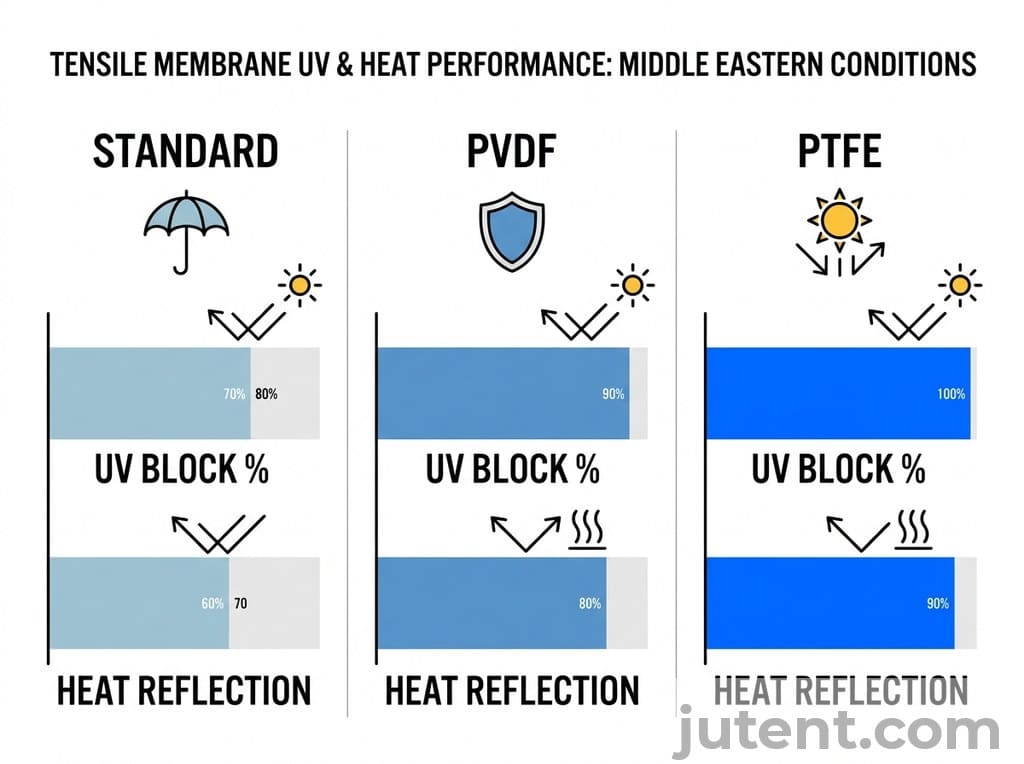
A proteção contra corrosão e a vida útil devem ser descritas de acordo com o sistema de proteção selecionado, o ambiente do projeto e as condições de manutenção, e não como uma garantia incondicional de vida útil.
O planejamento orçamentário deve ser baseado no tipo de estrutura, vão livre, classificação de vento, grau da membrana, tonelagem de aço e escopo do projeto. Para uma cotação precisa de EXW, FOB, CIP ou DDU, as dimensões do projeto e os requisitos de engenharia devem ser revisados primeiro.
For detailed structural sizing and material comparisons, contractors should consult our Hotel Tensile Canopy Guide. The membrane specification must also mandate a highly reflective white finish to minimize solar heat gain. Premium PVDF membranes reflect up to 73% of solar energy. This thermal rejection lowers the ambient temperature in the shaded zone below, a baseline requirement for guest comfort in luxury hospitality settings.
Carga de Vento: Padrões dos Emirados Árabes Unidos e da Arábia Saudita
While extreme heat is the primary driver of material degradation, wind dictates the steel tonnage and foundation sizing. A hotel tensile canopy Saudi Arabia or UAE project must comply with strict local municipal codes, which have become increasingly rigorous regarding open-sided structures.
A experiência da empresa deve ser descrita por meio de experiência de exportação verificada e capacidade de suporte ao projeto, em vez de anedotas de projeto não fundamentadas.
In Saudi Arabia, the Saudi Building Code (SBC 301) governs structural loading. For a resort in Jeddah or the Red Sea development area, wind loads must account for sudden coastal squalls. We frequently see contractors under-specify the base plate thickness and anchor bolt embedment depth during the initial tender phase. A standard 400-square-meter conical canopy in these high-wind zones typically requires 25mm to 30mm thick base plates and M24 or M30 chemical anchors embedded at least 400mm into the reinforced concrete footings to safely resist the massive uplift generated by the membrane's aerodynamic profile.
Referência de Caso: Projetos na Região do Golfo
Across 420+ projects globally, including extensive work in extreme climates, the most common installation error we see in the Middle East is under-tensioning the membrane at the perimeter. Contractors often try to avoid wrinkles rather than achieve the specified pre-stress. In a high-heat environment, an under-tensioned membrane will sag as the material relaxes under the 45°C sun, leading to wind flutter and accelerated mechanical wear at the connection points.
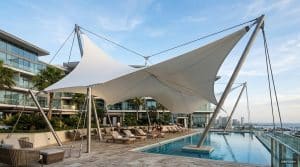
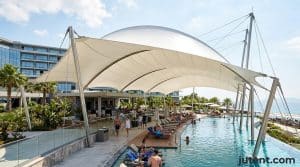
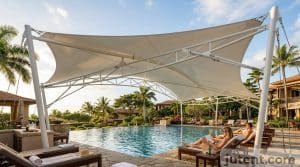
In a recent hospitality project in the region, the client required a 600-square-meter continuous shade structure over a resort pool deck. The architectural brief demanded a clear span with no intermediate columns to maintain unobstructed sightlines to the beach. This configuration required a cable-braced primary system rather than a standard portal frame. We specified 250mm diameter CHS (Circular Hollow Section) primary masts with a 12mm wall thickness, paired with a 1050g/㎡ PVDF membrane. By catching the wind load requirements at the design stage and engineering the connection plates for a 160 km/h wind rating, we saved the contractor a complete re-engineering cycle after the initial permit submission. The structure was fabricated, shipped, and erected exactly to the approved shop drawings. Providing the complete kit with numbered components and a step-by-step installation manual ensured the local site team could assemble the complex geometry without requiring specialized welding on site.
Se você está analisando opções técnicas, pergunte à nossa equipe pela ficha técnica mais recente e detalhes padrão dos materiais para este tipo de estrutura.
FAQ
- What membrane grade is recommended for a hotel tensile canopy in the UAE?
- For a hotel tensile canopy in the UAE, a high-performance membrane grade specifically engineered for extreme heat and intense UV radiation is essential. While the final technical values must always be confirmed against project-specific engineering requirements and local code conditions, typically, a Type IV or V PVC-coated polyester or PTFE-coated fiberglass membrane would be considered. These grades offer superior longevity, UV resistance, and thermal performance critical for the Middle Eastern climate, ensuring the canopy maintains its structural integrity and aesthetic appeal over its service life.
- Do hotel tensile canopy structures in Saudi Arabia need to meet specific building codes?
- Yes, hotel tensile canopy structures in Saudi Arabia must comply with the Saudi Building Code (SBC). Specifically, SBC Chapter 7 addresses wind loads, which are a critical consideration for tensile structures in the region's climate. Project specifications for these canopies should always reference the applicable SBC chapters to ensure structural integrity and regulatory compliance, impacting design, material selection, and installation methods.
Se você está analisando opções técnicas, pergunte à nossa equipe pela ficha técnica mais recente e detalhes padrão dos materiais para este tipo de estrutura.
 English
  Français
  Español de México
  Bahasa Melayu
  Tiếng Việt
  Português do Brasil
  Русский
  ไทย
ไทย  العربية