

O planejamento orçamentário deve ser baseado no tipo de estrutura, vão livre, classificação de vento, grau da membrana, tonelagem de aço e escopo do projeto. Para uma cotação precisa de EXW, FOB, CIP ou DDU, as dimensões do projeto e os requisitos de engenharia devem ser revisados primeiro.
The 5 Factors That Drive Tensile Carport Cost
Five variables dictate the final price of a tensile structure for vehicle protection. The primary driver is structural steel weight, followed closely by membrane specification and site-specific engineering requirements.
Os valores técnicos finais devem ser confirmados de acordo com os requisitos de engenharia específicos do projeto e as condições do código local.
2. Grau da Membrana: The canopy material determines both upfront price and design life. Heavy-duty architectural fabrics cost significantly more per square metre than standard commercial shade mesh, impacting the overall budget.
3. Economia de Escala: Multi-bay commercial Carports share intermediate columns. This structural efficiency reduces the per-bay cost compared to standalone single-bay units.
4. Requisitos de Fundação: Soil conditions dictate footing sizes. A standard 800mm × 800mm × 1000mm pad footing is economical, but poor soil bearing capacity (below 100 kPa) requires larger excavations and more concrete, driving up civil works budgets.
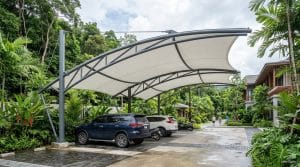
5. Forma Estrutural: Cantilever designs require heavier steel sections and larger moment-resisting base plates to manage the overturning moment, making them 15–25% more expensive than standard four-post portal frames.
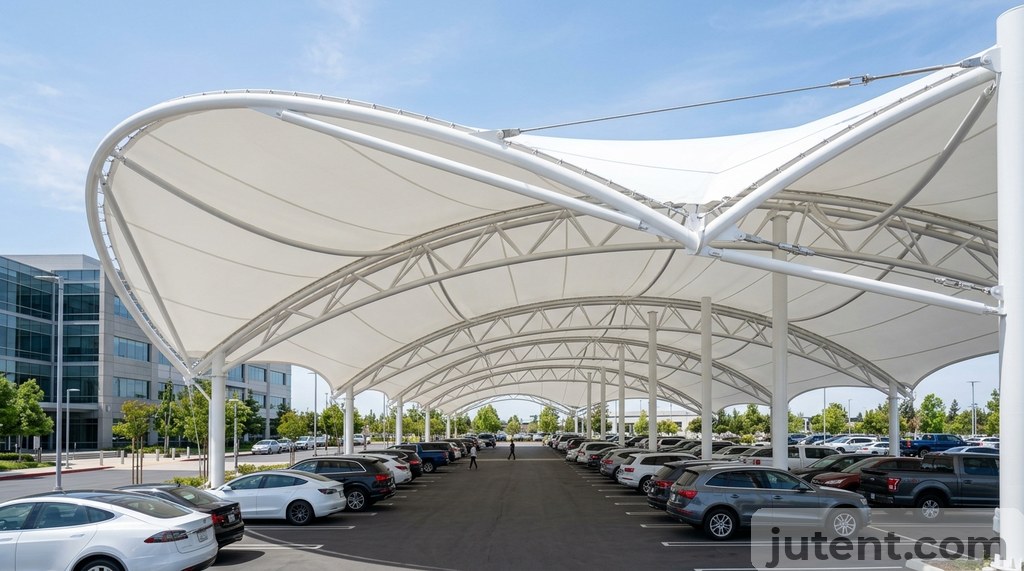
Cost by Scale: Single Bay vs Multi-Bay Commercial Carport
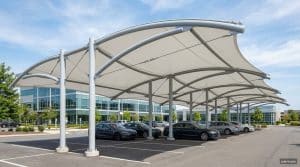
The cost per square metre drops significantly as the project scale increases. This is due to shared structural elements and reduced wastage in membrane patterning during the manufacturing process.
A single-bay residential structure (typically 3m × 5m) requires four independent columns and dedicated footings. The supply cost for this configuration generally sits between $45 and $60 per square metre. The engineering and fabrication overheads are absorbed by a very small footprint, keeping the unit rate high.
Com base na experiência da Jutent em mais de 400 projetos em mais de 30 países, problemas de especificação semelhantes frequentemente aparecem quando suposições de estágio inicial são feitas antes que as condições de engenharia sejam confirmadas.
Cantilever designs amplify this scale difference. A single cantilever bay requires massive rear columns to handle the eccentric load. When linked in a continuous commercial run, the structural framing stabilizes the entire row, optimizing the steel weight per vehicle space. For a deeper technical breakdown of these framing options, review the Estrutura de Carport Tensionado Guide.
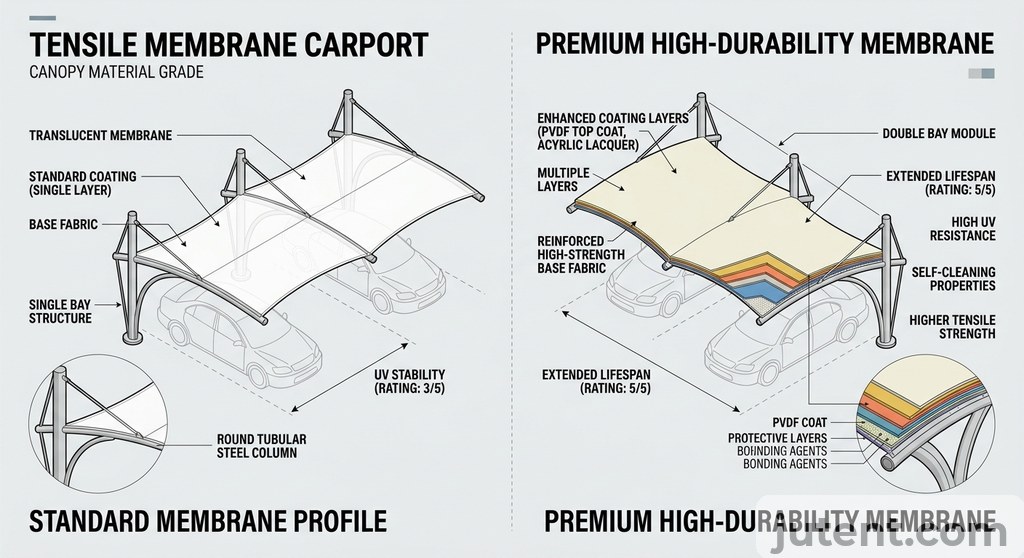
Membrane Grade: How PVDF vs Shade Cloth Affects the Budget
Membrane selection dictates 20–30% of the total cobertura tensionada para estacionamento price. The decision comes down to weather protection requirements, target design life, and the specific climate of the installation site.
High-density polyethylene (HDPE) shade cloth is the most economical option. Weighing between 280g/㎡ and 340g/㎡, it provides 90–95% UV blockage but remains permeable to rain. Structures using HDPE require less steel because the porous fabric allows wind to pass through, reducing uplift forces on the frame. This keeps the overall structural cost low, making it ideal for large-scale commercial lots where complete waterproofing is unnecessary.
PVDF-coated architectural fabric is the standard for 100% waterproof applications. The specification error we see most often in tropical climates is selecting 950g/㎡ PVDF instead of 1050g/㎡ to reduce cost. The price difference is approximately $3–5/㎡. The lifespan difference is 5–8 years. The math does not support the saving.
A proteção contra corrosão e a vida útil devem ser descritas de acordo com o sistema de proteção selecionado, o ambiente do projeto e as condições de manutenção, e não como uma garantia incondicional de vida útil.
Fornecimento Apenas vs Fornecimento e Instalação: Entendendo a Diferença de Preço
Contractors and developers must clearly define their procurement model early in the planning phase, as installation labor and heavy equipment heavily impact the final project budget.
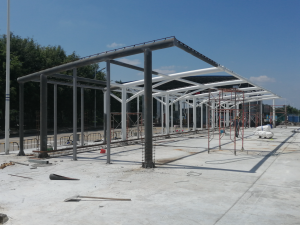
A supply-only contract covers the structural engineering, steel fabrication, membrane patterning, and all connection hardware. The factory ships a complete, ready-to-assemble kit directly to the site. In this model, the carport shade structure cost per sqm strictly reflects materials and manufacturing, typically landing between $20 and $55/m² ex-factory. This is the most economical route for general contractors who already have riggers, lifting equipment, and concrete crews mobilized on site for other civil works.
A supply-and-install contract transfers the site execution risk to a specialized installation team. This scope includes foundation excavation, concrete pouring, steel erection, and the critical membrane tensioning phase. Installation typically adds 40–60% to the base material cost, depending on local labor rates and site access constraints.
Site conditions dictate installation premiums. Erecting a canopy on an open greenfield site requires standard boom lifts and minimal traffic management. Installing the exact same structure on the top deck of an active multi-story parking garage requires specialized crane lifts, night-shift labor, and strict safety cordons, which can easily double the installation budget.
Como Obter um Orçamento Preciso
Vague inquiries yield vague estimates. To lock in a precise tensile carport budget, contractors must provide manufacturers with specific project parameters rather than asking for a generic price per square metre.
First, define the exact dimensions and bay count. A request for a “20-car parking shade” is insufficient, as vehicle spacing varies by region. Specify the required clear span, such as a 5m × 5m grid for double bays, and note the required clearance height (typically 2.5m for standard vehicles or 3.2m for commercial vans).
Second, provide the exact site location. Structural engineers use this to calculate local wind and snow loads. A canopy in a 100km/h inland zone requires vastly different steel sizing than one in a 180km/h coastal hurricane zone.
Third, state your membrane preference. Indicate whether the project requires 100% waterproof PVDF or permeable HDPE shade mesh. If fire compliance is a factor, note the required rating (such as Class 1 under BS 476).
Finally, clarify the structural form. Specify whether the site allows for standard four-post portal frames or if vehicle turning radiuses mandate a cantilever design with rear-only columns. Providing these four data points ensures the initial quote is tender-ready and structurally viable.
Se você deseja uma referência de orçamento precisa para este projeto, compartilhe suas dimensões, zona de vento e tipo de membrana preferido com nossa equipe.
Solicitar um orçamento personalizado
FAQ
- What is the cost per square metre for a tensile carport structure?
- The supply cost for a tensile carport structure typically ranges from $20–$55 per square metre ex-factory. This range is primarily influenced by the complexity of the structural form, such as cantilevers versus standard four-post designs, and the specified membrane grade. Higher-performance membranes, offering extended lifespan or enhanced UV resistance, will be at the upper end of this spectrum, impacting your overall project budget and material specifications.
- What information do I need to get an accurate tensile carport quote?
- To receive an accurate tensile carport quote, please provide the number of bays required and the specific dimensions for each bay, including length, width, and desired height. We also need the project's exact geographical location to calculate applicable wind and snow loads, which significantly impact structural design. Specifying your preferred structural form, such as cantilevered or arch-supported, and your desired membrane grade preference, like a standard architectural fabric or a high-performance PTFE-coated option, will allow us to tailor the quote precisely to your project's needs and budget.
- Does a cantilever design cost more than a standard portal frame carport?
- Yes, a cantilever design typically incurs higher costs. This is due to the inherent structural demands: cantilever structures necessitate heavier primary steel columns and significantly larger moment-resisting concrete footings. These components are essential to effectively counteract the substantial eccentric overturning forces generated by the unsupported span. Consequently, this increased engineering requirement for enhanced structural integrity and foundation work typically elevates the primary structural cost by 15–25% when compared to standard four-post portal frame designs, impacting overall project budgeting.
 English
  Français
  Español de México
  Bahasa Melayu
  Tiếng Việt
  Português do Brasil
  Русский
  ไทย
ไทย  العربية