

O planejamento orçamentário deve ser baseado no tipo de estrutura, vão livre, classificação de vento, grau da membrana, tonelagem de aço e escopo do projeto. Para uma cotação precisa de EXW, FOB, CIP ou DDU, as dimensões do projeto e os requisitos de engenharia devem ser revisados primeiro.
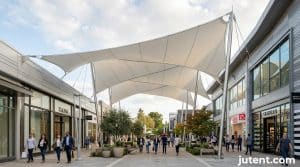
When developers request a covered pedestrian route, initial estimates often fail to account for site-specific engineering loads, material upgrades, or the difference between a simple bolt-down installation and a complex foundation requirement. Getting the numbers right early prevents value-engineering delays later in the project timeline and ensures the final structure meets both aesthetic and functional requirements. This guide breaks down the key cost factors, provides realistic price ranges, and explains exactly what moves the number from the baseline to the premium end of the spectrum, allowing you to establish a reliable cobertura de passarela comercial budget from day one.
The 5 Factors That Drive Retail Walkway Canopy Cost
Five primary variables dictate the final retail walkway canopy price: structural steel weight, membrane grade, foundation requirements, wind load specifications, and installation scope.
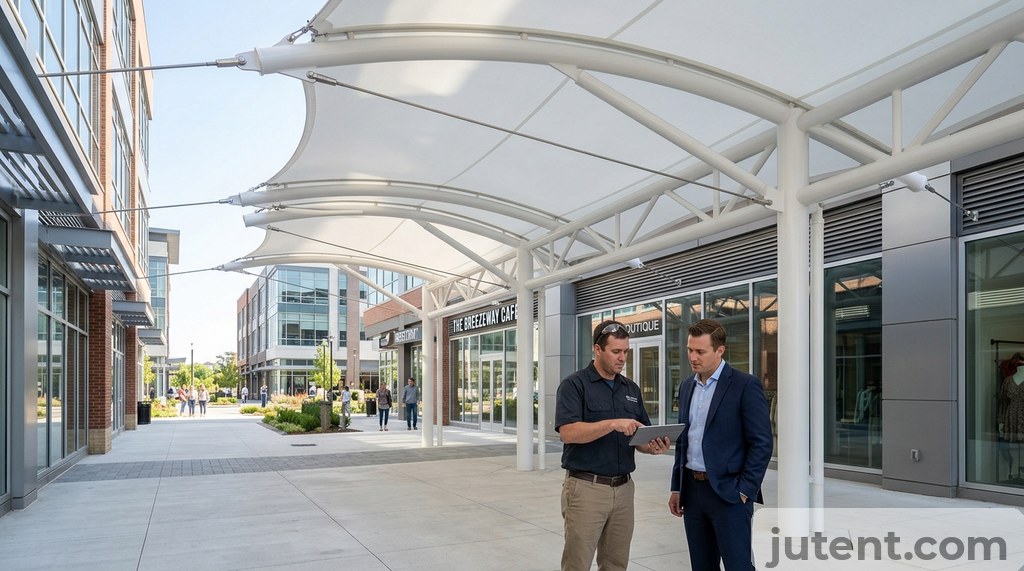
Os valores técnicos finais devem ser confirmados de acordo com os requisitos de engenharia específicos do projeto e as condições do código local.
Membrane selection represents the second largest variable, making up 20–30% of the material cost. Tensioning hardware also plays a role; specifying 316 marine-grade stainless steel edge cables instead of standard galvanized cables increases the hardware budget but prevents rust bleeding over the lifespan of the structure.
Foundation sizing dictates the remaining budget. Contractors specifying Retail Walkways must account for the difference between bolting base plates to an existing reinforced concrete slab versus excavating and pouring new 800mm × 800mm × 1000mm pad footings. Poor soil bearing capacity requires deeper excavation, adding hidden costs before the steel even arrives on site.
Custo por Escala de Projeto: Aplicações Pequenas vs Grandes
Economies of scale heavily influence the commercial retail walkway canopy cost per square metre. Large-scale applications yield a lower unit rate due to optimized steel cutting, continuous membrane patterning, and reduced setup waste in the manufacturing facility.
For a small application—such as a 15m × 3m entrance canopy—the supply cost often sits at the higher end of the $50–$70/m² spectrum. The engineering, detailing, and machine setup time remain fixed regardless of the short span, meaning these overheads are distributed across a much smaller footprint.
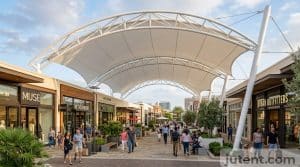
Conversely, a large application—like a 150m × 4m continuous retail promenade—pushes the supply cost closer to the $25–$40/m² baseline. In these projects, standardizing a repeating 5m bay spacing allows for mass production of identical steel trusses and membrane panels. This repetition drastically reduces the engineering cost per square metre and maximizes shipping efficiency, allowing components to pack tightly into a 40ft High Cube container.
As detailed in our Retail Walkway Canopy Guide, developers planning multi-phase retail parks should procure the canopy package as a single contract. Splitting a 200m walkway into four separate 50m orders typically increases the total material and shipping budget by 12–18% due to redundant setup phases.
Grau da Membrana: Como a Escolha do Material Afeta o Orçamento
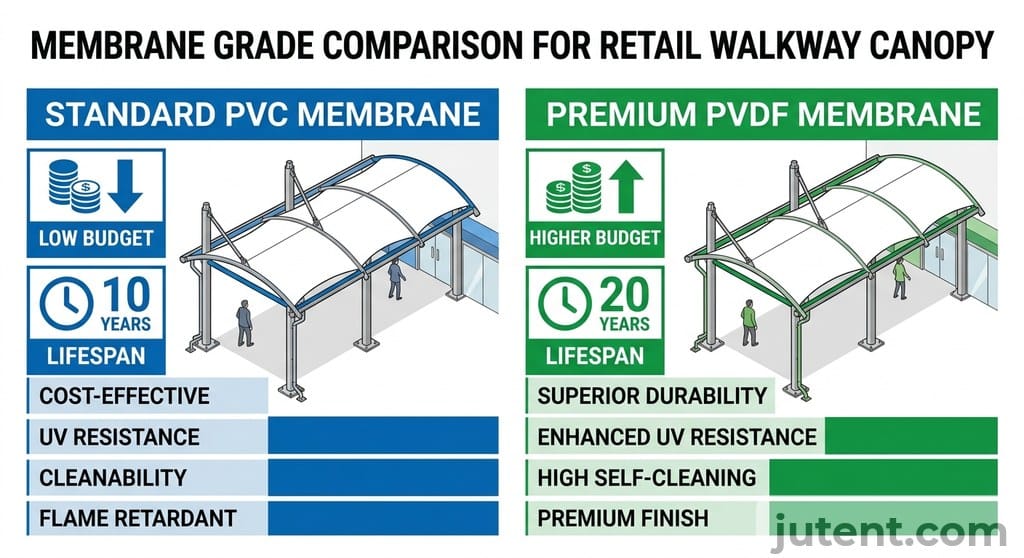
Membrane specification directly dictates both the initial retail walkway canopy budget and the long-term maintenance cycle. The decision comes down to weight, surface coating, and required design life.
A standard 750g/㎡ PVDF-coated membrane is the baseline for commercial walkways, offering a 10–12 year lifespan and keeping the initial cost low. However, specifying a heavier 1050g/㎡ PVDF membrane increases the fabric cost by approximately $3–$5/m² while extending the lifespan to 15–20 years. The thicker fluorocarbon surface layer also provides superior self-cleaning properties, reducing annual maintenance costs.
Com base na experiência da Jutent em mais de 400 projetos em mais de 30 países, problemas de especificação semelhantes frequentemente aparecem quando suposições de estágio inicial são feitas antes que as condições de engenharia sejam confirmadas.
For premium retail environments requiring a Class 1 fire rating or a 25+ year design life without replacement, PTFE is the required specification. This material upgrade typically doubles the membrane portion of the budget and requires specialized handling during installation to prevent creasing the fiberglass base cloth. PTFE also demands heavier tensioning hardware, marginally increasing the steel budget.
Fornecimento Apenas vs Fornecimento e Instalação: Entendendo a Diferença de Preço
Contractors must clearly define the procurement scope early, as the difference between a supply-only kit and a full supply-and-install contract drastically alters the final retail walkway canopy price.
A supply-only contract covers the engineering, fabrication, and delivery of the primary steel, tensioning hardware, and membrane. This typically costs $25–$70/m² ex-factory. The contractor assumes responsibility for site preparation, foundation pouring, steel erection, and membrane tensioning. This route is highly cost-effective for main contractors who already have riggers, lifting equipment, and site management in place.
A supply-and-install contract shifts the erection risk to the canopy specialist. This adds labor, travel, equipment hire (such as a 20-ton crane or scissor lifts), and site management fees to the budget. Installation typically adds $30–$60/m² to the project. Working in operational retail environments further increases this cost, as night shifts and phased cordons reduce daily productivity.
O sistema pré-fabricado é projetado para simplificar a montagem no local, e a Jutent pode fornecer desenhos, manuais e orientação remota gratuita de instalação. Para projetos mais complexos, instaladores experientes ou suporte de supervisão no local podem ser providenciados mediante solicitação.
Como Obter um Orçamento Preciso
To move from a rough budget to a fixed manufacturing price, contractors must provide four specific data points to the engineering team. Vague requests yield padded quotes; precise data yields optimized pricing.
First, provide the exact dimensions: total length, width, and required clearance height. A 3m clearance height requires significantly less steel column mass than a 4.5m clearance designed to accommodate delivery vehicles or emergency access.
Para projetos de exportação em regiões de alto vento ou alta exposição, a estrutura deve ser projetada de acordo com o código local aplicável e verificada quanto às condições de carregamento específicas do projeto.
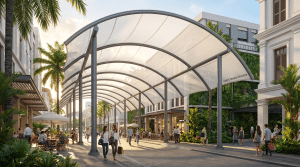
Third, define the preferred structural form. A cantilevered walkway requires heavier base plates and larger foundations to resist overturning moments compared to a symmetrical double-column barrel vault. Providing a preliminary soil report also prevents foundation cost surprises.
specify the membrane grade preference (e.g., 1050g/㎡ PVDF) and the required steel finish (hot-dip galvanized or epoxy painted).
Se você deseja uma referência de orçamento precisa para este projeto, compartilhe suas dimensões, zona de vento e tipo de membrana preferido com nossa equipe.
Solicitar um orçamento personalizado
FAQ
- What is the cost per square metre for a retail walkway canopy?
- Supply cost typically ranges from $25–$70/m² ex-factory, depending on structural form and membrane grade. This figure covers the engineering, fabrication, and delivery of the primary steel, tensioning hardware, and membrane, with the contractor managing site erection. Factors such as the chosen structural form, like a cantilevered design versus a symmetrical barrel vault, and the required clearance height significantly influence the steel mass and thus the cost. Membrane grade also plays a crucial role; for instance, a 1050g/㎡ PVDF membrane adds $3–$5/m² compared to a 750g/㎡ baseline, while PTFE can double the membrane budget for premium applications.
- What information do I need to get an accurate retail walkway canopy quote?
- Project dimensions, location (for wind load), preferred structural form, and membrane grade preference are essential for an accurate quotation. Providing exact dimensions, including total length, width, and required clearance height, directly impacts the necessary steel mass. The precise project location is critical for calculating local wind and snow load requirements, which dictates structural member sizing and foundation design. Defining the preferred structural form, such as a cantilevered or barrel vault design, influences foundation requirements and steel specifications. Finally, specifying the membrane grade (e.g., 1050g/㎡ PVDF) and desired steel finish ensures the initial quote is accurate to within 5% of the final manufacturing cost, preventing budget overruns.
 English
  Français
  Español de México
  Bahasa Melayu
  Tiếng Việt
  Português do Brasil
  Русский
  ไทย
ไทย  العربية