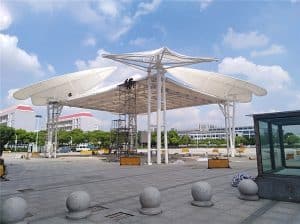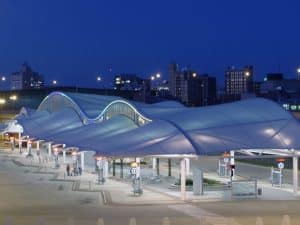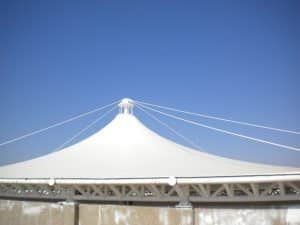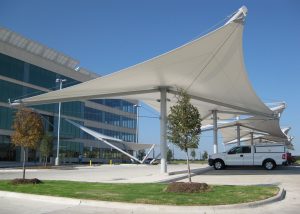


Selecting a roofing system for stadium stands requires careful consideration of structural performance, load resistance, and long-term durability. Tensile structure stadium stands are engineered systems that combine membrane mechanics with steel substructures to achieve large-span coverage while maintaining a lightweight profile.
At Jutent, tensile membrane roofs for stadium stands are designed based on project-specific load conditions, seating geometry, and local climate requirements.
Key Technical Takeaways:
- Large-span coverage achieved through membrane pre-tension and cable force equilibrium
- Lightweight roofing system reducing dead load on grandstand substructures
- Designed to meet wind and snow load requirements under international standards
- Flexible architectural forms enabled by anticlastic and synclastic membrane geometry
Structural Concept of Tensile Stadium Stands
A tensile structure stadium stand typically consists of a pre-stressed membrane surface supported by steel arches, edge beams, and tensioned cable systems. Structural stability is achieved through force equilibrium, where membrane tension, cable forces, and support reactions counteract external loads.
Unlike rigid roof systems, tensile structures rely on double-curved surfaces to maintain geometric stiffness and prevent deformation under variable loading conditions.
Membrane Geometry and Form-Finding Principles
The architectural form of a tensile roof is not purely aesthetic—it is the result of a form-finding process. Common membrane geometries used in stadium stands include:
- Anticlastic surfaces, where curvatures in two directions are opposite, providing high structural stability
- Hypar (hyperbolic paraboloid) forms, widely applied due to efficient stress distribution
- Radial cable-supported membranes, suitable for curved grandstand layouts
These geometries enhance load transfer efficiency and reduce stress concentration across the membrane surface.
Wind Load Performance in Stadium Environments
Wind load is often the governing design factor for tensile stadium roofs due to their lightweight nature. Design wind pressure is calculated according to local codes such as EN 1991-1-4 or ASCE 7, with typical design wind speeds ranging from 30–45 m/s depending on geographic location.
Key wind-related design considerations include:
- Uplift forces on membrane edges
- Aerodynamic stability at roof corners
- Dynamic response under fluctuating wind pressure
Proper edge detailing and cable anchorage are critical to maintaining membrane stability under extreme wind events.
Snow Load Considerations for Tensile Membrane Roofs
In cold or high-altitude regions, snow load plays a significant role in structural design. Tensile structures are typically designed with a minimum roof slope to promote snow shedding and prevent accumulation.
Typical design snow loads range from 0.5 to 1.5 kN/m², depending on regional climate data. The membrane pre-tension level is carefully calibrated to limit excessive deflection while avoiding overstressing under combined snow and wind conditions.
Material Selection and Long-Term Performance
Membrane material selection directly affects structural behavior, durability, and long-term service performance of tensile structure systems. Different membrane materials exhibit distinct mechanical properties, fire ratings, and environmental resistance, making material selection a critical engineering decision.
| Membrane Material | Typical Tensile Strength | Fire Performance | Design Service Life | Key Characteristics |
|---|---|---|---|---|
| PVC-coated Polyester Fabric | 3,000 – 5,000 N / 5 cm | Flame-retardant (B1 / NFPA 701) | 15 – 20 years | Flexible, cost-efficient, suitable for most standard stadium applications |
| PTFE-coated Fiberglass Fabric | 5,000 – 8,000 N / 5 cm | Non-combustible (A2 / ASTM E84) | 20 – 25+ years | High strength, excellent fire resistance, minimal aging and long-term stability |
Under typical design conditions, the service life of tensile membrane systems ranges from 15 to 25 years, depending on material selection, environmental exposure (UV, humidity, pollution), and maintenance strategy. Proper material choice combined with correct pre-tension levels significantly improves long-term structural reliability.
Installation and Tensioning Control
From an engineering perspective, installation quality has a direct impact on membrane performance. Membrane panels are tensioned according to predefined stress values to achieve the intended structural form.
Common on-site issue: Non-uniform tensioning can result in localized stress concentration, accelerating material fatigue and reducing overall lifespan. Controlled tensioning procedures and real-time measurement are essential during installation.
Application Scope Beyond Stadium Stands
While stadium seating roofs remain a primary application, the same engineering principles are applied to:
- Sports arenas and multi-purpose halls
- Transportation hubs and public concourses
- Parking shade and large-span canopies
Each project requires tailored load analysis and form-finding to suit its functional and environmental conditions.
Engineering-Focused Conclusion
Tensile structure stadium stands are highly engineered roofing systems. Through proper form-finding, load analysis, and material selection, tensile membrane roofs deliver reliable performance under wind and snow loads while maintaining a lightweight and expressive architectural form.
For stadium projects seeking efficient large-span solutions, tensile structures offer a technically sound and visually refined approach.