

Engineering a durable outdoor stage canopy Middle East contractors can rely on requires an entirely different baseline for structural survival. These performance structures face ambient temperatures exceeding 45°C (with membrane surface temperatures surpassing 70°C), UV indices regularly hitting 12+, and abrasive, sand-laden shamal winds. Consequently, standard Eurocode or IBC specifications routinely fail in this region within three years due to premature membrane degradation and structural fatigue.
Specifying a performance venue for the Gulf involves critical environmental adaptations that are frequently underestimated during the initial design phase. To ensure structural integrity and membrane longevity across the UAE, Saudi Arabia, and Qatar, engineers must deviate from standard codes. This guide details the exact engineering parameters required for high-heat thermal expansion tolerances, advanced PTFE and PVC surface treatments, sand-shedding geometry, and localized wind load compliance—providing the precise data needed to finalize specifications before going to tender and avoid costly rework.
Gulf Climate: Why Standard Stage Canopy Specs Don't Apply
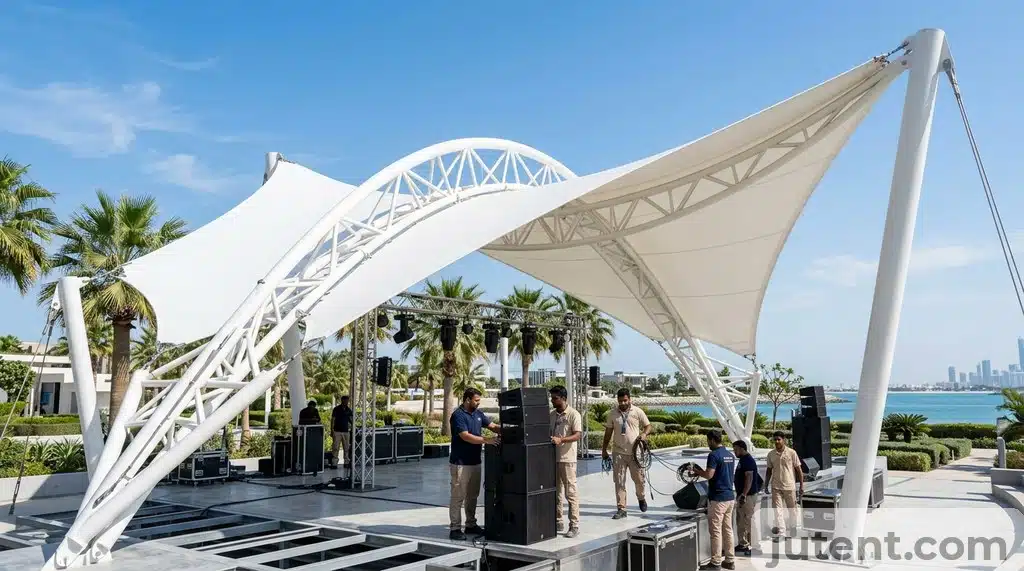
Standard off-the-shelf stage covers degrade rapidly in the Gulf. The primary failure points are thermal degradation of the membrane plasticizers and abrasive wear from wind-blown sand. A standard 650g/㎡ PVC membrane, which might last 10 years in a temperate climate, typically loses its tensile strength within 36 months in Dubai or Riyadh.
Contractors must shift their specification baseline. The structural frame must account for high thermal expansion, while the membrane requires specific surface treatments to resist UV breakdown and dust adhesion. When specifying an Stage Covers, the baseline requirement shifts from basic weather protection to extreme environmental isolation.
Thermal loads also impact the primary rigging points. Steel trusses exposed to 50°C direct sunlight experience significant thermal expansion. If the membrane is detailed with zero tolerance, this expansion transfers excessive stress directly to the fabric seams, leading to micro-tears and eventual failure. Engineering for the Middle East requires detailing slip joints or adjustable tensioning systems that accommodate a ±15mm thermal movement across a standard 20m span. Ignoring these thermal dynamics during the drafting phase guarantees high maintenance costs and premature structural fatigue. The structural detailing must prioritize flexibility without compromising the overall system rigidity required for rigging lighting and audio equipment.

UV and Heat Resistance: Membrane Grade for Middle East Stage Projects

A heat resistant stage canopy in this region requires a high-grade PVDF membrane, minimum 1050g/㎡. Lower grades absorb UV radiation, causing the plasticizers to migrate to the surface, which leads to embrittlement, discoloration, and structural weakening.
The fluorocarbon surface layer of a premium PVDF membrane reflects UV radiation rather than absorbing it. At UV Index 12, common in the Gulf summer, a 1050g/㎡ PVDF membrane maintains its tensile strength within 10% of its original specification after 15 years. This is the minimum acceptable standard for permanent or semi-permanent performance venues.
For projects requiring maximum thermal reflection, specifying a highly opaque white membrane with a block-out layer reduces the radiant heat transfer to the stage deck below. This lowers the ambient temperature for performers and sensitive AV equipment by up to 8°C compared to standard translucent fabrics. For further details on material selection, refer to our Outdoor Stage Canopy Guide. The specification must explicitly state the requirement for a weldable PVDF top coat to ensure seam strength under constant 40°C+ thermal loads, preventing the delamination that plagues cheaper alternatives. Contractors should reject any material submittal that does not provide independent laboratory testing for UV degradation specific to desert climates.
Sand and Dust: Drainage and Surface Requirements
Sand accumulation acts as a structural dead load, not just an aesthetic defect. An outdoor stage canopy in the Middle East must be engineered to prevent sand ponding. Fine desert dust mixed with occasional winter rain creates a dense mud that exceeds 20kg/㎡ in localized pockets if the geometry allows settling. To prevent this, the membrane must maintain a minimum slope of 15 degrees across all surface areas. Flat or low-pitch designs fail in the Gulf. High-tension anticlastic (saddle) shapes are standard because they force wind to scour the surface clean, utilizing natural airflow to remove dust.

The membrane surface treatment dictates how easily sand adheres. Standard acrylic lacquers become sticky under high heat, trapping dust permanently. A high-grade PVDF topcoat remains hard and slick even at 50°C, allowing wind and rain to wash the surface. Gutter systems must be oversized—typically a 150mm minimum diameter—and designed without 90-degree bends to prevent blockages from compacted sand. Maintenance schedules must mandate quarterly inspections of these drainage points to ensure continuous water flow during sudden winter downpours. Failing to account for this dead load during initial engineering causes membrane sagging and eventual tearing.
Wind Load: Saudi and UAE Standards for Stage Structures
Wind loads dictate the primary steel sizing for any stage cover Saudi Arabia or the UAE. The Saudi Building Code (SBC 301) and the UAE Fire and Life Safety Code of Practice require specific wind load calculations based on the exact site topography and exposure category.
Company experience should be described through verified export experience and project support capability rather than unsupported project anecdotes.
Company experience should be described through verified export experience and project support capability rather than unsupported project anecdotes.
Case Reference: Stage Canopy Projects in the Gulf Region

Based on Jutent's experience across 400+ projects in 30+ countries, similar specification issues often appear when early-stage assumptions are made before the engineering conditions are confirmed.
For a recent stage tensile membrane Middle East project, the client required a 25m × 15m clear span over an amphitheater with no intermediate columns. The site's wind zone required a 180 km/h design load. That combination of span and wind rating pushed the specification toward a tensile membrane structure with a cable-braced primary system rather than a standard portal frame.
Company experience should be described through verified export experience and project support capability rather than unsupported project anecdotes.
If you want an accurate budget reference for this project, share your dimensions, wind zone, and preferred membrane type with our team.
Get Your Desert Stage Canopy Quote
FAQ
- What membrane grade is recommended for an outdoor stage canopy in the UAE?
- For outdoor stage canopies in the UAE, a high-grade PVDF membrane, specifically an architectural grade with a weight of 1050 g/m², is the recommended standard. This specification ensures superior resistance to extreme heat, intense UV radiation, and abrasive sand loads prevalent in the region. This material choice provides the necessary durability and longevity for demanding public performance venues, minimizing maintenance and maximizing the lifespan of the structure.
- Do stage canopies in Saudi Arabia need to meet specific building codes?
- Yes, stage canopies in Saudi Arabia must comply with the Saudi Building Code (SBC). Specifically, SBC Chapter 7 addresses wind loads, which are critical for tensile membrane structures exposed to the region's strong winds. Project specifications will require calculations demonstrating compliance with these wind load provisions, often necessitating detailed structural analysis and engineering stamps. Furthermore, other relevant SBC chapters might apply depending on the canopy's integration with permanent structures or its intended use, impacting material fire ratings and egress requirements.


