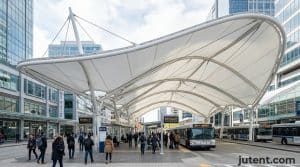

Pricing should be reviewed by product category and project scope rather than treated as a fixed published number. For an accurate quotation, the structure size, wind rating, membrane grade, and delivery terms should be confirmed first.
This guide breaks down the primary cost drivers, structural choices, and procurement methods so contractors and transit authorities can build a realistic transit terminal canopy budget before going to tender. Whether you are pricing a single suburban stop or a central transit hub, understanding the cost per square metre and the impact of structural form is the only way to avoid specification errors and budget blowouts. We will examine the exact variables that dictate pricing, from steel tonnage and wind loads to membrane grades and installation scopes. Getting these details right at the feasibility stage prevents costly redesigns, eliminates tender ambiguities, and ensures the final structure meets both municipal safety codes and long-term maintenance expectations.
The 5 Factors That Drive Bus Station Canopy Cost
Five primary variables dictate the final transit canopy price: scale, structural form, membrane grade, wind load requirements, and site constraints. Scale and structural form establish the baseline cost. A single-bay cantilevered structure requires less total steel than a multi-bay clear-span terminal, but demands heavier base plates.
The final technical values should be confirmed against the project-specific engineering requirements and local code conditions.
Finally, site constraints dictate installation complexity. Night-shift installations over active bus lanes carry a 20–30% labor premium compared to greenfield sites.
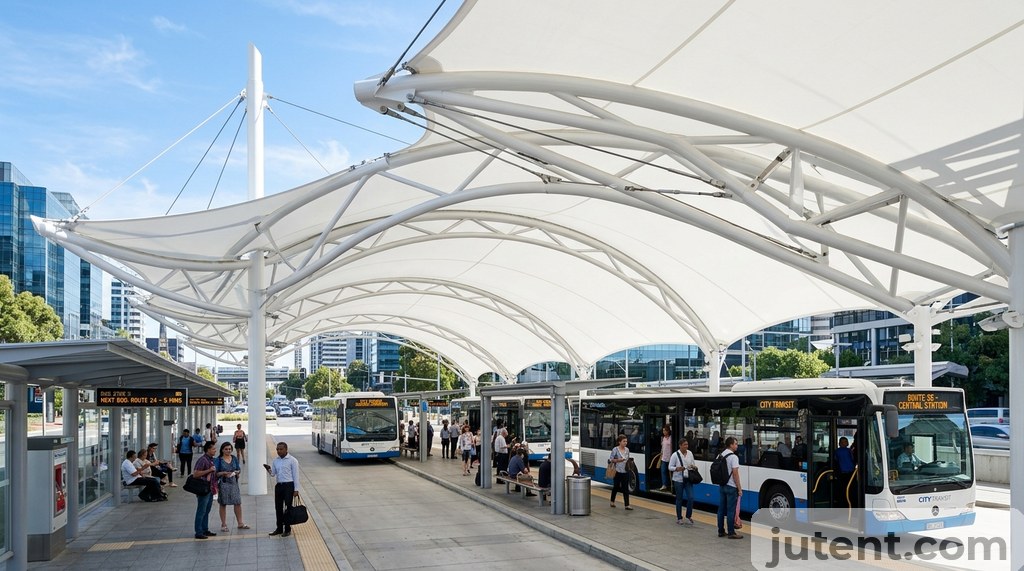
Contractors specifying Transit Canopies must lock in these five variables early. Leaving wind load or membrane grade undefined guarantees a high variance in supplier quotes. A quote based on 650g/㎡ fabric and 100km/h wind loads will look artificially cheap until the municipal engineer rejects the structural calculations.
Cost by Scale: Small Bus Stop vs Large Transit Terminal
Scale is the most obvious budget driver, but the cost per square metre does not scale linearly. Small bus stops carry a higher per-square-metre rate due to fixed engineering and mobilization costs, while large transit terminals benefit from economies of scale in steel fabrication and membrane patterning.
A standard two-bay suburban bus stop covering approximately 30 square metres typically ranges from $600 to $850 per square metre, supply and install. The engineering overhead is distributed across a very small footprint. Conversely, a 500-square-metre central transit terminal drops the rate to $350–$550 per square metre. The total steel tonnage increases, but the fixed design, drafting, and mobilization costs are diluted across a much larger area.
Clearance height also alters the scale equation. A standard 3.2m clearance for single-decker buses requires standard column profiles. Increasing the clearance to 5.5m to accommodate double-decker buses exponentially increases the overturning moment at the base. This requires larger concrete footings and heavier base plates. Shifting from a 3.2m to a 5.5m clearance can increase the required footing depth from 1.2m to over 2.0m. For a complete breakdown of sizing logic, consult our Bus Station Canopy Guide.
Structural Form: How Tensile vs Hip Roof Affects the Budget
Tensile membrane structures generally offer a 15–25% cost advantage over traditional steel-clad hip roofs for transit applications, primarily due to reduced steel tonnage and faster installation.
A traditional hip roof requires a dense grid of purlins and rafters to support rigid metal decking. This increases the dead load, requiring heavier primary columns and larger concrete footings. A tensile membrane structure uses a high-strength architectural fabric tensioned across a minimal steel frame. The membrane itself weighs only 1.05kg/㎡ to 1.3kg/㎡, drastically reducing the dead load on the primary steelwork.
The structural form also dictates the lighting and drainage budget. Tensile membranes offer 10–15% light transmission, reducing daytime artificial lighting requirements and lowering ongoing electrical costs. For drainage, a barrel vault or hypar (hyperbolic paraboloid) tensile form naturally directs water to perimeter columns. This eliminates the need for complex internal gutter systems required by flat or low-pitch rigid roofs.
When evaluating the transit hub canopy cost, contractors must compare the total installed weight. A tensile structure weighing 25kg of steel per square metre will always cost less to freight and erect than a rigid roof requiring 45kg per square metre.
Supply-Only vs Supply-and-Install: Understanding the Price Difference
Procurement strategy dictates whether you pay a premium for risk transfer. Supply-only contracts are highly cost-effective for experienced civil contractors, while supply-and-install contracts carry a 30–50% premium to cover site labor, equipment hire, and weather risk.
In a supply-only arrangement, the manufacturer provides the engineered steel frame, tensioned membrane, cables, and hardware ex-factory. The bus station shade cost per sqm drops significantly—typically to $35–$85/m² for the materials alone. The contractor absorbs the installation risk and manages the site works.
Based on Jutent’s experience across 400+ projects in 30+ countries, similar specification issues often appear when early-stage assumptions are made before the engineering conditions are confirmed.
To mitigate this, reputable manufacturers provide pre-cut, pre-drilled kits with numbered components and step-by-step tensioning manuals. If your site team has experience with rigging or structural steel, a supply-only kit with detailed documentation is the most effective way to protect your project margin.
How to Get an Accurate Quote
Requesting a quote with vague dimensions guarantees a heavily padded price. To get an accurate, tender-ready figure, contractors must provide manufacturers with five specific data points to eliminate engineering assumptions.
First, provide exact dimensions: length, width, and required clearance height. A 4.5m clearance for standard transit requires vastly different engineering than a 5.5m clearance for double-decker routes. Second, specify the location. The manufacturer needs the exact city to calculate the basic wind speed and snow load according to local building codes.
A 1050 g/㎡ PVDF membrane is commonly specified as a standard option, with a 10-year warranty and a typical service life of 15+ years under proper project design, fabrication, and maintenance conditions.
Finally, clarify the scope. State explicitly whether you require a supply-only kit delivered to the port, or a full supply-and-install package. In a recent transit hub project, catching the clearance requirement early—shifting from 3.2m to 5.5m—saved the contractor a complete re-engineering of the base plates after permit submission. Providing exact parameters eliminates guesswork.
If you want an accurate budget reference for this project, share your dimensions, wind zone, and preferred membrane type with our team.
FAQ
- What is the cost per square metre for a bus station canopy?
- The supply cost for a tensile membrane bus station canopy typically ranges from $35–$85 per square metre ex-factory. This range accounts for variations in the structural form, such as cantilevered or arch-supported designs, and the specific grade of architectural membrane chosen. Factors like UV resistance, translucency, fire rating, and expected lifespan significantly influence the membrane material cost, directly impacting the overall ex-factory price for contractors and project managers.
- What information do I need to get an accurate bus station canopy quote?
- To receive an accurate quote for your bus station canopy, please provide the precise station dimensions, including length, width, and height requirements. Specify the desired number of bays or modules, as this impacts material quantities and structural complexity. The project’s geographic location is crucial for calculating appropriate wind and snow load requirements, ensuring structural integrity. Indicate your preferred structural form (e.g., conic, barrel vault, hypar) and any specific aesthetic preferences. Finally, detail your membrane grade preference, considering factors like lifespan, translucency, and fire rating, as these significantly influence material costs.
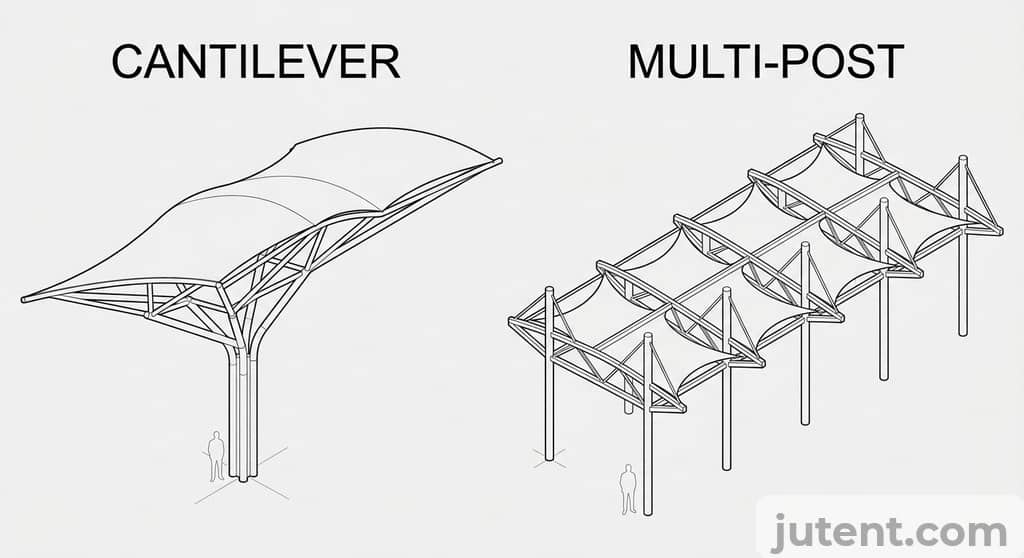
- Why do cantilevered bus shelters cost more than four-post designs?
- Cantilevered structures keep the boarding platform clear of obstacles, which is ideal for passenger flow and ADA compliance. However, supporting the entire roof from a single line of rear columns creates a massive overturning moment. This requires significantly heavier steel profiles for the uprights—often exceeding 200×200×8mm SHS—and much larger concrete footings to resist wind uplift, increasing both material and civil works costs.