
Pricing should be reviewed by product category and project scope rather than treated as a fixed published number. For an accurate quotation, the structure size, wind rating, membrane grade, and delivery terms should be confirmed first.
The 5 Factors That Drive Loading Dock Canopy Cost
The final loading dock canopy price is determined by five primary variables: structural span, wind and snow load requirements, membrane grade, foundation complexity, and supply scope.
The final technical values should be confirmed against the project-specific engineering requirements and local code conditions.
Membrane selection alters the price per square metre based on lifespan and coating technology. Foundation complexity scales with the structural loads; poor soil conditions or high uplift forces require larger concrete footings, adding to the civil works budget. Finally, the procurement model—whether you source a complete kit or require full installation—shifts the commercial loading dock canopy cost significantly.
For contractors evaluating Loading Docks, isolating these five variables is the first step toward an accurate budget. Ignoring any of these factors during the initial estimation phase guarantees a discrepancy between the preliminary budget and the final manufactured cost.
Cost by Project Scale: Small vs Large Applications
Economies of scale heavily influence the loading dock canopy cost per sqm. Large logistics centres yield a lower unit rate than single-bay retail docks because fixed engineering costs are amortized over a larger footprint.
For a small application—typically covering 1 to 3 bays with a footprint under 150m²—the supply cost often sits at the higher end of the spectrum, around $50 to $70/m². The engineering, detailing, and machine setup costs are distributed over a smaller area. A standard 10m × 5m canopy requires the same baseline structural calculations and drafting time as a massive facility.
Budget planning should be based on structure type, clear span, wind rating, membrane grade, steel tonnage, and project scope. For an accurate EXW, FOB, CIP, or DDU quotation, the project dimensions and engineering requirements should be reviewed first.
Based on Jutent’s experience across 400+ projects in 30+ countries, we consistently see contractors overestimating the steel requirements for continuous multi-bay canopies. By sharing intermediate columns between bays rather than building isolated frames, the total steel tonnage drops by up to 22%.
Consult our Loading Dock Canopy Guide to see how bay spacing impacts the structural grid.
Membrane Grade: How Material Choice Affects the Budget
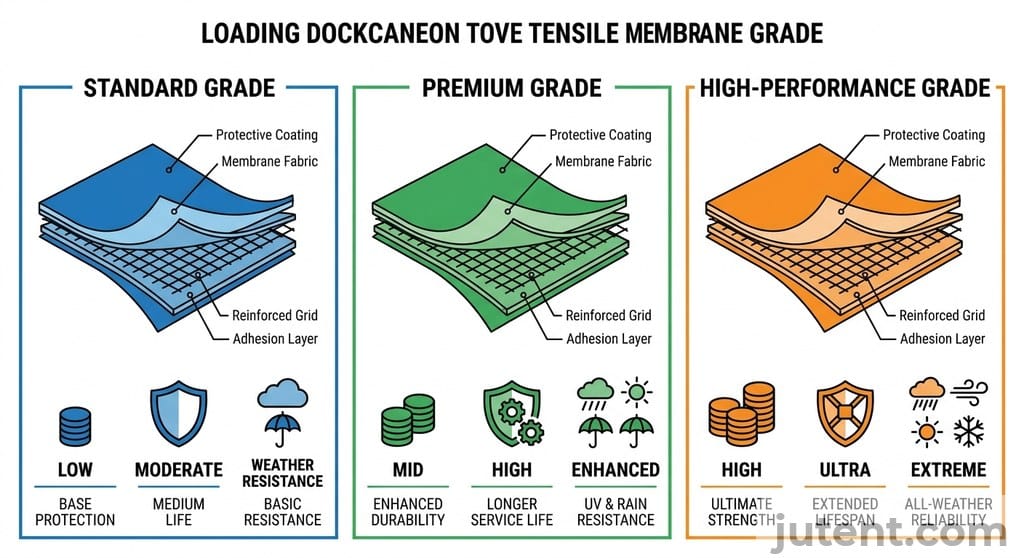
Membrane selection accounts for 15% to 30% of the total material cost. PVDF-coated fabrics are the industry standard for commercial logistics facilities, but the specific weight and coating thickness drive the exact loading dock canopy budget.
A standard 900g/m² PVDF membrane is sufficient for moderate climates and typically represents the baseline cost. Upgrading to a 1050g/m² or 1200g/m² PVDF fabric increases the membrane cost by $4 to $8/m². This heavier grade is necessary for high-wind zones or areas with heavy snow loads, as the increased base fabric density provides higher tensile strength and tear resistance under sustained environmental stress.
Corrosion protection and service life should be described according to the selected protection system, project environment, and maintenance conditions rather than as an unconditional lifespan guarantee.
Supply-Only vs Supply-and-Install: Understanding the Price Difference
The procurement model dictates whether you are paying for materials or absorbing local labor rates. A supply-only contract provides the engineered steel, membrane, and hardware delivered to the site. A supply-and-install contract includes the labor, lifting equipment, and site management required to erect the structure.
Pricing should be reviewed by product category and project scope rather than treated as a fixed published number. For an accurate quotation, the structure size, wind rating, membrane grade, and delivery terms should be confirmed first.
Adding installation typically doubles the total project cost, depending on the local labor market. In regions with high construction wages, site labor, crane hire (typically a 20-ton mobile crane for standard dock canopies), and elevated work platforms add $30 to $60/m² to the final figure. Contractors managing the civil works and concrete footings internally should opt for supply-only to maintain control over the loading dock canopy budget and project schedule.
How to Get an Accurate Quote
To convert a rough loading dock canopy budget into a fixed manufacturing price, suppliers require specific site and operational data. Vague requests yield conservative, inflated quotes because engineers must assume worst-case scenarios.
First, define the exact dimensions: overall length, projection (cantilever depth), and minimum clearance height. A clearance height of 4.5 metres accommodates standard trailers, but specifying 5.5 metres to clear specialized freight requires longer, heavier columns to resist the increased wind overturning moment.
Second, provide the site location. This allows the engineering team to calculate the exact wind and snow loads based on local building codes. A canopy in a 120km/h wind zone requires a fundamentally different steel specification than one in a 160km/h coastal zone.
Finally, specify any site constraints. If the canopy must attach to an existing tilt-up concrete wall rather than standing independently on new footings, the supplier must engineer custom wall brackets and verify the pull-out loads for the chemical anchors. Providing these three data points ensures the quote reflects the actual engineering reality rather than a worst-case assumption.
If you want an accurate budget reference for this project, share your dimensions, wind zone, and preferred membrane type with our team.
FAQ
- What is the cost per square metre for a loading dock canopy?
- Supply cost typically ranges from $25–$70/m² ex-factory, depending on structural form and membrane grade. For large-scale projects exceeding 500m², the supply-only rate can drop to $25 to $40/m² due to bulk material purchasing and repetitive detailing. This figure represents a supply-only contract, which includes engineered steel, membrane, and hardware. Adding installation services, which cover labor, lifting equipment, and site management, can typically double the total project cost, influenced by local labor market rates. Membrane grade also significantly impacts the budget, with heavier PVDF fabrics increasing costs by $4 to $8/m² for enhanced durability.
- What information do I need to get an accurate loading dock canopy quote?
- To obtain an accurate loading dock canopy quote, essential information includes project dimensions, site location for wind load calculations, preferred structural form, and membrane grade preference. Specifically, defining the overall length, projection, and minimum clearance height is crucial, as higher clearances necessitate heavier structural components. Providing the exact site location enables engineers to calculate precise wind and snow loads according to local building codes, directly influencing steel specifications. Additionally, detailing any site constraints, such as attachment to existing structures, allows for the engineering of custom solutions and ensures the quote reflects the actual project requirements rather than worst-case assumptions.