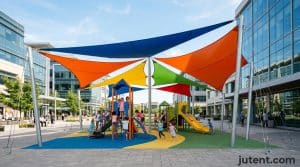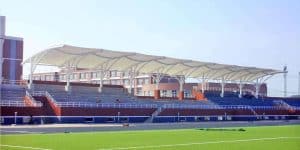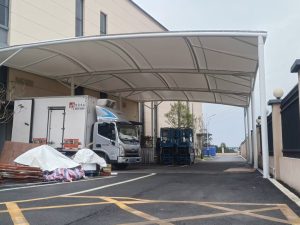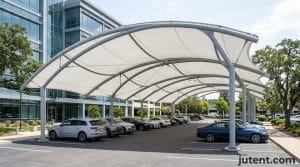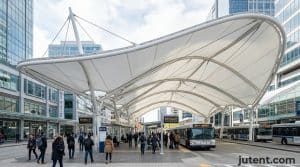

A retail walkway canopy in Southeast Asia must handle typhoon wind loads and intense tropical UV. This guide covers what contractors in the Philippines, Malaysia, and Indonesia need to specify.
Retail Walkway Canopy Southeast Asia: Engineering for Typhoon Loads & Tropical UV
Designing outdoor retail shading structures in tropical maritime climates requires strict attention to structural integrity and material durability. Commercial developers and main contractors are frequently tasked with delivering aesthetically pleasing covered corridors that seamlessly connect retail complexes, multi-level parking zones, and public transit hubs. The primary goal is to maintain uninterrupted pedestrian foot traffic regardless of inclement weather conditions. However, the severe environmental realities of the region dictate rigorous engineering standards. Successfully executing these commercial projects means integrating robust steel frameworks with high-performance tensile membranes capable of withstanding extreme weather patterns, ranging from high-velocity wind events to relentless equatorial sun exposure. Understanding localized engineering codes and detailed material specifications ensures the final structure provides optimal public safety, regulatory compliance, and long-term asset value.
Specifying a Typhoon Rated Retail Walkway Canopy
Wind loading is the single most critical structural consideration for tensile architecture operating in the Asia-Pacific region. When evaluating a retail walkway canopy Philippines specification, contractors must ensure total compliance with the National Structural Code of the Philippines (NSCP). This rigorously updated framework frequently requires designing outdoor structures to withstand basic wind speeds of 200–250 km/h, depending on the specific regional zoning and coastal proximity. The highly dynamic nature of tensile architecture means that massive uplift forces acting on the broad membrane surfaces can transfer immense stress to the supporting steel geometry. Structural engineers must utilize advanced finite element analysis to model these aerodynamic forces accurately.
Moving westward across the region, the meteorological requirements shift but remain equally demanding for project managers. A retail walkway canopy Malaysia project must adhere strictly to MS 1553 standards, typically accommodating basic wind speeds ranging from 28–40 m/s. While the peninsula is generally less prone to direct super typhoons, the seasonal monsoon gusts and sudden localized squalls necessitate highly precise structural engineering and anchoring. Similarly, executing a retail walkway canopy Indonesia installation requires careful adherence to SNI 1727 codes. Engineers must carefully calculate specific wind pressure profiles based on the complex island topography, immediate coastal exposure, and surrounding urban density.
Achieving these high-capacity load tolerances requires robust structural steel grades, specifically utilizing Q235B or Q355B. The primary tubular framework must be engineered using comprehensive form-finding software to guarantee the membrane tension naturally resists excessive wind deflection without fatiguing the connection plates. For procurement teams evaluating retail walkway canopy products, it is important to note that Jutent requires a strict minimum project scope of 100 m² of membrane area. For example, a 3m wide × 34m transit corridor yields 102 m². This baseline ensures that structural efficiencies and factory engineering overheads are optimized for commercial-scale property developments.

UV Protection in Tropical Climates: Membrane Grade Requirements
Prolonged exposure to intense ultraviolet radiation rapidly degrades inferior architectural fabrics. The harsh equatorial sun requires advanced, multi-layered coating technologies to prevent premature yellowing, plasticizer migration, and catastrophic loss of tensile strength. For standard commercial applications, a Type II PVDF-coated PVC membrane weighing 1050 g/m² is highly recommended. The Polyvinylidene Fluoride (PVDF) topcoat acts as an impenetrable sacrificial barrier, actively blocking harmful UV rays and preventing environmental dirt, exhaust particulate, and organic matter from adhering to the base PVC core. This specific self-cleaning characteristic significantly reduces ongoing maintenance costs for facility management teams. Jutent provides a standard 10-year warranty on PVDF membranes, which generally offer a functional, aesthetically pleasing service life exceeding 15 years in severe equatorial conditions.
When the architectural brief demands maximum structural longevity or superior self-cleaning properties, Polytetrafluoroethylene (PTFE) coated fiberglass serves as the optimal engineering upgrade. PTFE is uniquely chemically inert and completely immune to structural UV degradation over time. While the initial capital expenditure for this advanced fabric is higher, PTFE carries a 15-year warranty and a proven service life extending well beyond 25 years in the field. Sourcing raw materials from established international manufacturers like Heytex or Sattler guarantees consistent protective coating thickness and reliable biaxial load resistance across the entire fabric batch. By selecting the mathematically correct membrane grade, contractors ensure the retail walkway retains its visual appeal and structural integrity over decades of continuous tropical sun exposure.

Drainage Design for High-Rainfall Environments
Southeast Asia experiences some of the highest annual precipitation rates globally, driven by prolonged and intense seasonal monsoons. Tensile membrane structures are uniquely susceptible to severe water ponding if the geometric curvature is not engineered correctly from the conceptual phase. Ponding creates localized, rapidly increasing dead loads that can quickly exceed the fabric’s maximum yield strength, ultimately leading to severe material failure. To systematically prevent this risk, the computational form-finding process must ensure a steep minimum slope angle is maintained throughout every square meter of the fabric surface, forcibly directing all water runoff toward designated structural gutters or ground-level drainage points.
Different architectural forms manage this extreme water shedding differently. A classic barrel vault design uses continuous lateral curvature to shed heavy water volume strictly to the sides, making it a highly efficient and cost-effective choice for long transit corridors connecting retail hubs. For a standard PVDF-coated PVC membrane in a simple barrel vault form, the supply cost typically ranges from $40–$70/m² ex-factory, depending on wind load requirements and site conditions. Alternatively, a conic structure utilizes high-tension center masts and peripheral anchoring rings to create steep, dramatic radial slopes. This highly engineered form accelerates water runoff rapidly while providing a striking, modern visual aesthetic for premium retail and hospitality environments. Complex conic or high-wind-rated structures typically range from $60–$90/m² ex-factory, reflecting increased engineering hours and fabrication precision. Upgrading to a PTFE-coated fiberglass membrane adds approximately $20/m² to either range. Both structural profiles ensure that the heaviest tropical downpours are managed safely without placing undue tension stress on the canopy perimeter.
Supply Scope and Installation Support
Delivering successful tensile projects on schedule requires a clearly defined supply scope and highly resilient corrosion protection methodologies. Coastal and high-humidity environments necessitate rigorous, multi-layered steel surface treatments. Standard structural protection consists of an industrial epoxy zinc-rich primer followed by a durable acrylic topcoat, while premium architectural applications utilize an epoxy zinc-rich primer paired directly with an advanced fluorocarbon topcoat. When extreme project environments demand the absolute highest level of heavy corrosion resistance, hot-dip galvanizing is systematically recommended for the underlying framework. If an aesthetic painted finish is strictly specified over the galvanized steel, a galvanized phosphating primer must be applied first to ensure proper topcoat adhesion and prevent flaking. Jutent stands completely behind its structural fabrication with a comprehensive 1-year overall warranty.
Having successfully completed 400+ commercial projects across 30+ countries globally, Jutent thoroughly understands the intricate logistical, packaging, and technical requirements of international B2B contracting. The standard commercial supply scope delivered with every order includes highly detailed design drawings, structural load calculations, precise material specifications, and comprehensive installation guidance manuals. It is important to note that Jutent does not provide direct installation services. Instead, detailed remote guidance is provided completely free of charge to directly support the contractor’s local assembly team. For complex architectural geometries or inexperienced field crews, on-site technical supervision is available as an optional paid service to ensure precise membrane tensioning, safe hoisting procedures, and accurate structural alignment.
FAQ: Retail Walkway Canopy in Southeast Asia
The minimum project scope required for manufacturing a commercial tensile structure is precisely 100 square meters of total membrane area. This specific threshold ensures that the highly specialized engineering analysis, computational form-finding software operations, and heavy steel fabrication processes remain economically viable for large-scale property developments. For example, calculating a standard three-meter wide pedestrian corridor measuring approximately thirty-four meters in length would yield a total membrane area of just over one hundred square meters, perfectly meeting the factory production minimum.
Due to the highly corrosive nature of coastal and tropical maritime environments, hot-dip galvanizing is recommended as the primary corrosion protection system for the structural steel framework. Immersing the fabricated steel in molten zinc creates a robust metallurgical bond that effectively prevents deep rust penetration. If a specific colored painted finish is also required over the galvanized framework for aesthetic reasons, apply an appropriate primer for galvanized surfaces (such as a galvanized phosphating primer) before the topcoat.
Every commercial tensile structure order includes a comprehensive suite of technical documentation to assist the main contractor and local assembly team. The standard engineering package contains detailed factory design drawings, thorough structural load calculations verifying regional wind resistance, specific material specifications for both steel and architectural membrane components, and extensive installation guidance manuals. These essential documents empower your local construction crews to safely execute the complex assembly and fabric tensioning processes on the job site.
Ensure your next commercial development is protected by highly engineered tensile architecture built for extreme weather conditions.
Tell us your project location in Southeast Asia and we’ll provide a typhoon-rated specification.