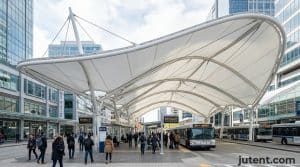
Specifying a retail walkway canopy involves five decisions that most contractors and developers get wrong the first time: structural configuration, span clearance, wind load engineering, membrane grade selection, and budget allocation. This guide covers each one, providing the exact dimensions, material specifications, and cost figures required to finalize the specification before going to tender. A retail walkway canopy protects shoppers from weather while enhancing the visual appeal of commercial precincts. This guide covers every specification decision for retail and shopping centre applications, ensuring the final commercial walkway shade structure performs structurally and commercially without requiring mid-project re-engineering.
What Makes Retail Walkway Canopy Specification
The specification of a retail walkway canopy determines the long-term structural performance, maintenance schedule, and visual integration within a commercial precinct. Unlike temporary shade structures, a permanent retail covered walkway must meet local building codes, strict fire safety regulations, and high-volume pedestrian traffic demands. The specification process begins by defining the primary structural material—typically hot-dip galvanized steel—and the architectural membrane, usually high-grade PVDF. These material choices dictate the baseline durability of the entire system.
Corrosion protection and service life should be described according to the selected protection system, project environment, and maintenance conditions rather than as an unconditional lifespan guarantee.
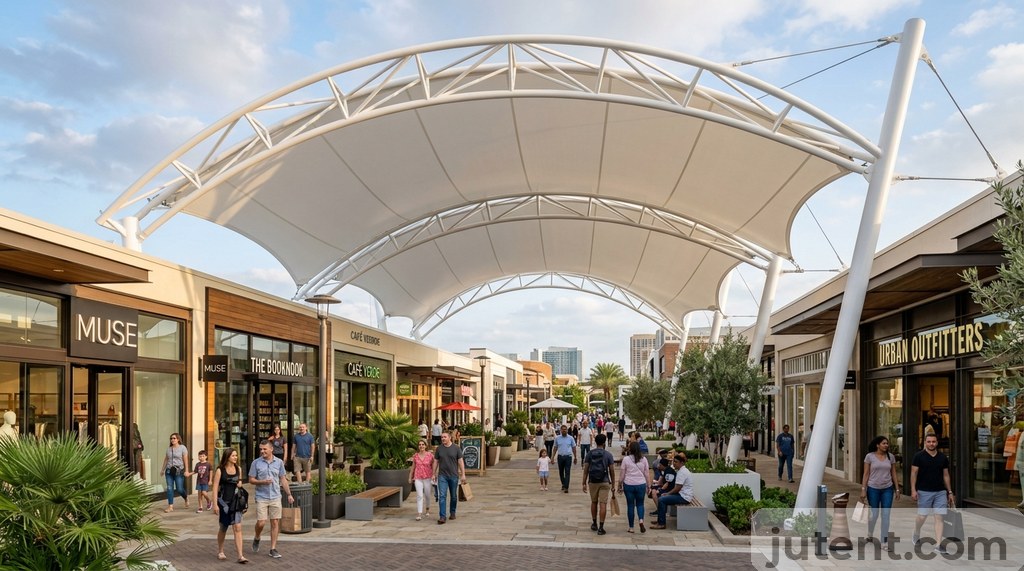
The specification must also detail connection methods and installation tolerances. Field welding is rarely acceptable in operational retail environments due to fire risks, hot-work permit delays, and shopper disruption. Consequently, the specification must mandate bolted connections using high-tensile galvanized or stainless steel hardware. Every base plate, cleat, and tensioning component requires exact detailing in the shop drawings before fabrication begins. This approach ensures the structure can be erected rapidly on site using standard lifting equipment and hand tools, minimizing site downtime.
Retail Walkways
Electrical integration requires planning from the initial design phase. Retail environments demand illuminated walkways for nighttime safety and commercial visibility. The steel framework specification should include pre-drilled access holes and internal conduits to route electrical wiring invisibly through the columns and rafters. This prevents exposed cables that degrade the aesthetic of the retail tensile canopy while protecting the electrical systems from weather exposure, UV degradation, and public tampering.
Different
Different commercial precincts demand specific structural adaptations that separate retail canopies from standard industrial or sporting shade structures. The primary differentiator is water management. Industrial canopies often tolerate water shedding directly off the perimeter. In a retail environment, this approach is entirely unacceptable.
Based on Jutent’s experience across 400+ projects in 30+ countries, similar specification issues often appear when early-stage assumptions are made before the engineering conditions are confirmed.
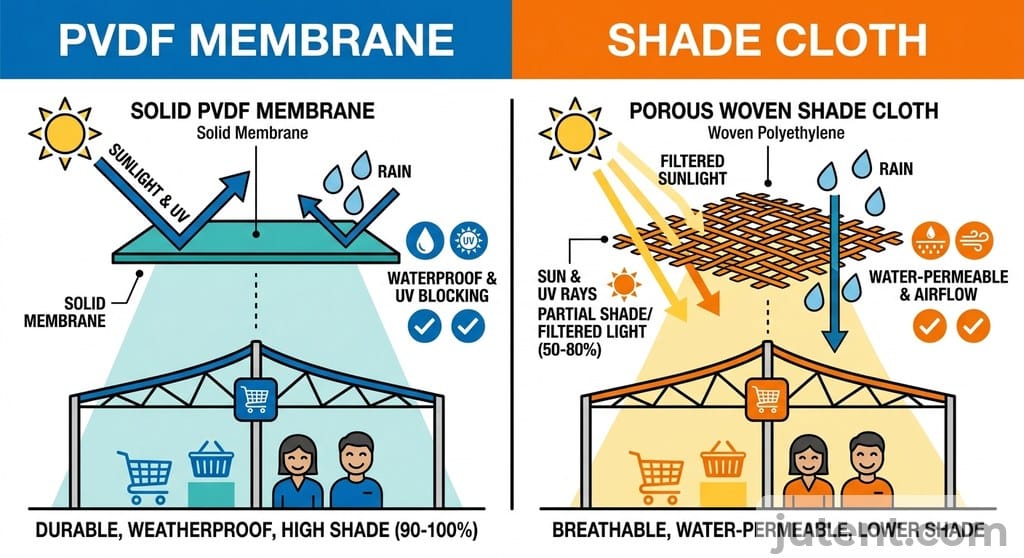
Fire compliance represents another critical difference. When a commercial walkway shade structure connects directly to a retail building facade or covers a primary egress route, it triggers strict fire propagation codes. The membrane must achieve a Class 1 or B1 fire rating, ensuring it does not produce flaming droplets or contribute to fire spread. Standard polyethylene shade cloth cannot meet these requirements, forcing the specification toward architectural PVC or PVDF membranes.
Pvdf Vs Ptfe Membrane Comparison
custom architectural fluorocarbon topcoat
Structural Forms: Tensile, Hip Roof, and Modular Walkway Canopies
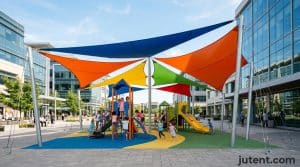
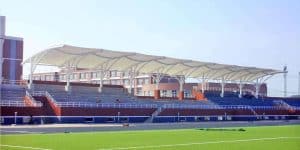
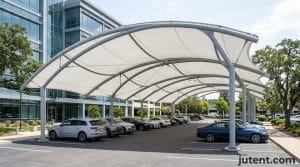
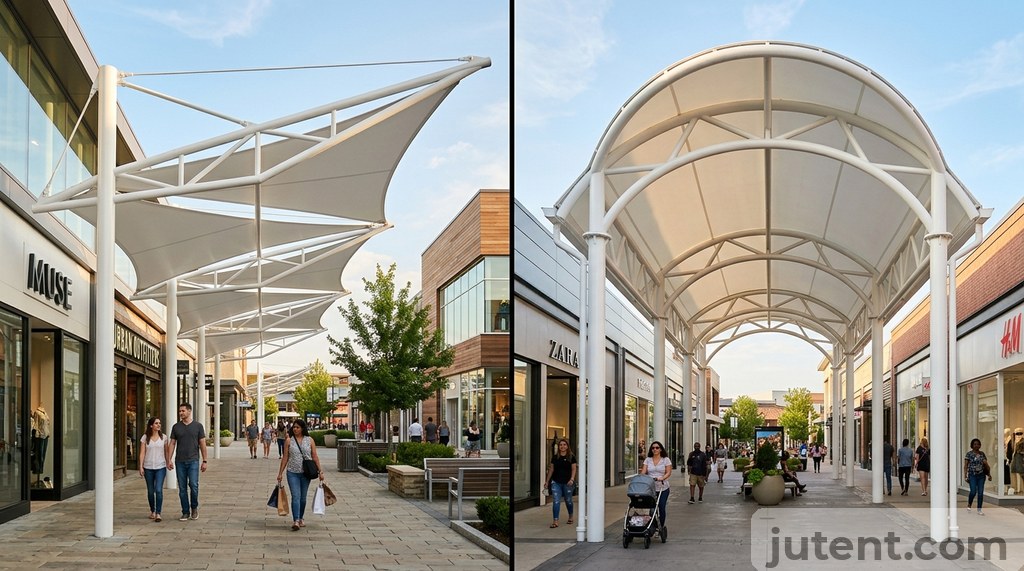
Tensile membrane structures handle the majority of modern retail walkway projects. These forms utilize double-curvature—such as hypar (hyperbolic paraboloid), conic, or barrel vault designs—to achieve structural stability. The tension applied to the membrane transfers wind and snow loads efficiently to the primary steelwork, allowing for greater distances between support columns. A well-engineered retail tensile canopy can achieve clear spans of 10 to 15 meters between columns, minimizing ground-level obstructions for shoppers and maximizing retail storefront visibility.
Hip roof structures provide a more traditional architectural aesthetic. These utilize a rigid steel frame with rafters and purlins, over which the membrane is tensioned. While they require more steel weight per square meter than pure tensile forms, hip roof canopies excel in environments requiring heavy snow load capacities or where the developer wants to match the pitched roofs of adjacent retail buildings. The rigid framework also makes it easier to suspend heavy secondary loads, such as large digital advertising screens or heavy HVAC ducting, directly from the rafters.
Modular walkway canopies offer a standardized approach, utilizing repeating structural bays—typically 4.0m to 6.0m in length. The primary advantage of a modular system is rapid deployment and scalability. Developers can install a 50-meter walkway in a matter of days using pre-fabricated 5.0m bays. The structural framework usually consists of 150×150×5mm square hollow section (SHS) columns and rolled circular hollow section (CHS) arches.
This modularity allows shopping centres to extend their covered walkways in phases without requiring complete re-engineering or disrupting ongoing retail operations. If a section of the walkway needs to be removed temporarily to allow heavy crane access for building maintenance, a modular system allows contractors to unbolt and remove a single bay without compromising the tension or stability of the rest of the structure.
Span and Clearance: What Retail Walkway Applications Require
Span and clearance dimensions dictate both the pedestrian experience and the structural steel sizing. Standard pedestrian walkways require a minimum clear width of 3.0m to accommodate two-way foot traffic and shopping trolleys comfortably. However, main arterial walkways connecting parking structures to major retail entrances typically require widths of 4.5m to 6.0m to prevent bottlenecking during peak trading hours. The column placement must also account for tactile paving requirements and ADA compliance, ensuring the structural supports do not impede accessible routes.
Clearance height is equally critical and is driven by both safety and operational requirements. A standard retail walkway canopy requires a minimum eaves height of 3.2m. This height prevents accidental damage or vandalism by pedestrians while providing sufficient vertical space for suspended directional signage, security cameras, and lighting fixtures. Dropping the eaves height below 3.0m in a public retail space significantly increases the risk of the membrane being cut or damaged.
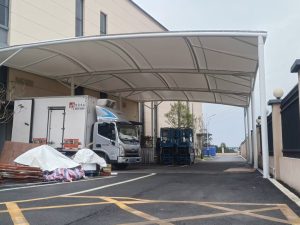
When the commercial walkway shade structure crosses a vehicle path, fire lane, or delivery route, the clearance requirements change drastically. The structure must provide a minimum of 4.5m to 5.0m of vertical clearance to accommodate emergency vehicles, waste management trucks, and rigid delivery vehicles.
A 40GP container typically supports about 21–28 tons of payload, while the actual covered area depends on structure type, steel quantity, and packing method.
Wind Load and Structural Compliance for Commercial Precincts
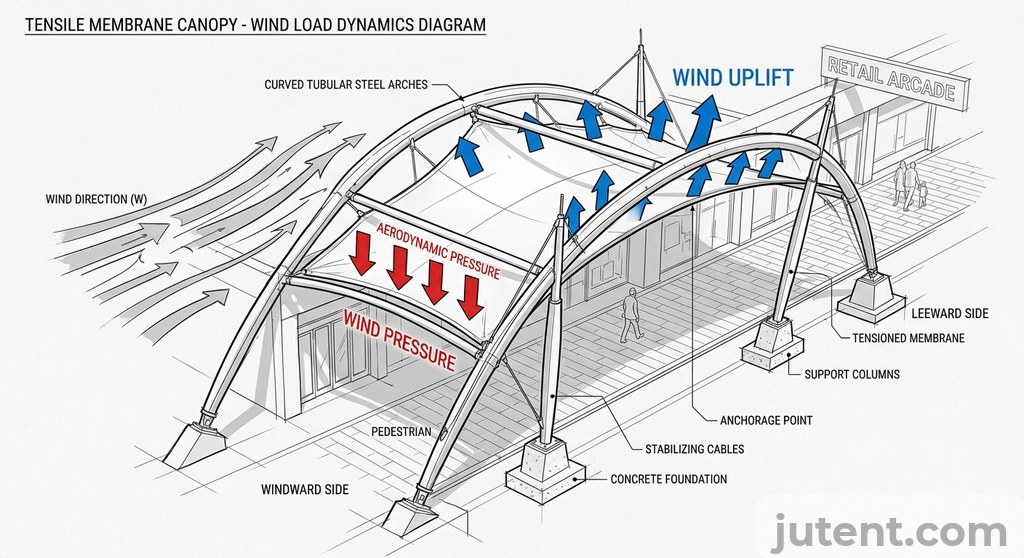
Wind load engineering dictates both the structural survivability of the retail walkway canopy and the required mass of the foundational concrete. Because these structures are open-sided, they are highly exposed and generate significant uplift forces during storm events. Structural compliance requires engineering the canopy to site-specific wind speed codes, such as ASCE 7-16, Eurocode 1, or regional equivalents.
Company experience should be described through verified export experience and project support capability rather than unsupported project anecdotes.
In standard commercial environments, design wind speeds typically range from 120 km/h to 160 km/h. The engineering documentation must calculate both downward pressure—often combined with snow loads in colder climates—and upward suction. This uplift force directly dictates the concrete footing mass required to anchor the structure safely. For a standard 5.0m × 5.0m modular bay in a 140 km/h wind zone, each column generally requires a pad footing measuring approximately 1.0m × 1.0m × 0.8m.
Contractors must verify that the retail walkway canopy manufacturer provides site-specific engineering calculations rather than generic structural drawings. Local topography, adjacent multi-story buildings, and wind tunneling effects between retail facades significantly alter the localized wind pressures acting on the canopy. The engineering must also account for vortex shedding—oscillating wind forces that cause the membrane to flutter. Applying precise bi-axial pre-stressing to the membrane during installation prevents this flutter, eliminates the risk of premature material fatigue, and ensures the structure remains silent during high winds.
Membrane Grade: What Retail Walkway Canopies Require
PVDF (Polyvinylidene Fluoride) at 1050g/㎡ handles 95% of retail walkway canopy projects. PTFE (Polytetrafluoroethylene) is the right choice only when the project specifies a 25+ year design life without membrane replacement or requires absolute non-combustibility. For the vast majority of shopping centre walkway canopies, high-grade PVDF provides the optimal balance of longevity, aesthetic performance, and cost-efficiency.
The reason PVDF outperforms standard PVC in commercial environments is the fluorocarbon surface layer, which reflects UV radiation rather than absorbing it. At UV Index 12–13, a 1050g/㎡ PVDF membrane maintains tensile strength within 10% of its original specification after 15 years. This surface treatment also provides critical self-cleaning properties. Rainwater washes dirt, dust, and bird droppings off the low-friction surface, significantly reducing the maintenance burden on facility management teams. Standard PVC membranes lack this topcoat, causing them to attract dirt and degrade rapidly under high UV exposure.
Light transmission is another critical factor in membrane selection. A standard white 1050g/㎡ PVDF membrane offers approximately 10% to 13% light transmission. This provides bright, diffused natural light during the day, eliminating the need for artificial daytime lighting and reducing energy costs for the precinct. The diffused light also prevents harsh shadows and glare, creating a comfortable environment for shoppers.
At night, the underside of the membrane acts as a highly reflective surface. Bouncing upward-facing LED lighting off the canopy back down onto the pedestrian walkway creates a safe, evenly illuminated environment without the glare of direct overhead bulbs. Finally, the selected membrane must carry a B1 or Class 1 fire retardancy rating, backed by laboratory test certificates, to pass commercial building inspections.
Retail Walkway Canopy Cost: What Drives the Budget
Budget planning should be based on structure type, clear span, wind rating, membrane grade, steel tonnage, and project scope. For an accurate EXW, FOB, CIP, or DDU quotation, the project dimensions and engineering requirements should be reviewed first.
The primary cost driver is the steel weight per square meter, which is dictated by the required wind load rating and the clear span between columns. A standard modular walkway designed for 120 km/h winds might require 25 kg of steel per square meter, keeping costs near the $90 to $110/㎡ mark. A custom clear-span structure engineered for 200 km/h typhoon conditions, or one requiring 5.0m vehicle clearances, may require 45 kg of steel per square meter, pushing the cost toward $150/㎡.
The complexity of steel fabrication also impacts the budget. Straight SHS portal frames are highly efficient to manufacture and transport. In contrast, rolled CHS arches or complex double-curvature tensile frames require specialized bending equipment and more labor-intensive welding, increasing the fabrication cost by 15% to 20%. Custom architectural paint finishes applied over the galvanizing will also add $10 to $15 per square meter to the final price.
Membrane selection accounts for the next major budget variable. Upgrading from a standard 900g/㎡ PVDF to a premium 1050g/㎡ PVDF adds approximately $4 to $7 per square meter to the material cost, but extends the design life by 5 to 8 years, making it a highly logical investment for developers. Generally, the cost breakdown for a commercial walkway shade structure is 55–65% for the steel framework, 20–25% for the architectural membrane, and 10–15% for the tensioning hardware, cables, and aluminum extrusions.
What Jutent Provides: Factory Supply, Documentation, and Logistics
Jutent operates as a specialized retail walkway canopy manufacturer, providing a complete factory-to-site supply model for contractors and developers. We eliminate the risks associated with site fabrication by delivering fully engineered, pre-cut, and pre-finished structural kits ready for immediate assembly. This approach drastically reduces site hours and minimizes disruption to operational retail environments.
The supply scope begins with engineering documentation. We provide site-specific structural calculations, finite element analysis for the membrane, and detailed shop drawings for every steel component. Once approved, the steel framework is fabricated using automated laser cutting and robotic welding to ensure millimeter precision. All steel components are then hot-dip galvanized to a minimum thickness of 85 microns, providing decades of corrosion resistance even in coastal commercial precincts. We conduct non-destructive testing (NDT) on primary welds to guarantee structural integrity.
The architectural membrane is patterned using specialized software and cut on automated flatbed plotters before being joined via high-frequency welding. This ensures 100% waterproof seams that match the tensile strength of the base fabric. The membrane is then carefully folded and packed into protective PVC bags to prevent transit damage.
For logistics, the entire structure is designed to pack efficiently into standard 40ft HQ or open-top shipping containers. Every steel column, rafter, and tensioning cable is individually numbered and cross-referenced with the provided step-by-step installation manual. The manual includes exact torque specifications for all bolts and tensioning sequences for the membrane. This modular, bolt-together approach means local contracting teams can erect the retail covered walkway using standard lifting equipment and hand tools, completely eliminating the need for on-site welding, painting, or membrane modification.
If you want an accurate budget reference for this project, share your dimensions, wind zone, and preferred membrane type with our team.
FAQ
- What is the typical lead time for a retail walkway canopy from Jutent?
- The typical lead time for a retail walkway canopy involves two primary phases. Factory production, encompassing material fabrication and assembly, generally takes 20 to 35 days from finalized design approval. Following production, sea freight for delivery to Southeast Asian destinations typically requires an additional 7 to 14 days. Therefore, project managers can anticipate a total lead time of approximately 5 to 8 weeks from the commencement of manufacturing to the arrival of the structure at the port of destination. This timeframe allows for efficient project planning and scheduling.
- What membrane grade is recommended for a retail walkway canopy?
- For retail walkway canopies, a high-grade PVDF (polyvinylidene fluoride) coated polyester membrane is consistently recommended. This material offers superior UV resistance, color stability, and self-cleaning properties, which are crucial for maintaining aesthetic appeal and minimizing maintenance in high-traffic commercial environments. Its durability ensures a long service life, providing excellent weather protection against sun and rain, and contributing to a positive shopper experience without frequent upkeep or degradation over time.