
Corrosion protection and service life should be described according to the selected protection system, project environment, and maintenance conditions rather than as an unconditional lifespan guarantee.
Gulf Climate: Why Standard School Walkway Specs Don’t Apply
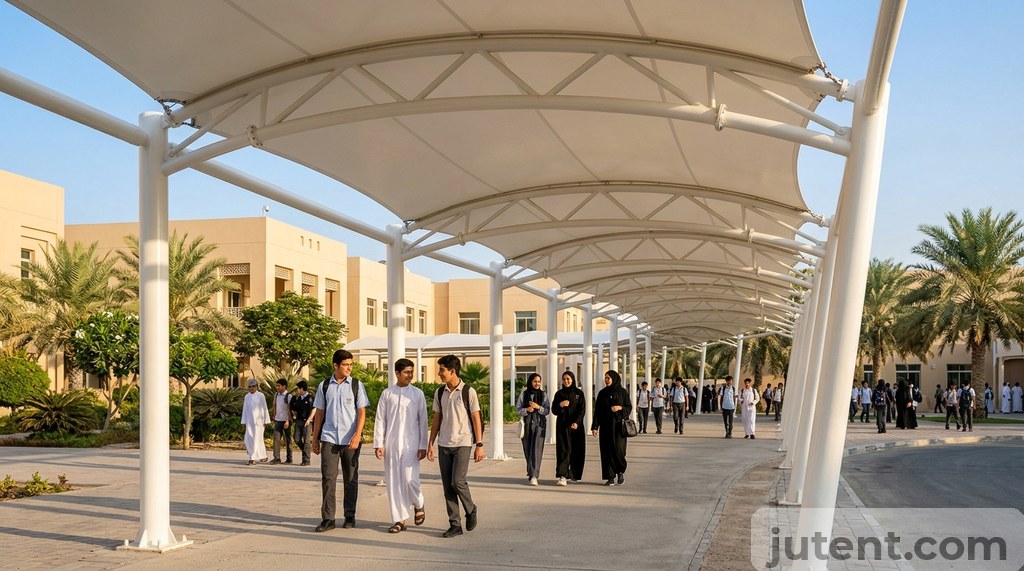
A heat resistant school walkway canopy in the Gulf region requires a fundamentally different engineering approach than a standard European or North American specification. The primary failure modes in the GCC are UV degradation of the membrane and corrosion of the steel framework due to high salinity in coastal areas like Doha, Dubai, and Jeddah.
Contractors specifying School Walkways must account for three distinct environmental stressors. First, ambient temperatures regularly exceed 45°C, pushing the surface temperature of the membrane above 70°C. Second, airborne sand acts as an abrasive, stripping standard fluorocarbon topcoats from steel columns within three to five years. Third, coastal humidity combined with high temperatures accelerates oxidation on any exposed structural connections, particularly at the base plates.
To prevent premature failure, the specification must mandate hot-dip galvanized steel (minimum 85 microns thickness) for the primary framework, rather than standard cold-rolled steel with a basic primer. Base plates must be elevated at least 50mm above the finished floor level and encased in non-shrink grout to prevent water pooling during routine maintenance washdowns. Ignoring these specific environmental factors inevitably leads to rust bleeding down the columns and early structural fatigue, resulting in rejected inspections by local educational authorities and costly remediation work.
UV and Heat Protection: Membrane Grade for Middle East School Walkways
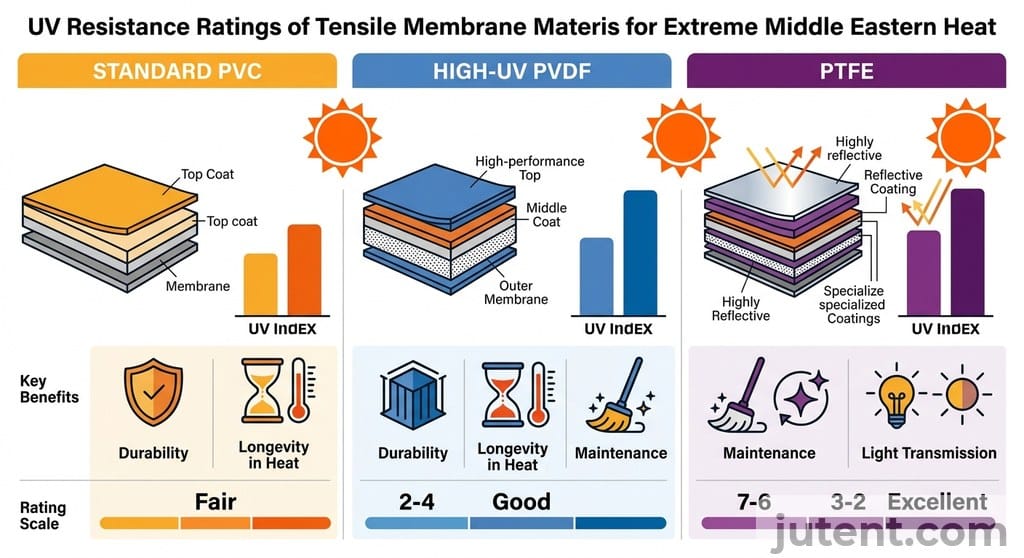
High-grade PVDF handles 95% of school walkway shade Qatar and UAE projects. Standard PVC or HDPE mesh fails in the Gulf; these materials degrade rapidly under continuous UV Index 11+ exposure, losing tensile strength, becoming brittle, and discoloring within 36 months of installation.
For a school walkway canopy UAE specification, the membrane must be a Type II PVDF-coated fabric weighing at least 900g/㎡. The primary component is the fluorocarbon surface layer. This topcoat reflects UV radiation rather than absorbing it, keeping the structural polyester base yarn intact. At 45°C ambient temperatures, a 900g/㎡ PVDF membrane maintains its tensile strength within 10% of the original specification after 10 years of continuous exposure, securing long-term structural stability.
The membrane must also provide a UPF 50+ rating to protect students during transit between buildings. As detailed in our School Walkway Canopy Guide, specifying a highly translucent white PVDF (typically 12-15% light transmission) reduces the need for artificial daytime lighting under the canopy while reflecting thermal energy away from the pedestrian zone. This lowers the perceived temperature at ground level, creating a safer environment for students.
Wind Load: UAE and Saudi Standards for School Walkway Structures
A school covered walkway Saudi Arabia project must comply with the Saudi Building Code (SBC) Chapter 7, while UAE projects typically follow the Dubai Municipality or Abu Dhabi IBC adaptations. The critical engineering metric is the basic wind speed, which dictates the sizing of the primary steel members, the tensioning cables, and the concrete footings.
Company experience should be described through verified export experience and project support capability rather than unsupported project anecdotes.
Based on Jutent’s experience across 400+ projects in 30+ countries, similar specification issues often appear when early-stage assumptions are made before the engineering conditions are confirmed.
Safety and Drainage Considerations for Gulf School Walkways
Clearance heights and water management dictate the geometric design of school walkway canopies in the Middle East. The structure must allow safe passage for students while managing the intense, infrequent rainstorms characteristic of the region.
The minimum clearance height at the lowest point of the canopy edge (the eaves) must be 2.5 meters. This prevents accidental contact, limits vandalism by students, and allows clearance for maintenance equipment. The central apex of the walkway should rise to at least 3.5 meters to ensure adequate air circulation and prevent heat trapping beneath the membrane during peak summer months.
For drainage, flat or low-pitch designs fail during Gulf winter downpours. The membrane must be engineered with a minimum 15-degree pitch to ensure rapid water runoff and prevent ponding. Ponding adds severe dead load to the structure and accelerates dirt accumulation, which degrades the PVDF topcoat. Water should be directed to specific low points equipped with PVC downpipes integrated into the steel columns. This system discharges water directly into the school’s surface water drainage network rather than spilling it onto the pedestrian path, preventing slip hazards for students and staff.
Case Reference: School Walkway Projects in the Gulf Region
In a recent school campus project in Sharjah, the contractor required a 120-meter continuous covered walkway connecting the main academic block to the sports hall. The site constraint was an existing underground utility corridor that prevented standard 5-meter column spacing.
We engineered a custom cantilevered structural system using 200×200×8mm SHS columns spaced at 8-meter intervals, bridging the utility lines without requiring foundation relocation. The canopy utilized a 1050g/㎡ PVDF membrane tensioned with 12mm stainless steel edge cables. The entire steel framework was hot-dip galvanized and finished with a marine-grade polyurethane topcoat to resist the coastal humidity.
This configuration provided a 4-meter wide clear path for student transit, completely free of structural obstructions. By supplying the steel pre-cut, pre-drilled, and clearly marked, the local installation team erected the primary framework in six days during the school’s summer closure. This modular approach eliminates on-site welding, preserving the integrity of the galvanized coating and ensuring strict compliance with local fire safety regulations during the construction phase. The result is a highly durable, code-compliant structure delivered ahead of the academic year.
If you want an accurate budget reference for this project, share your dimensions, wind zone, and preferred membrane type with our team.
FAQ
- What membrane grade is recommended for a school walkway canopy in the UAE?
- High-grade PVDF (1050 g/m² architectural grade) with UPF 50+ rating is standard for UAE school projects. This specification ensures the fabric can withstand the extreme summer temperatures and high UV index without degrading, tearing, or losing its structural pre-stress over a 15-year design life.
- Do school walkway canopies in Saudi Arabia need to meet specific building codes?
- Yes. Saudi Building Code (SBC) Chapter 7 covers wind loads. Contractors must ensure that the primary steel framework, base plates, and concrete footings are engineered to handle the specific regional wind speeds, which dictate the structural sizing required for municipal permit approvals and safe student transit.
- How long does it take to install a heat resistant school walkway canopy?
- A standard 50-meter modular walkway system typically takes 7 to 10 days to erect on-site, assuming the concrete footings have already cured. Using pre-engineered, bolted connections eliminates the need for on-site welding, which accelerates the timeline, reduces labor costs, and minimizes disruption to the active school campus during term time.