
Decision Framework
This guide resolves five critical contractor decisions when specifying a tensile shade structure for sports courts: selecting the best structural form, choosing the right fabric material, determining structural sizing for safety and cost-effectiveness, vetting manufacturers before procurement, and understanding installation responsibilities.
Covering an outdoor sports court with a tensile shade structure is not simply about blocking sunlight. The choice of span, wind rating, membrane grade, and column placement directly impact the structure's longevity and performance. Contractors must balance cost, installation speed, and durability while meeting site-specific challenges. Based on Jutent's experience across 420+ tensile structure projects in 30+ countries, this guide offers an engineering-focused roadmap to sourcing sport court shade structures that stand the test of time.
Why Tensile Shade Structures Have Become the Default for Outdoor Sports Courts
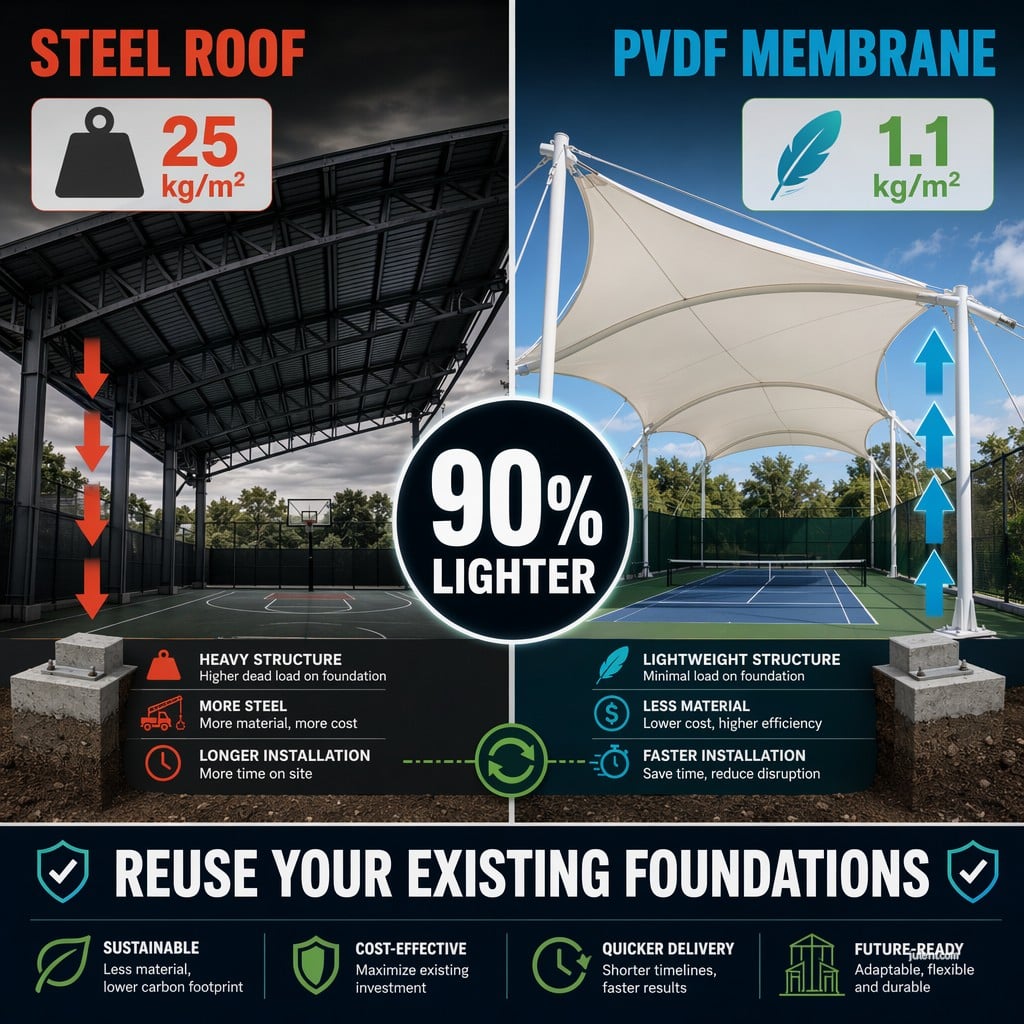
Tensile shade structures have eclipsed traditional steel canopies for sports courts due to three decisive factors: cost efficiency, rapid installation, and superior performance under environmental loads.
- Cost Efficiency: Tensile membrane materials typically reduce steel tonnage by 40-60%, lowering raw material and fabrication expenses. A commercial shade structure for sports courts using tensile fabric often costs 20-30% less in initial investment compared to full steel roofing solutions.
- Installation Speed: Prefabricated membrane panels and modular framing allow site assembly within 2-4 weeks, versus 8-12 weeks for steel canopies requiring welding and heavy lifting. This accelerates project timelines, crucial for contractors managing multiple bids.
- Performance: Tensile shade structures excel in dynamic wind load distribution. Their flexible membranes absorb wind energy, reducing stress concentrations on columns and foundations. This makes them especially suitable for high wind zones, where rigid steel roofs may require costly reinforcement.
The tensile shade structure for sports courts integrates lightweight architecture principles, delivering efficient sun protection while minimizing structural mass and foundations. These factors make tensile solutions the default choice in modern outdoor sport court shade structure projects.
Sport Court Shade Structure Types: Sail Shade, Cantilever, Multi-Post, Barrel Vault
Selecting the optimal structural form depends on site constraints, span requirements, and aesthetic goals. Below are the main tensile shade structure types used for sports courts, with their engineering justifications.
Sail Shade Structures
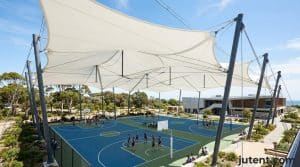
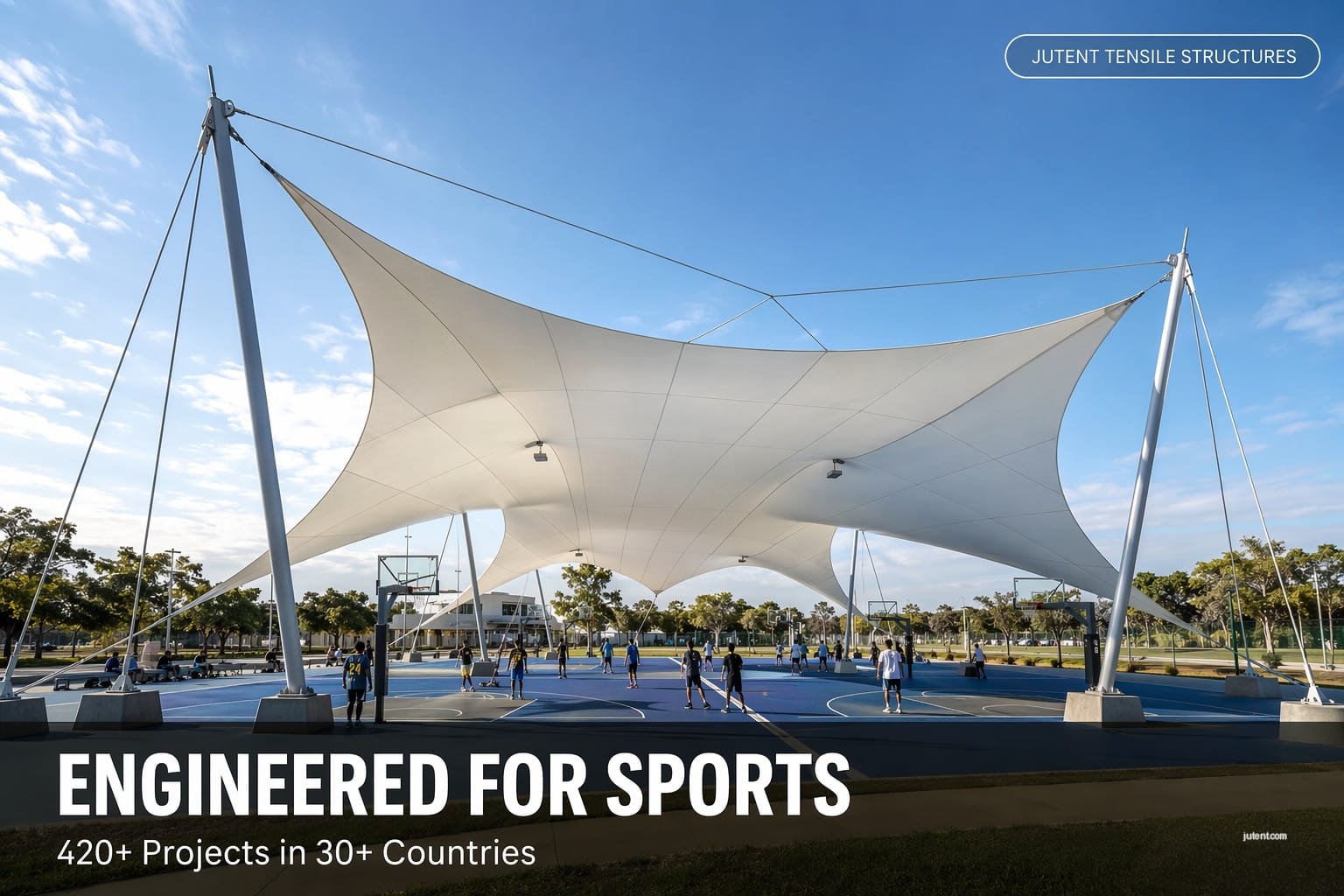
Sail-shaped membranes are tensioned between 3 or more high points, creating dynamic, sculptural canopies. They are ideal for smaller courts (spans under 12m) where column placement must minimize court obstructions.
- Structural sense: Efficient for irregular court layouts requiring minimal columns.
- Limitations: Limited maximum span and less column height control.
Cantilever Shade Structures
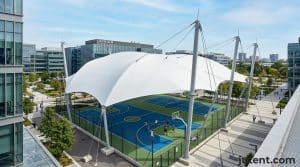
Cantilever designs feature a support column or frame on one side, with the membrane extending over the court unsupported on the other. This eliminates columns on the play area.
- Structural sense: Best for courts needing clear, unobstructed floor space.
- Span capacity: Effective for spans up to 15m with engineered steel framing.
- Considerations: Requires robust foundations and careful wind loading analysis.
Multi-Post Shade Structures
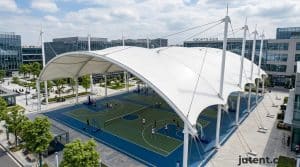
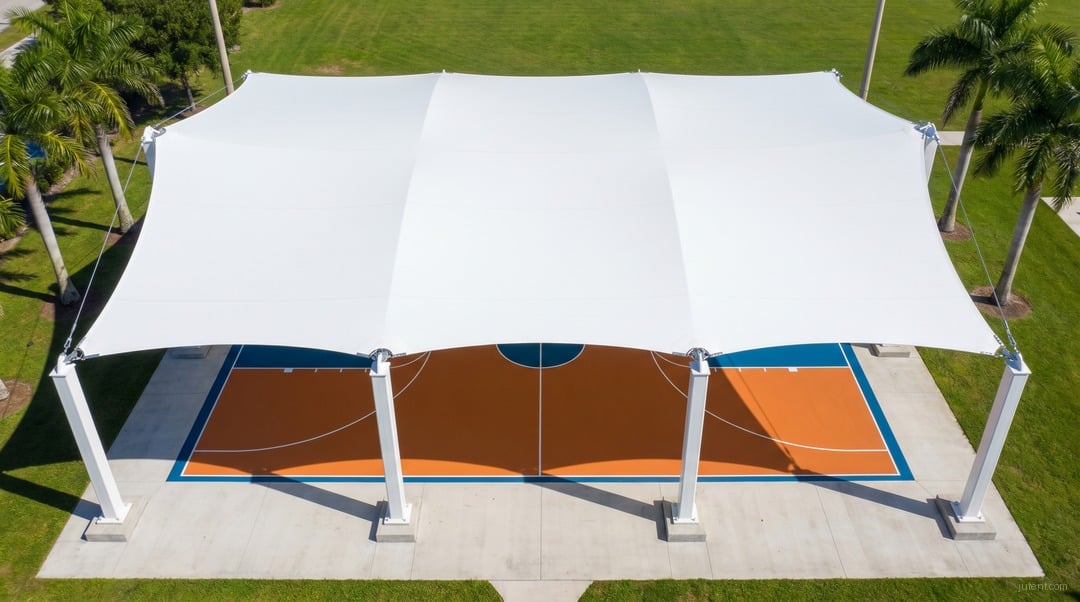
Multi-post configurations use multiple columns around the court perimeter supporting a membrane roof. This is the most common form for full-court coverage over 15m spans.
- Structural sense: Balances column placement with structural redundancy.
- Flexibility: Column spacing can be adjusted to meet load and clearance requirements.
Barrel Vault Shade Structures
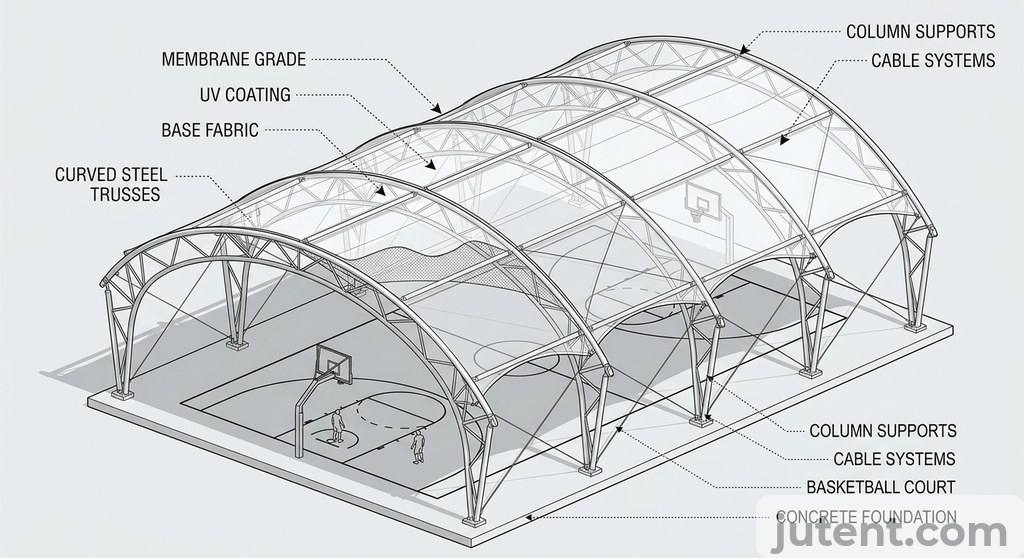
Barrel vault membranes create curved roofs supported by frame arches or multiple columns. They offer high clearance and self-draining surfaces.
- Structural sense: Suitable for long, narrow courts requiring weather protection beyond shade.
- Span capacity: Can cover spans exceeding 20m with engineered arches.
Fabric Shade Structure Materials: PVDF vs PTFE vs PVC
The membrane material determines UV resistance, lifespan, maintenance, and fire performance. Understanding the trade-offs enables accurate specification.
| Property | PVDF (Polyvinylidene Fluoride) | PTFE (Polytetrafluoroethylene) | PVC (Polyvinyl Chloride) |
|---|---|---|---|
| UV Resistance | Excellent (up to 25 years) | Superior (30+ years) | Moderate (10-15 years) |
| Lifespan | 20-25 years | 30+ years | 10-15 years |
| Maintenance | Low (requires periodic cleaning) | Very low | Moderate (prone to discoloration) |
| Fire Rating | Class B or A2 (varies by spec) | Class A (highly fire resistant) | Class B or C (varies widely) |
| Weight per m² | 550-700 g | 600-750 g | 550-650 g |
| Cost | Mid-range | Premium | Budget |
PVDF membranes offer a strong balance of cost, durability, and UV stability. They are ideal for contractors seeking commercial shade structures for sports with solid lifespan and moderate maintenance.
PTFE membranes have the highest durability and fire resistance but come with premium pricing. They suit projects where long-term lifecycle costs and safety certifications are priorities.
PVC membranes are cost-effective but have shorter lifespans and require more maintenance. Suitable for short-term or budget-sensitive installations.
Structural Sizing: How Span, Column Height, and Wind Zone Determine Your BOQ
Bill of Quantity (BOQ) accuracy hinges on three core structural parameters: membrane span, column height, and local wind zone.
- Span: The horizontal distance between support columns. Longer spans demand stronger framing and higher-tensile membranes. Typical sports courts range from 12m to 24m spans. Exceeding 20m requires specialized steel arches or tension cables.
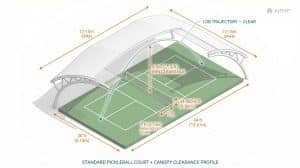
- Column Height: Minimum clearance for sports courts is typically 7.5m to 9m to allow safe play of balls and player movement. Structural column height affects foundation depth and frame wind loads.
- Wind Zone: Building codes classify wind pressure zones (e.g., ASCE 7 in the US). Higher wind zones increase membrane tension and column loading, requiring thicker steel sections and heavier foundations.
Example: A 20m span cantilever tensile shade structure in a wind zone with design wind speed 120 km/h will require approximately 40% higher steel tonnage and 30% stronger membrane tensioning than a similar structure in 90 km/h wind zones.
Accurate site wind data and clearance requirements must inform BOQ calculations to avoid under-design. Jutent's engineering teams provide detailed structural analysis and material takeoffs after initial site surveys.
Procurement Checklist for Contractors: What to Ask a Shade Structure Manufacturer Before Placing the Order
- Structural certification: Ask for engineering reports confirming wind, snow, and seismic load compliance for your site.
- Membrane specifications: Confirm membrane type, fire rating, UV resistance, and warranty terms.
- Column and foundation details: Ensure foundation design is included or consult local engineers for geotechnical adaptation.
- Customization options: Verify availability of custom colours, logo printing, and lighting integration.
- Lead times and delivery: Get clear timelines from order to on-site delivery, including freight and customs if applicable.
- Installation support: Clarify which installation steps the manufacturer handles remotely and what the contractor's site team must manage.
- Maintenance plan: Request recommended cleaning and inspection schedules to maintain membrane performance.
- After-sales service: Confirm warranty coverage and availability of spare parts or membrane repairs.
These questions mitigate procurement risks and streamline the project workflow.
Installation Overview: What Jutent Provides Remotely vs What Your Site Team Handles
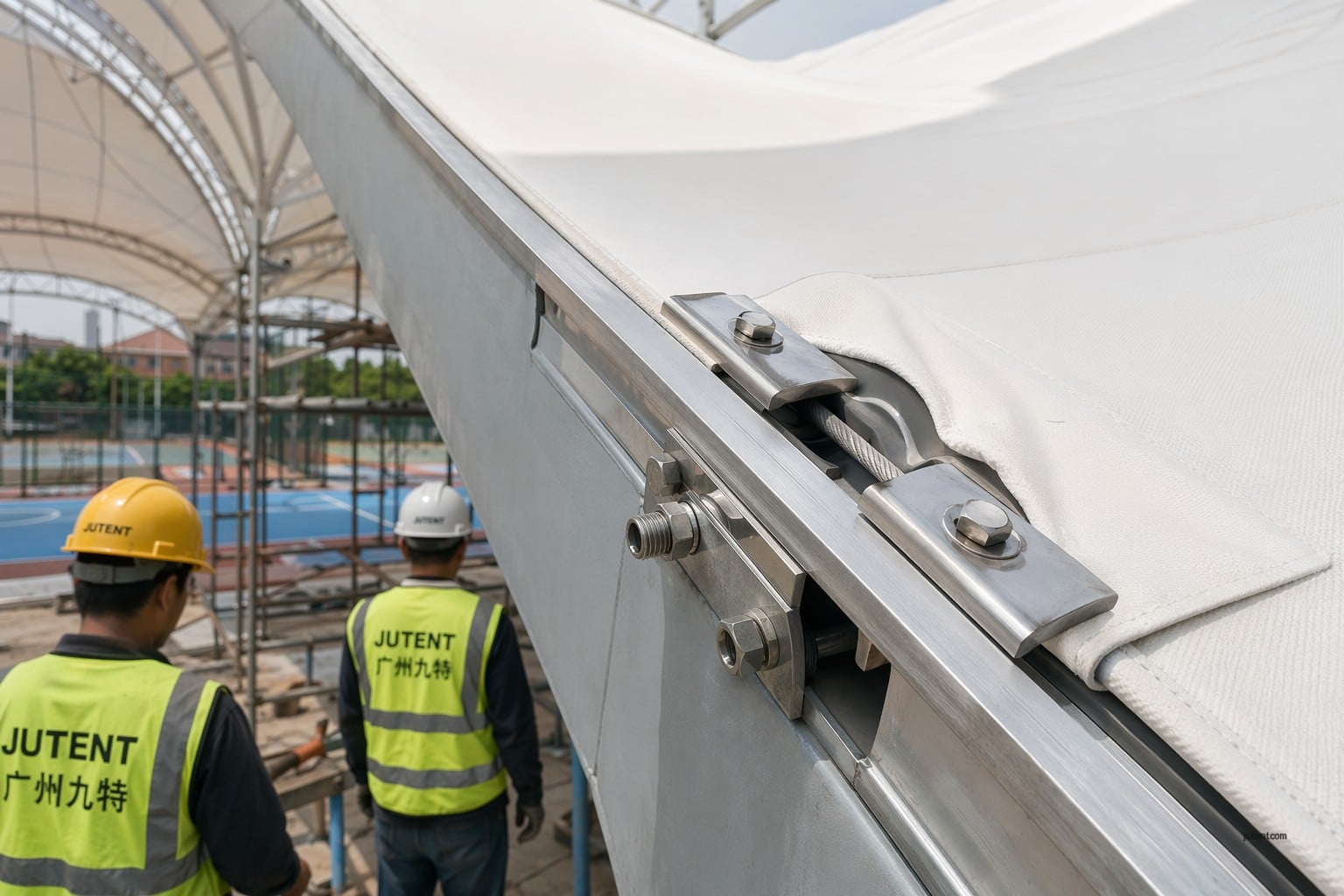
Jutent delivers a collaborative installation model maximizing contractor control while ensuring technical precision.
- Remote services by Jutent:
- Detailed shop drawings and 3D installation models.
- Pre-fabricated membrane panels with numbering and cutting precision.
- Engineering support during foundation layout and steel assembly.
- Technical guidance through video calls and progress monitoring.
- Site team responsibilities:
- Excavation and pouring of foundations per engineering specs.
- Steel frame erection and column anchoring.
- Membrane installation, tensioning, and edge finishing under Jutent remote supervision.
- Final inspections and commissioning.
FAQ
What is the minimum clearance height for a sports court shade structure?
The minimum clearance height is generally 7.5 meters (approximately 24.6 feet) to allow safe play, including ball trajectory and player movement. Some sports or local regulations may require up to 9 meters.
Can a tensile shade structure withstand tropical storms?
Yes, provided the structure is engineered for the site's wind zone with appropriate membrane tensioning, steel sizing, and foundation design. Structures certified for wind speeds up to 150 km/h or higher can withstand most tropical storms.
What's the typical lead time from order to delivery?
Lead times vary by project size and complexity but typically range from 3 to 6 weeks for fabrication and shipment after final design approval.