
Pricing should be reviewed by product category and project scope rather than treated as a fixed published number. For an accurate quotation, the structure size, wind rating, membrane grade, and delivery terms should be confirmed first.
Whether you are a main contractor tendering for a new highway infrastructure project or a developer upgrading an existing provincial checkpoint, locking in an accurate toll station canopy price early in the planning phase is critical. Estimating based on generic square-metre rates often leads to significant budget shortfalls once site-specific wind loads, clearance heights, and material grades are factored into the final engineering drawings. By understanding the specific variables that dictate the commercial toll station canopy cost, procurement teams can evaluate supplier quotes effectively, eliminate hidden contingencies, and ensure the final structure meets both local building codes and long-term durability requirements.
The 5 Factors That Drive Toll Station Canopy Cost
Five primary variables dictate the final toll station canopy price: structural steel weight, membrane material grade, foundation requirements, wind load specifications, and the complexity of the structural form.
A 40GP container typically supports about 21–28 tons of payload, while the actual covered area depends on structure type, steel quantity, and packing method.
The final technical values should be confirmed against the project-specific engineering requirements and local code conditions.
Finally, the structural form dictates the membrane patterning and tensioning hardware required. Simple barrel vaults are highly efficient to manufacture. Complex hyperbolic paraboloids require more fabric waste and heavier perimeter cables. For related infrastructure like Toll Gas Stations, similar structural logic applies to the canopy budget.
Cost by Project Scale: Small vs Large Applications
The toll station canopy cost per sqm decreases as the total footprint increases, primarily due to economies of scale in steel fabrication and membrane cutting.
A small, two-lane provincial toll booth (approximately 150 square metres) will sit at the higher end of the per-square-metre cost spectrum. The fixed costs of engineering design, structural analysis, and machine setup for cutting the membrane are distributed over a smaller area. In these applications, supply-only costs often hover around $60 to $70/m².
Conversely, a large commercial toll station canopy spanning eight to twelve lanes (800+ square metres) benefits from high material efficiency. The primary steel trusses can span longer distances with fewer intermediate columns, reducing foundation costs, excavation requirements, and base plate hardware. For these large-scale applications, the supply cost drops closer to $35 to $45/m².
Based on Jutent’s experience across 400+ projects in 30+ countries, similar specification issues often appear when early-stage assumptions are made before the engineering conditions are confirmed.
Membrane Grade: How Material Choice Affects the Budget
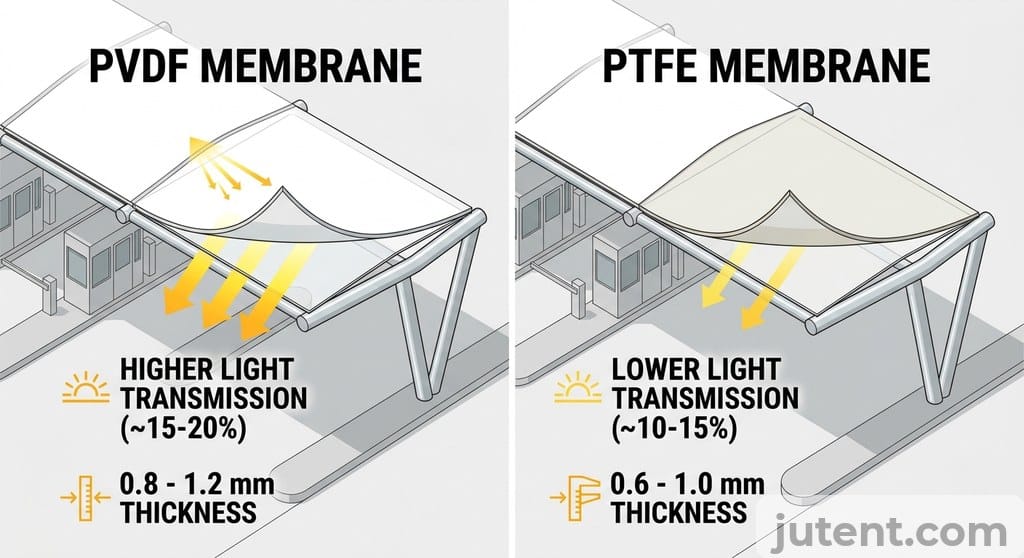
Membrane selection directly impacts both the initial capital expenditure and the long-term maintenance budget. The commercial toll station canopy cost heavily depends on whether the specification calls for standard PVC, PVDF-coated PVC, or PTFE.
Corrosion protection and service life should be described according to the selected protection system, project environment, and maintenance conditions rather than as an unconditional lifespan guarantee.
Standard 900g/㎡ PVC is cheaper upfront, saving approximately $3 to $5/m². However, without the protective fluorocarbon surface layer, standard PVC absorbs UV radiation and traps exhaust dirt, often requiring replacement within 8 to 10 years. The math does not support the initial saving.
The final technical values should be confirmed against the project-specific engineering requirements and local code conditions.
Supply-Only vs Supply-and-Install: Understanding the Price Difference
Contractors must clearly define the procurement scope when evaluating a toll station canopy price. The difference between a supply-only contract and a full supply-and-install package fundamentally changes the budget structure.
A supply-only contract covers the engineering drawings, fabricated steel components, tensioned membrane panels, cables, and all necessary connection hardware delivered to the port or site. This approach is highly cost-effective for main contractors who already have steel erection crews and crane access on site. The supplier provides a detailed installation manual, and the local team executes the build.
A supply-and-install contract shifts the labor, equipment hire, and site management risk to the canopy specialist. This includes mobilizing specialized membrane technicians, hiring mobile cranes (typically 25-ton to 50-ton capacity depending on truss weights), and managing elevated work platforms.
In a recent 6-lane highway project in the Philippines, the contractor opted for a supply-only kit. We supplied the structure pre-cut and pre-drilled with numbered components. By utilizing their existing site cranes and following the provided tensioning sequence, they reduced their total installation budget by 40% compared to a full turnkey subcontract.
How to Get an Accurate Quote
To move from a rough estimate to a precise toll station canopy budget, contractors must provide suppliers with specific, measurable project data. Vague requests yield padded quotes, as engineers must build in contingencies for unknown variables.
First, define the exact dimensions: total length, width, and the required minimum clearance height. A 5.5-metre clearance requires a different steel profile than a 6.0-metre clearance.
The final technical values should be confirmed against the project-specific engineering requirements and local code conditions.
Third, state the preferred structural form and membrane grade. If the project requires a specific aesthetic—such as a wave-form roof or a standard flat-pitch design—include reference images or architectural sketches.
Finally, clarify the scope of work. State whether the request is for supply-only (ex-factory or CIF) or if site supervision is required. Providing these four data points allows the engineering team to generate an accurate, fabrication-ready cost breakdown within days rather than weeks.
If you want an accurate budget reference for this project, share your dimensions, wind zone, and preferred membrane type with our team.
FAQ
- What is the cost per square metre for a toll station canopy?
- Supply cost typically ranges from $25–$70/m² ex-factory, depending on structural form and membrane grade. Large-scale, multi-lane structures utilizing standard 1050g/㎡ PVDF and simple portal frames benefit from high material efficiency, placing them at the lower end of this spectrum. Conversely, smaller two-lane provincial stations or designs requiring complex hyperbolic paraboloid forms, heavy 300x300mm SHS columns, and high wind-load engineering will push the final per-square-metre price toward the upper limit.
- What information do I need to get an accurate toll station canopy quote?
- Project dimensions, location (for wind load), preferred structural form, and membrane grade preference. You must also specify the required clearance height—typically 5.5 metres for heavy commercial transport—as this directly dictates the primary column steel tonnage and base plate sizing. Additionally, clarifying whether you require a supply-only kit or on-site technical supervision ensures the final proposal aligns perfectly with your procurement strategy and site capabilities.