
The final technical values should be confirmed against the project-specific engineering requirements and local code conditions.
What Makes Transit Hub Tensile Canopy Engineering Different
Transit environments impose strict constraints on structural geometry and material selection. Unlike standard commercial shade structures, a transit terminal tensile structure must accommodate high-clearance vehicles, manage massive rainwater runoff, and operate in highly corrosive exhaust environments.
The primary engineering difference lies in the load-to-weight ratio. A traditional steel-and-glass canopy spanning 20m requires significant structural depth and heavy foundations. A tensile membrane system achieves the same span using a 1050g/㎡ PVDF fabric tensioned across a lightweight steel frame, transferring loads through geometry rather than mass. This reduces foundation requirements—a critical advantage when building over existing subway lines or dense underground utility networks where deep excavation is impossible.
Clearance heights dictate the structural form. Double-decker buses and articulated transit vehicles typically require a minimum clear height of 5.5m at the perimeter. To maintain membrane tension and prevent ponding, the central peaks of the canopy must rise to 9m or higher, creating a steep pitch that accelerates water shedding during heavy downpours.
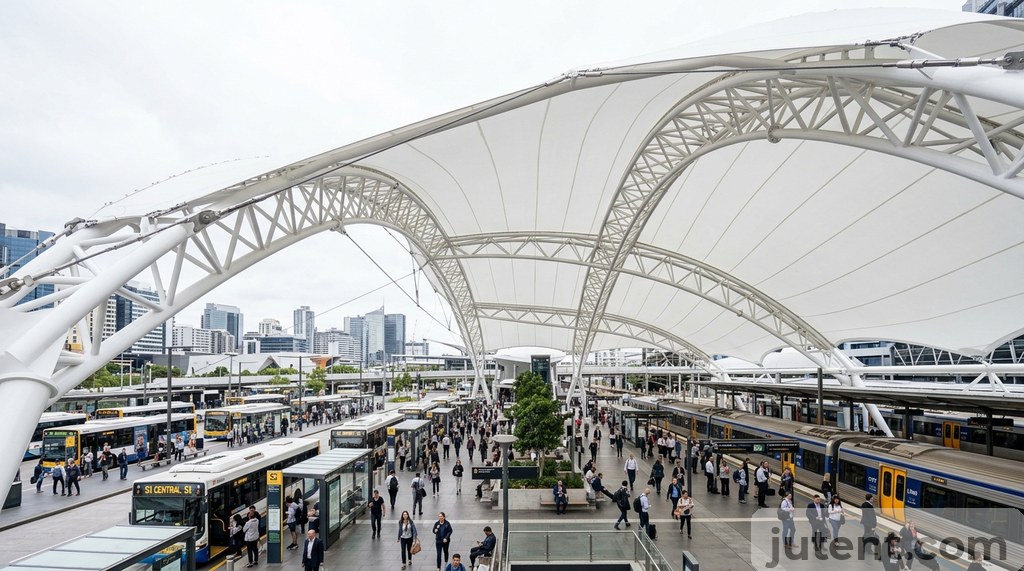
For contractors, the focus must be on pre-fabrication. Transit hubs cannot close for months. Specifying Transit Canopies that arrive pre-cut and pre-drilled allows for rapid night-shift assembly, minimizing disruption to active bus lanes and passenger concourses.
Span Options: How Much Area Tensile Canopies Can Cover
Tensile structures excel at covering expansive footprints with minimal material. The maximum practical span depends entirely on the chosen structural configuration and the site’s wind exposure.
Barrel vault and continuous ridge-and-valley forms are the standard for linear passenger platforms. These configurations typically span 10m to 15m wide and can extend infinitely in length by repeating the structural bays. For central interchanges or main concourses, conical or mast-supported structures are preferred. A single central mast can support a membrane spanning up to 30m in diameter, covering approximately 700㎡ of ground area without a single intermediate column.
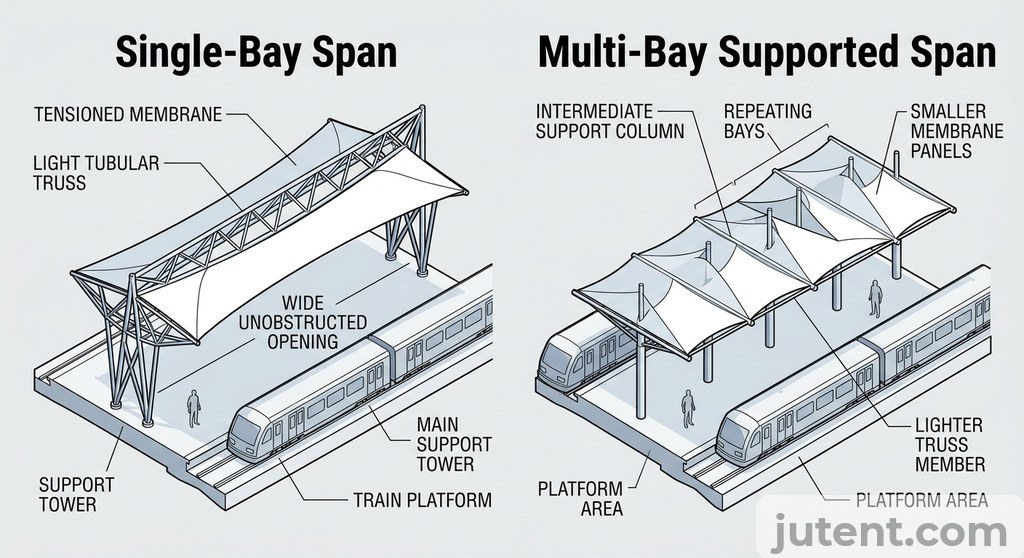
When specifying a transit hub shade canopy, contractors must balance span against steel tonnage. Pushing a clear span from 20m to 30m does not just increase the membrane area; it exponentially increases the required diameter and wall thickness of the primary steel members to resist deflection. This directly impacts the project budget and installation crane requirements.
For detailed bay spacing recommendations on linear platforms, refer to our Bus Station Canopy Guide. In most municipal projects, a 12m × 12m grid offers the optimal balance between foundation costs, steel weight, and passenger circulation space.
Wind Performance: What Transit Hub Canopies Need to Withstand
Wind loading dictates the primary steel sizing and membrane pre-stress levels. A public transit tensile canopy acts as a massive sail; it must be engineered to resist both downward pressure and severe uplift forces generated by open-sided structures.
The final technical values should be confirmed against the project-specific engineering requirements and local code conditions.
Uplift is the critical failure point for lightweight roofs. To counter this, the membrane must be double-curved (anticlastic). This geometry ensures that when wind pushes down on one axis, the opposing axis resists the load. The membrane is typically pre-stressed to 2.5–3.0 kN/m during installation. If the pre-stress is too low, the fabric will flutter under high winds, leading to rapid fatigue of the structural connections and eventual tearing at the perimeter plates. Specifications must clearly state the required wind speed based on local building codes, not generic estimates.
Column Placement: Minimising Obstruction for Passenger Flow
Column placement is a circulation decision before it is a structural one. In a transit facility tensile roof, every ground-level obstruction creates a bottleneck for pedestrian traffic and a collision risk for maneuvering vehicles.
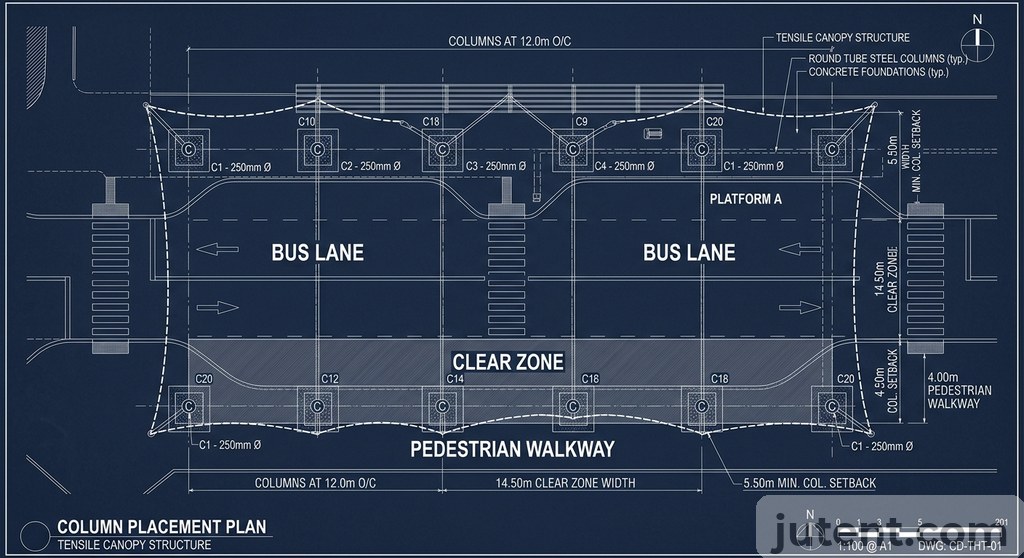
The most effective strategy is perimeter support. By pushing columns to the outer edges of the bus lanes or passenger islands, the central concourse remains entirely clear. When intermediate columns are unavoidable due to extreme spans, they must be integrated into existing dead zones, such as between seating banks, ticketing kiosks, or structural retaining walls.
Cantilevered structures are frequently specified for boarding platforms. A single row of rear columns can support a canopy overhanging 5m to 8m, providing complete weather protection for boarding passengers while keeping the bus approach lane completely free of structural supports.
However, cantilevers introduce high torsion loads at the base. A 6m cantilevered canopy engineered for a 150km/h wind zone typically requires a reinforced concrete footing measuring at least 2.5m × 2.5m × 1.0m deep per column. Contractors must verify that the existing platform width and underground utility layout can accommodate these foundation dimensions before committing to a cantilevered design.
Maintenance Considerations for High-Traffic Transit Canopies
Transit hubs are high-pollution environments. Diesel exhaust, brake dust, and urban smog accumulate rapidly on roof surfaces. The specification of the membrane material directly determines the maintenance cycle and the long-term visual appeal of the facility.
Budget planning should be based on structure type, clear span, wind rating, membrane grade, steel tonnage, and project scope. For an accurate EXW, FOB, CIP, or DDU quotation, the project dimensions and engineering requirements should be reviewed first.
A 1050g/㎡ PVDF (Polyvinylidene Fluoride) membrane features a low-friction topcoat that repels dirt. Rainwater naturally washes away most surface contaminants. Maintenance is reduced to an annual low-pressure wash using water and a mild, non-abrasive detergent, keeping operational costs low for the transit authority.
hot-dip galvanized to a minimum of 85 microns (ISO 1461) and finished with a marine-grade epoxy topcoat
If you are reviewing technical options, ask our team for the latest specification datasheet and standard material details for this structure type.
Get the specification datasheet
FAQ
- What is the maximum span for a transit hub tensile canopy?
- Tensile canopies can span 15–30m between supports, depending on structural form. These structures offer a distinct advantage in weight reduction compared to traditional steel, enabling wider column-free zones critical for efficient passenger circulation and bus lane layouts. This capability minimizes ground-level obstructions, which is a key consideration for transit facilities where every support creates a potential bottleneck. For specific applications like boarding platforms, cantilevered designs can provide 5m to 8m overhangs, keeping approach lanes entirely clear.
- How are transit hub tensile canopies maintained?
- PVDF membrane requires minimal maintenance — periodic cleaning with water and mild detergent. In high-pollution transit environments, a 1050g/㎡ PVDF membrane features a low-friction topcoat that effectively repels dirt and allows rainwater to naturally wash away most surface contaminants. This reduces maintenance to an annual low-pressure wash, significantly lowering operational costs compared to standard PVC which degrades and requires harsh chemical cleaning. Additionally, all primary and secondary steelwork must be hot-dip galvanized to a minimum of 85 microns (ISO 1461) and finished with a marine-grade epoxy topcoat to prevent corrosion in the slightly acidic conditions caused by exhaust fumes.