
A warehouse tensile canopy in Southeast Asia must solve three problems that most temperate-zone specifications never address: typhoon-rated wind loads, sustained tropical UV degradation, and drainage volumes that can exceed 200 mm per hour during monsoon events. Contractors and procurement managers in the Philippines, Malaysia, Vietnam, and Indonesia regularly encounter these challenges when sourcing from suppliers who lack regional design experience. This guide covers the critical engineering decisions — from wind load calculation methods and membrane grade selection to drainage geometry and steel surface treatment — so that your next warehouse tensile canopy project in Southeast Asia is specified correctly from the start and built to last.
Typhoon Wind Load Requirements in Southeast Asia
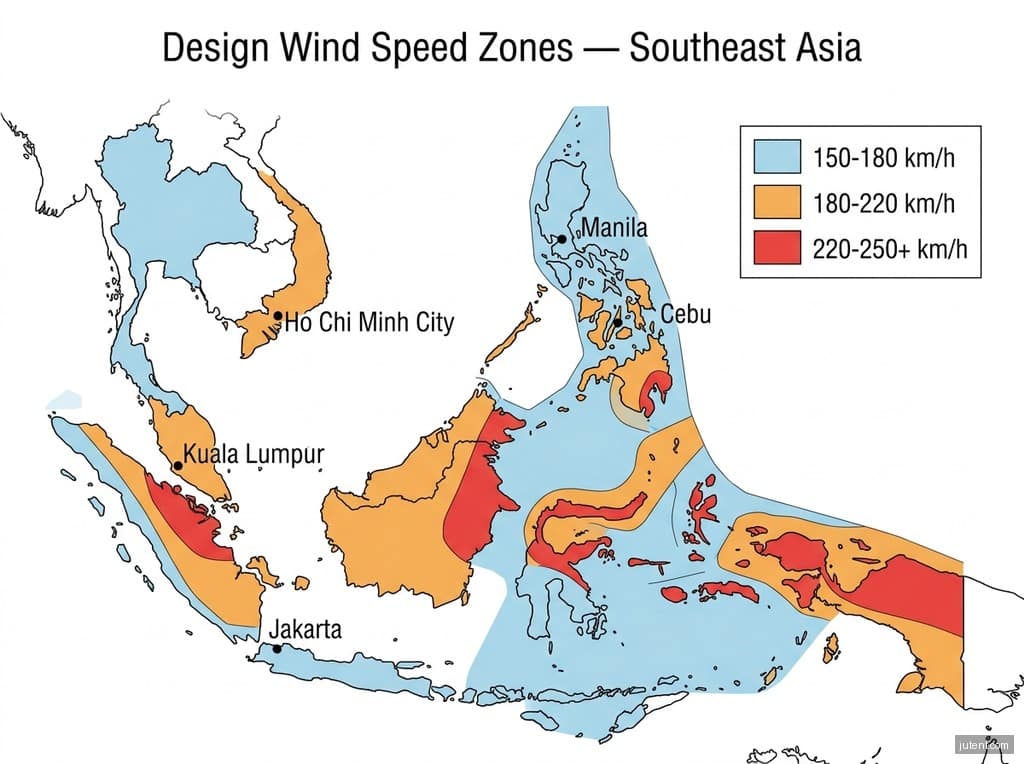
Designing a warehouse tensile canopy for Southeast Asia means confronting some of the world’s most extreme wind events. Typhoons, known as tropical cyclones or hurricanes in other regions, bring devastating wind speeds that can exert immense pressure on large surface areas like warehouse roofs. Local building codes, such as the National Structural Code of the Philippines (NSCP), are explicit about the design wind speeds required, often exceeding 200 km/h in many coastal areas. Ignoring these specifications is not an option; it risks structural failure, property damage, and significant safety hazards.
Engineers must perform detailed wind load analysis, considering factors like the building’s height, location (coastal vs. inland), terrain category, and the canopy’s geometry. The structural steel framework – typically Q235B or Q355B – must be engineered to withstand these dynamic forces, with connections and foundations designed for uplift and lateral loads. Anchorage systems, including foundation bolts and plates, are critical components that transfer these forces safely to the ground. Based on Jutent’s experience across 400+ projects in 30+ countries, we consistently specify heavy-section steel members and connection details to meet or exceed regional typhoon-rated standards. For export projects, Jutent can provide design drawings, calculations, material specifications, installation manuals, and free remote guidance, subject to project scope and contract terms.
Warehousing
UV Protection in Tropical Climates: Membrane Grade Requirements
The tropical sun in Southeast Asia delivers an unrelenting dose of ultraviolet (UV) radiation, which can rapidly degrade conventional materials. For a warehouse tensile canopy, the membrane is the primary shield against these elements, making its UV resistance paramount. Standard PVC membranes, while cost-effective for some applications, often lack the long-term UV stability required for this region, leading to premature material degradation, discolouration, and loss of mechanical properties.
High-performance membranes like PVDF (Polyvinylidene Fluoride) and PTFE (Polytetrafluoroethylene) are essential for tropical climates. PVDF membranes, such as Jutent’s standard 1050 g/m² option, offer excellent UV resistance, maintaining their integrity and aesthetic appeal for 15+ years. PTFE membranes provide even greater longevity, with a service life exceeding 25 years and superior resistance to environmental factors. The choice between PVDF and PTFE depends on the project’s budget, desired lifespan, and specific environmental exposures. Both types feature advanced surface treatments that reflect a significant portion of solar radiation, helping to reduce heat build-up underneath the canopy – a crucial benefit for warehouse operations in hot climates.
Warehouse Tensile Canopy Guide
Drainage Design for High-Rainfall Environments
Southeast Asia experiences some of the highest annual rainfall totals globally, often delivered in intense, short bursts. Effective drainage design for a warehouse tensile canopy is not merely an add-on; it’s a fundamental engineering requirement to prevent water ponding, structural overload, and potential damage to stored goods. Inadequate drainage can lead to significant issues, including membrane stretching, corrosion of steel components, and even collapse under extreme water loads.
The design must account for peak rainfall intensity, which varies by location but can be substantial. Gutter systems, downspouts, and internal drainage channels must be sized appropriately to handle these volumes. The membrane’s form itself plays a critical role; hyperbolic paraboloid (hypar) or conical shapes naturally shed water more effectively than flatter designs. Jutent engineers meticulously calculate catchment areas and flow rates to specify the correct gutter dimensions and downpipe diameters, typically using SS304 stainless steel for durability and corrosion resistance. Slopes within the membrane design are carefully considered to ensure positive drainage, preventing any accumulation of water that could compromise the canopy’s structural integrity or lead to unsightly staining and mildew growth.
Case Reference: Projects in Southeast Asia
Based on Jutent’s experience across 400+ projects in 30+ countries, warehouse tensile canopy projects in Southeast Asia consistently require three design adjustments compared to standard export specifications: a higher steel section class to handle typhoon uplift, a PVDF or PTFE membrane rather than standard PVC, and a drainage system sized for monsoon peak flow rather than average annual rainfall.
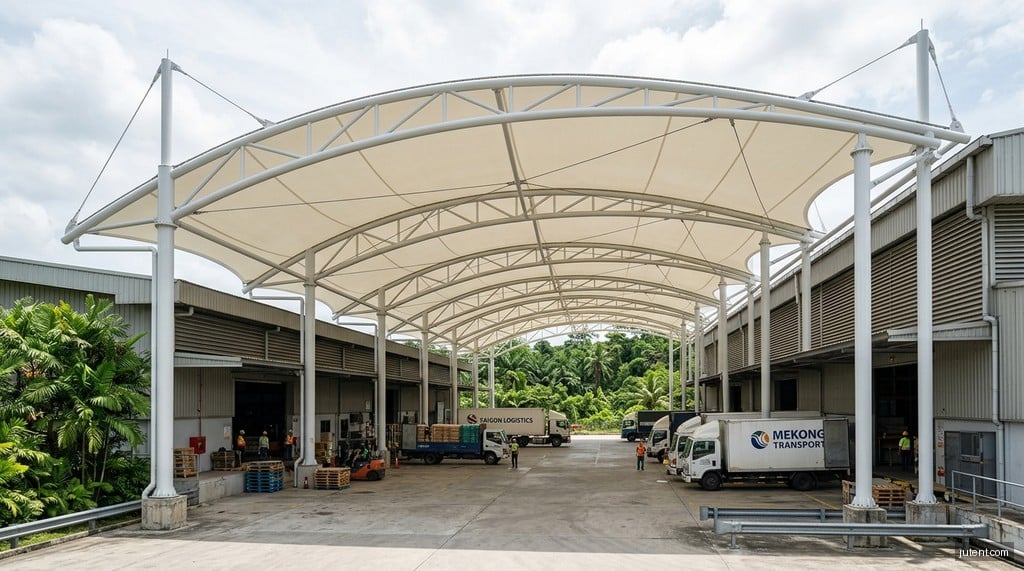
For a logistics hub project in a Philippine coastal zone, the design wind speed was set at 250 km/h per NSCP requirements. The 2,500 m² PVDF canopy used Q355B steel with hot-dip galvanising plus an epoxy zinc-rich primer and fluorocarbon topcoat. Gutter and downpipe sizing was calculated at 1.5× the standard tropical rainfall intensity to provide a safety margin during typhoon-driven rain events. Supply documentation included structural calculations, material certificates, and a full installation manual with remote guidance support.
A separate manufacturing facility project in Malaysia specified a 1,800 m² PTFE canopy to achieve a 25+ year service life with minimal maintenance. The PTFE membrane’s self-cleaning surface property was a key selection criterion given the site’s proximity to industrial emissions. Steel was hot-dip galvanised to handle the high ambient humidity. Both projects were supplied with Jutent’s standard documentation package, including design drawings, calculations, material specifications, and installation guidance, subject to project scope and contract terms.
These references illustrate the typical engineering adjustments required for Southeast Asian warehouse projects. Contractors should treat these as baseline expectations when preparing RFQs for the region, rather than assuming a standard catalogue specification will be sufficient.
FAQ
- What wind speed should a warehouse tensile canopy in the Philippines be designed for?
- The National Structural Code of the Philippines (NSCP) mandates specific design wind speeds depending on the location. For most areas, especially coastal regions prone to typhoons, a warehouse tensile canopy should be engineered to withstand design wind speeds typically ranging from 200 km/h to 250 km/h. This ensures the structure can safely endure the extreme forces exerted by tropical cyclones, protecting both the canopy and its contents.
- How does tropical humidity affect a warehouse tensile canopy steel structure?
- Tropical humidity significantly increases the risk of corrosion for steel structures. To counteract this, Jutent employs advanced surface treatments. For projects in Southeast Asian coastal areas, hot-dip galvanising is a standard and highly effective method, providing a durable zinc coating that acts as a sacrificial barrier. For enhanced longevity and aesthetic appeal, an epoxy zinc-rich primer followed by an acrylic or fluorocarbon topcoat is also a common and approved specification.
Tell us your project location in Southeast Asia and we’ll provide a typhoon-rated specification.