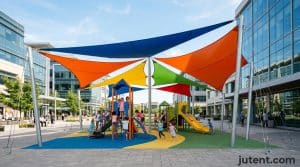

Australia records some of the highest UV radiation levels globally, paired with strict cyclonic and non-cyclonic wind codes. For contractors, installing a school playground shade structure Australia requires navigating two non-negotiable standards: UPF 50+ UV protection and AS/NZS 1170.2 wind load compliance. Failing either metric guarantees the structure will not pass council certification or school board sign-off. This guide covers exactly what contractors need to specify, the documentation required for local approvals, and how to source compliant tensile structures effectively.
UPF 50+ UV Protection: What Australian Standards Require for School Playgrounds
The final technical values should be confirmed against the project-specific engineering requirements and local code conditions.
Corrosion protection and service life should be described according to the selected protection system, project environment, and maintenance conditions rather than as an unconditional lifespan guarantee.
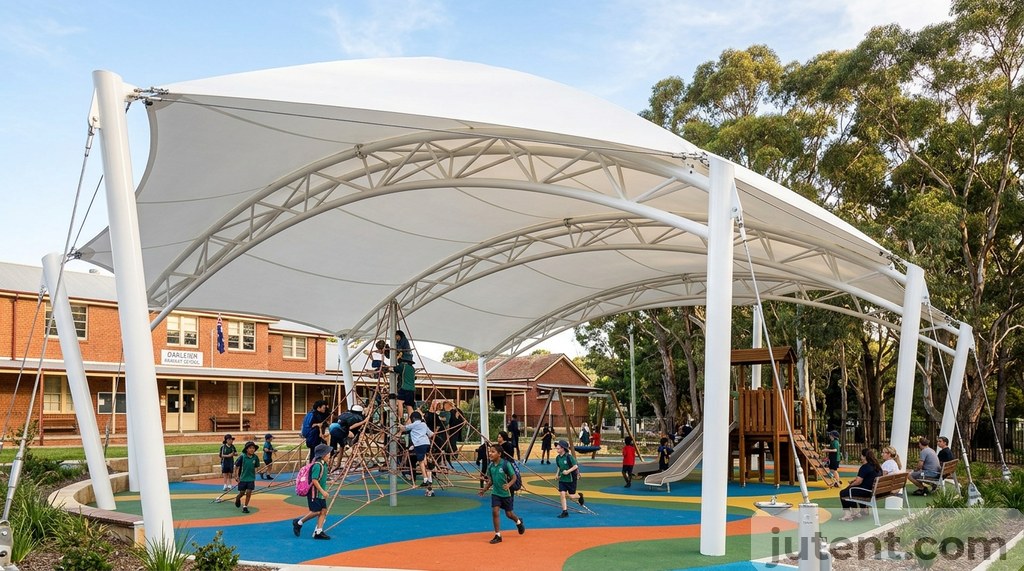
The membrane must be tested according to AS 4174 for synthetic shade fabrics or equivalent standards for solid tensioned membranes. Contractors must secure the UPF 50+ test certificate from the manufacturer before submitting the tender. Without this documentation, school administrators and local councils will reject the proposal. A playground canopy UPF 50 specification is a strict liability requirement for educational facilities protecting students, not an optional upgrade.
AS/NZS
Compliance with AS/NZS 1170.2 (Structural Design Actions – Wind Actions) dictates the steel sizing, footing depth, and membrane tensioning of any school shade structure AS NZS. Australia is divided into distinct wind regions, from Region A (non-cyclonic, interior) to Region D (severe cyclonic, Western Australia coast).
A structure designed for Sydney (Region A, 43 m/s ultimate wind speed) requires vastly different engineering than one in Cairns (Region C, 66 m/s). Contractors must ensure the manufacturer provides site-specific engineering calculations. Standardized kits without local engineering stamps will fail certification. This standard ensures the canopy will not fail catastrophically during severe weather events, protecting both property and lives.
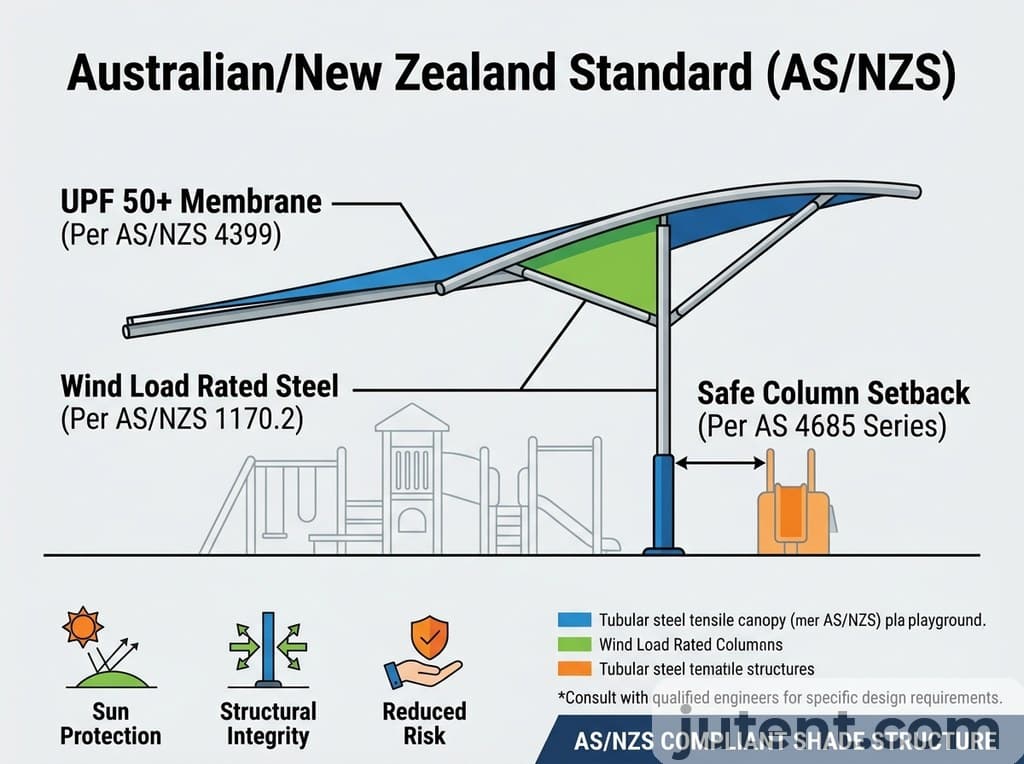
The primary framework typically utilizes hot-dip galvanized steel, such as 150×150×6mm SHS columns for standard spans, to resist uplift forces. For a complete breakdown of structural sizing, refer to our Playground Shade Structures Guide. The engineering drawings must explicitly state the design wind speed, terrain category, and importance level to satisfy the certifier. If the supplier cannot provide calculations referencing AS/NZS 1170.2, the structure cannot be legally erected on an Australian school site.
Wind Load Requirements for Australian Playground Shade
Wind load engineering for playground shade Australia goes beyond identifying the regional wind speed. The calculations must account for Terrain Category and Importance Level. Schools are high-occupancy zones, meaning structures are usually classified as Importance Level 3. This classification applies a multiplier to the base wind load, requiring heavier steel sections and larger concrete footings.
For example, a 15m × 15m hip-roof shade structure in an open school oval (Terrain Category 2) experiences significantly higher wind pressure than the same structure shielded by surrounding multi-story buildings (Terrain Category 3). The uplift force on a 225m² membrane can exceed 150 kilonewtons during a severe storm.
To counteract this, contractors must install bored pier footings, often reaching 1.5m to 2.5m in depth depending on the soil report. The membrane itself must be tensioned using stainless steel catenary cables—typically 8mm or 10mm 316-grade—to prevent wind whip. Wind whip causes premature fabric failure and structural fatigue at the connection points. Proper tensioning transfers the wind loads efficiently from the membrane through the cables and into the primary steel frame.
Council Approval: What Documentation Is Typically Required
Securing local council approval for a school playground shade structure requires a specific set of technical documents. Missing paperwork remains the primary cause of project delays. Contractors must submit a complete package to the principal certifying authority (PCA) before any site work begins.
The required documentation includes site-specific architectural drawings detailing clearance heights. Schools typically mandate a minimum clearance of 2.5m at the lowest eaves to prevent vandalism and ensure safe play. Contractors must also provide structural engineering plans stamped by a structural engineer registered on the National Engineering Register (NER).
Across our Australian projects, the most common delay at the permit stage is the absence of a site-specific soil report. Engineers cannot finalize the footing design without knowing the exact soil bearing capacity. Assuming a standard 100 kPa allowable bearing pressure often leads to rejected applications and mandatory redesigns.
Councils also require UPF 50+ membrane test certificates and a fire test report, such as AS 1530.2 or AS 1530.3, to confirm the fabric’s flammability index. Submitting these manufacturer-prepared documents upfront accelerates the approval timeline and prevents costly compliance failures.
Sourcing from China: What Australian Contractors Need to Verify
Importing a shade structure from China offers significant cost advantages, but Australian contractors must verify that the materials and engineering align with local codes. The primary risk is receiving a structure designed to lighter international standards that cannot pass Australian certification. Skipping this verification step often results in structures that are stranded at the port or rejected by the site inspector.
First, verify the steel grade. Chinese manufacturers typically use Q355B steel. The supplier must provide mill certificates proving this material meets the mechanical properties equivalent to Australian Standard AS 3678 Grade 350.
fluorocarbon topcoat should be applied over the galvanized layer for an architectural finish and extended lifespan.
Finally, ensure the manufacturer can coordinate with an Australian-registered engineer to review and stamp the shop drawings. The supplier must provide all connection details, weld sizes, and bolt specifications—such as Grade 8.8 high-tensile bolts. This allows the local engineer to run the AS/NZS 1170.2 compliance checks without ambiguity, ensuring the imported structure is fully compliant before it ships.
Cost Benchmarks: Playground Shade Structure Supply Cost in Australia
Pricing should be reviewed by product category and project scope rather than treated as a fixed published number. For an accurate quotation, the structure size, wind rating, membrane grade, and delivery terms should be confirmed first.
This translates to approximately $80 to $125 AUD per square metre for the complete kit, including the pre-cut steel frame, PVDF membrane, tensioning hardware, and fasteners. Structures destined for cyclonic regions (Region C or D) sit at the higher end of this spectrum due to the heavier steel sections and reinforced base plates required.
Pricing should be reviewed by product category and project scope rather than treated as a fixed published number. For an accurate quotation, the structure size, wind rating, membrane grade, and delivery terms should be confirmed first.
If you are developing a project concept and need layout or structural guidance, share your project information and our team can review the design direction with you.
FAQ
- Do playground shade structures from China meet Australian standards?
- Yes, reputable manufacturers can supply playground shade structures from China that fully meet Australian standards. This is confirmed when the manufacturer provides comprehensive engineering drawings stamped and certified by a registered Australian engineer. Crucially, they must also furnish detailed wind load calculations specifically compliant with AS/NZS 1170.2, demonstrating structural integrity for Australian conditions. Furthermore, the tensile membrane material must be accompanied by independent test certificates verifying a UPF 50+ rating, ensuring optimal sun protection for children.
- What is the cost of a school playground shade structure in Australia?
- The supply cost for a standard school playground shade structure, typically ranging from 100–200m², generally falls between $8,000–$25,000 AUD ex-factory when sourced from China. This figure represents the material and manufacturing cost, excluding shipping, import duties, local installation, and any necessary engineering certifications specific to Australian standards. Project managers and contractors should factor in these additional costs, which can significantly impact the final installed price. Variations in material specifications, design complexity, and membrane type will also influence the ex-factory cost.