
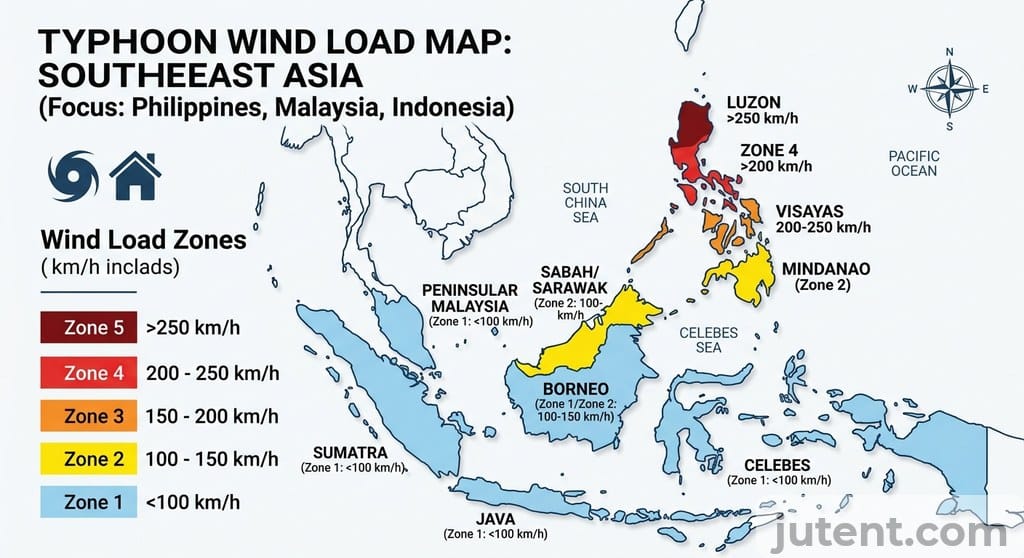
When engineering an outdoor stage canopy, Southeast Asia presents a structural reality that standard European or North American templates simply cannot accommodate: Category 5 typhoon wind loads and relentless tropical humidity. For contractors and structural engineers in the Philippines, Malaysia, or Indonesia, specifying a performance venue means designing for wind speeds exceeding 250 km/h and extreme UV exposure that accelerates plasticizer migration in standard PVC membranes. This guide details the specific engineering modifications required to ensure your tensile structure survives the local climate and secures municipal approvals. We examine the exact architectural membrane grades, steel anti-corrosion treatments (such as ISO 1461 hot-dip galvanizing), and regional wind code compliance necessary to construct a permanent, safe performance space in one of the world’s most demanding environments.
Typhoon Wind Load Requirements for Stage Canopies in Southeast Asia
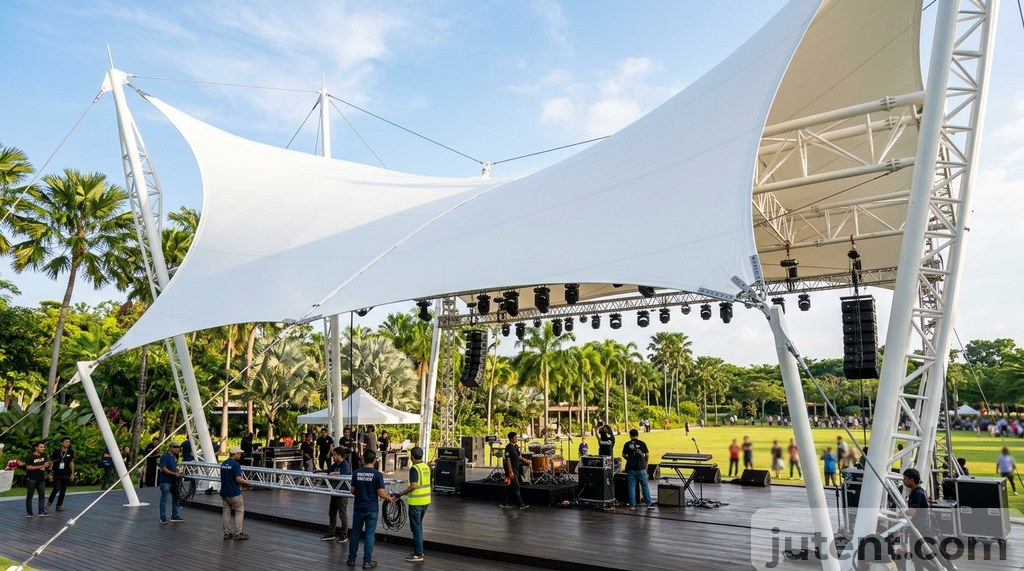
A typhoon rated stage canopy requires a primary steel frame and foundation system engineered for extreme uplift forces. Standard stage covers designed for temporary European festivals typically fail under Southeast Asian wind loads because they are engineered for 100 km/h gusts. In contrast, permanent structures in this region must meet much stricter local codes.
For example, the National Structural Code of the Philippines (NSCP) mandates design wind speeds of 200 to 250 km/h for coastal and typhoon-prone provinces. To handle this, the engineering specification must shift from lightweight aluminum trusses to heavy-duty structural steel. We typically specify 200×200×8mm Square Hollow Section (SHS) primary columns with moment-connected base plates for a standard 15m x 10m stage footprint. The connections themselves require high-tensile M24 bolts to resist the massive shear forces generated during a storm event.
The membrane tensioning system also requires modification. Cable-braced perimeters using 12mm or 16mm stainless steel wire rope are necessary to transfer wind loads efficiently to the primary steel, preventing the membrane from tearing under extreme negative pressure. If you are evaluating Stage Covers, ensure the supplier provides structural calculations specifically modeled for your exact site coordinates, not a generic wind rating.
UV and Humidity: How Tropical Conditions Affect Stage Membrane Longevity
Tropical humidity and high UV radiation dictate the material specification for any outdoor stage shade Indonesia or Malaysia requires. A standard 650g/㎡ PVC membrane will degrade, discolor, and lose tensile strength within three to five years under a constant UV Index of 11 to 13.
The baseline specification for Southeast Asia must be a 1050g/㎡ PVDF architectural membrane. The fluorocarbon surface layer of PVDF reflects UV radiation rather than absorbing it. At these extreme UV levels, a 1050g/㎡ PVDF membrane maintains its tensile strength within 10% of the original specification after 15 years of continuous exposure. The price difference between standard PVC and heavy-duty PVDF is approximately $3 to $5 per square meter, but the lifespan difference is five to eight years. The math simply does not support the initial cost saving.
The required specification is hot-dip galvanizing to a minimum of 85 microns, followed by a marine-grade fluorocarbon topcoat.
Drainage Design for High-Rainfall Environments
Monsoon seasons in Southeast Asia introduce massive water loads that cause catastrophic ponding if the stage canopy lacks adequate slope and tension. A stage cover Malaysia contractors install must handle rainfall rates exceeding 250mm per hour during peak monsoon downpours.
The critical engineering metric for these environments is membrane slope. We specify a minimum pitch of 15 to 20 degrees for all tropical stage canopies to ensure rapid runoff. Flat or low-pitch designs inevitably accumulate water, leading to membrane stretching and structural failure from dead weight. A single cubic meter of ponded water adds 1,000 kg of dead load, quickly exceeding standard steel frame limits and risking collapse.
Proper drainage requires strict control of membrane pre-stress during installation. Under-tensioning creates slack areas where water collects and pools. Installers must tension the membrane to a minimum of 2.5 kN/m to ensure the fabric remains taut under heavy rain and wind. To protect the stage floor and sensitive electrical equipment, water runoff is directed through integrated perimeter gutters and PVC downpipes concealed within the primary steel columns. This configuration manages high-volume drainage while maintaining structural aesthetics.
Local Authority Approval in the Philippines and Malaysia
Securing building permits for a stage canopy Philippines contractors are building requires site-specific engineering documentation. Local authorities will reject generic structural drawings. The submission must prove the structure complies with local building codes, specifically regarding wind loads and foundation design.
In the Philippines, the Office of the Building Official (OBO) requires structural calculations stamped by a locally licensed civil or structural engineer, proving compliance with the NSCP 2015. The foundation design must account for local soil conditions, which often require a geotechnical report. A typical 15m clear-span stage canopy might require reinforced concrete pad footings measuring 1.5m x 1.5m x 0.8m deep, depending on soil bearing capacity.
In Malaysia, the Uniform Building By-Laws (UBBL) dictate the approval process. The submission must include detailed wind load modeling and fire safety compliance. Tensile membranes must meet specific fire retardancy standards, typically requiring a Class 1 or Class 0 rating under BS 476. Providing the local engineer with a complete, pre-calculated design package from the manufacturer reduces the approval timeline from months to weeks. This documentation must include detailed connection nodes, base plate dimensions, and certified material test reports for both the steel and the membrane.
Case Reference: Stage Canopy Projects in Southeast Asia
Real-world application demonstrates how these specifications come together. A recent outdoor performance venue project in the Philippines required the structure to meet NSCP 250 km/h wind loading. We specified 250×250×8mm SHS primary columns with moment-connected base plates—catching this at the design stage saved the project a complete re-engineering after permit submission.
The client needed a 20m wide clear span to ensure unobstructed sightlines for the audience, with a front clearance height of 8 meters to accommodate lighting trusses and line array speakers. To achieve this without intermediate supports, we engineered a twin-mast tensile structure with a heavy-duty rear arch. The structural drawings were completed and approved by the local engineer of record in just 12 days.
The membrane selected was a 1050g/㎡ PVDF fabric, tensioned via a 16mm stainless steel perimeter cable system. The entire steel frame was hot-dip galvanized and finished with a white marine-grade fluorocarbon topcoat to resist coastal humidity. Delivered as a pre-engineered kit with numbered components, the local contracting team completed the structural erection and membrane tensioning in just 14 days, avoiding costly on-site welding and fabrication delays.
If you are developing a project concept and need layout or structural guidance, share your project information and our team can review the design direction with you.
FAQ
- What wind speed should an outdoor stage canopy in the Philippines be designed for?
- NSCP requires design wind speeds of 200–250 km/h in most Philippine locations. This is significantly higher than standard European or North American requirements. To accommodate these extreme uplift and lateral forces, the engineering specification must utilize heavy-duty structural steel, such as 200x200x8mm SHS columns, rather than lightweight aluminum trusses. The foundation design must also be upsized, often requiring reinforced concrete pad footings exceeding 1.5 meters in width and depth to prevent overturning during a severe typhoon event. Failure to design for these specific wind speeds will result in permit rejection by the local Office of the Building Official.
- How does tropical humidity affect a stage canopy steel structure?
- Hot-dip galvanising plus fluorocarbon topcoat is standard for Southeast Asian coastal projects. Tropical humidity, combined with high ambient temperatures and coastal salt spray, creates a highly corrosive environment that will rapidly degrade standard painted steel. Unprotected or poorly coated steel will develop surface rust within months, eventually compromising the structural integrity of the primary frame. By applying a minimum of 85 microns of hot-dip galvanizing followed by a marine-grade fluorocarbon topcoat, the steel is sealed against moisture ingress, ensuring a design life of over 20 years even in harsh tropical conditions.