
Procuring a playground shade structure from an overseas manufacturer involves more steps than a local purchase. This checklist covers everything from RFQ to delivery — so nothing falls through the cracks.
Step 1: Define the Scope — Playground Dimensions, UPF Requirements, and Wind Zone
Before initiating any playground shade structure procurement, a precise definition of the project scope is paramount. This initial phase establishes the foundational requirements for design, material selection, and structural integrity. Begin by accurately mapping the playground dimensions, including the area to be shaded, existing equipment locations, and any potential obstructions. This spatial data will directly influence the shade structure’s footprint and form.
Next, specify the required Ultraviolet Protection Factor (UPF) for the membrane. While a minimum UPF 50+ is generally recommended for playground applications, local regulations or client specifications may demand higher ratings. Requesting UPF test certificates from potential manufacturers is a critical due diligence step.
Crucially, identify the project’s wind zone and corresponding wind load requirements. This involves consulting local building codes and engineering standards to determine the design wind speed and pressure. A reputable manufacturer will require this information to engineer a structure capable of withstanding anticipated environmental forces. For export projects, Jutent can provide design drawings, calculations, material specifications, installation manuals, and free remote guidance, subject to project scope and contract terms. Finally, consider the desired aesthetic, color palette, and any specific architectural integration requirements.
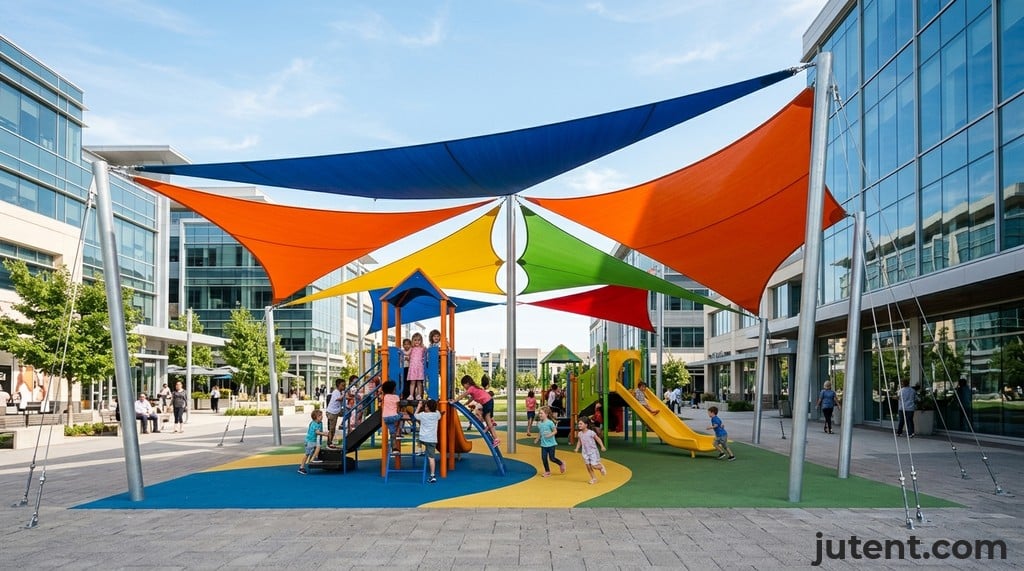
Playground Shade
Step 2: Evaluate Suppliers — What to Ask and What to Look For
Evaluating potential suppliers is a critical phase in playground canopy sourcing. Beyond initial pricing, focus on a manufacturer’s technical capabilities, quality control, and experience. Begin by verifying their certifications; ISO 9001 is a standard indicator of a reliable quality management system. Request proof of certification, such as an SGS certificate.
Inquire about their engineering team’s qualifications and their process for structural analysis and design. A credible manufacturer will utilize advanced software for wind load calculations and provide detailed engineering drawings. Ask for examples of similar playground shade projects they have completed, ideally with references or case studies. Based on Jutent’s experience across 400+ projects in 30+ countries, a manufacturer’s project portfolio is a strong indicator of their capabilities.
Investigate their material sourcing and quality control protocols. For steel components, confirm the use of specified grades like Q235B or Q355B, and request material certificates. For membranes, ascertain the type (e.g., 1050 g/m² PVDF or PTFE), its expected service life, and warranty terms. A PVDF membrane typically offers a 10-year warranty and 15+ years service life, while PTFE offers a 15-year warranty and 25+ years service life. Understand their surface treatment processes; approved methods include epoxy zinc-rich primer + acrylic topcoat, epoxy zinc-rich primer + fluorocarbon topcoat, or hot-dip galvanizing. Avoid manufacturers who cannot clearly articulate these details.
About
Step 3: Review the Quotation — What Should and Shouldn’t Be Included
A thorough quotation for a playground shade structure should be detailed and transparent, leaving no room for ambiguity. When reviewing a playground canopy tender, ensure it clearly itemizes all components and services.
What should be included:
- Detailed Bill of Materials (BOM): This should list all steel components (type, grade, dimensions, surface treatment), membrane material (type, weight, color, UPF rating), cables (material, diameter, grade, e.g., SS304 standard, SS316 optional upgrade), and connection hardware.
- Engineering Scope: Confirmation of design calculations, wind load analysis, and provision of shop drawings.
- Fabrication Details: Description of manufacturing processes, quality checks, and any specific standards adhered to.
- Packing and Shipping: Clear details on packaging methods (e.g., seaworthy packing), incoterms (e.g., EXW, FOB, CIF), and estimated shipping costs and lead times.
- Installation Support: Specification of remote guidance (often free) or on-site supervision (available as a paid service).
- Warranty Information: Explicit statements on the overall project warranty (typically 1 year), membrane warranty (e.g., 10 years for PVDF), and expected service life for steel components.
- Pricing Breakdown: Itemized costs for materials, fabrication, engineering, packing, and any optional services. Pricing for tensile membrane structures typically ranges from $30–$50/m² for minimal steel, $40–$70/m² for simple PVDF forms, and $60–$90/m² for complex PVDF forms. PTFE membranes add approximately $20/m² to the PVDF range. Always ensure the minimum project scope of 100 m² is met.
What shouldn’t be included (or should be clarified):
- Vague Descriptions: Avoid quotations with generic terms or lack of specific material grades and dimensions.
- Hidden Costs: Ensure all potential costs, especially for shipping, customs, and installation support, are explicitly stated or clearly excluded.
- Unrealistic Warranties: Be wary of manufacturers offering lifetime warranties on steel or excessively long membrane warranties that deviate from industry standards.
- Unspecified Standards: The quotation should reference relevant international or local standards for design and materials.
Step 4: Confirm the Order and Monitor Production
Once the quotation is thoroughly reviewed and all specifications are aligned, the next step in playground shade structure procurement is to confirm the order and establish a reliable system for monitoring production. This phase is critical for ensuring the project stays on schedule and meets all quality benchmarks.
Upon order confirmation, a formal contract should be executed, detailing all agreed-upon terms, specifications, payment schedules, and delivery timelines. Standard payment terms for overseas orders often involve a 30–50% deposit upon order confirmation, with the balance due before shipment.
Establish clear communication channels with the manufacturer’s project management team. Request a detailed production schedule, including key milestones such as material procurement, steel fabrication, membrane cutting and welding, surface treatment, and final assembly checks.
Implement a system for production monitoring. This can involve requesting regular progress reports, photographic updates at critical stages (e.g., after steel surface treatment, during membrane fabrication), and even arranging third-party inspections at the factory. For example, verifying the application of epoxy zinc-rich primer + fluorocarbon topcoat on steel components or inspecting the quality of PVDF membrane welds. Ensure that all material certificates (steel, membrane, cables) are provided as production progresses, not just at the final delivery stage. This proactive approach helps identify and address any potential issues early, minimizing delays and ensuring adherence to the playground shade specification checklist.
Step 5: Receive, Inspect, and Install
The final stages of playground shade structure procurement involve receiving the shipment, conducting thorough inspections, and managing the installation process. This phase requires meticulous attention to detail to ensure the integrity and longevity of the installed structure.
Upon arrival, carefully inspect the packaging for any signs of damage during transit. Cross-reference the received items against the packing list and Bill of Materials (BOM) to ensure all components are present and accounted for. Any discrepancies or damages should be documented immediately with photographic evidence and reported to the shipping carrier and manufacturer.
Before commencing installation, conduct a detailed inspection of individual components. Verify the quality of the steel surface treatment (e.g., hot-dip galvanizing, or epoxy zinc-rich primer + acrylic topcoat) and check for any scratches or defects. Inspect the membrane for tears, punctures, or manufacturing flaws. Confirm that all connection hardware (e.g., SS304 or SS316) is present and correctly sized.
For installation, follow the manufacturer’s provided installation guide and engineering drawings precisely. Jutent offers free remote guidance to assist with the installation process, and on-site supervision is available as a paid service for more complex projects or if required by local regulations. Ensure that all safety protocols are strictly adhered to during the entire installation. After installation, a final inspection should be conducted to confirm the structure’s stability, tensioning, and overall aesthetic appeal. This final check ensures compliance with the original playground shade specification checklist and confirms the successful completion of the playground shade structure procurement.
FAQ
- What documents should a playground shade manufacturer provide with an order?
- A reputable manufacturer should provide a thorough set of documents. This typically includes UPF test certificates for the membrane, detailed engineering drawings, wind load calculations specific to the project site, steel material certificates (e.g., for Q235B or Q355B), a complete packing list for all components, and a clear installation guide. These documents are crucial for permitting, quality verification, and successful installation.
- What payment terms are typical for a playground shade order from China?
- Standard payment terms for playground canopy sourcing from Chinese manufacturers usually involve an initial deposit upon order confirmation, followed by the balance payment before shipment. A common structure is 30–50% deposit to initiate production, with the remaining 50–70% paid once the goods are manufactured and ready for dispatch from the factory. This arrangement balances risk for both the buyer and the manufacturer.
Contact Jutent with your playground project details and we’ll guide you through every step of the procurement process.