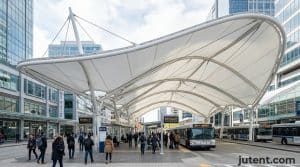

Pricing should be reviewed by product category and project scope rather than treated as a fixed published number. For an accurate quotation, the structure size, wind rating, membrane grade, and delivery terms should be confirmed first.
Whether you are a developer planning a new retail complex or a general contractor pricing a commercial office canopy, securing an accurate baseline is critical. The variance in pricing is rarely arbitrary; it is tied directly to engineering requirements, material lifespans, and site-specific load demands. By isolating these variables, project teams can align their architectural vision with strict financial realities before moving to the tender phase.
The 5 Factors That Drive Atrium Tensile Skylight Cost
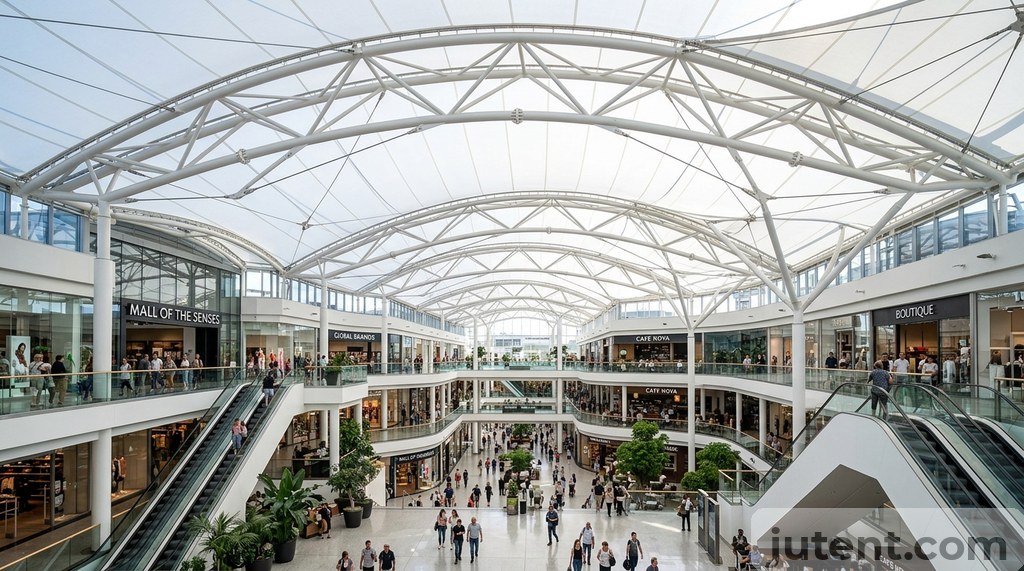
The final atrium tensile skylight price is determined by five primary variables: structural form, membrane grade, project scale, wind and snow load requirements, and procurement scope.
Structural form dictates the steel tonnage required. A simple hypar (hyperbolic paraboloid) design uses minimal steel framing, keeping costs at the lower end of the spectrum. Conversely, a complex ETFE cushion system or a heavily cabled flying-mast design requires extensive custom steelwork and tensioning hardware, pushing the price upward.
The final technical values should be confirmed against the project-specific engineering requirements and local code conditions.
When specifying Atrium Skylights, contractors must also account for the membrane grade. A standard 950g/㎡ PVDF fabric is highly cost-effective, while premium PTFE or ETFE options increase the material baseline. Finally, the choice between a supply-only kit and a full supply-and-install package shifts the commercial atrium tensile skylight cost significantly, as site labor, scaffolding, and specialized tensioning equipment enter the equation.
Cost by Project Scale: Small vs Large Applications
Economies of scale heavily influence the atrium tensile skylight cost per sqm. Large applications benefit from distributed fixed costs, whereas small projects carry a higher per-square-metre premium due to engineering and setup minimums.
For a small application—typically under 300 square metres—the engineering, patterning, and custom hardware fabrication represent a disproportionate percentage of the budget. In these cases, the supply cost often pushes toward the $60–$70/m² mark. The design time required to calculate membrane pre-stress and steel deflection remains largely the same whether the canopy is 200 or 2,000 square metres.
Pricing should be reviewed by product category and project scope rather than treated as a fixed published number. For an accurate quotation, the structure size, wind rating, membrane grade, and delivery terms should be confirmed first.
For example, a recent 1,200m² shopping mall atrium required a continuous barrel-vault tensile structure. Because the steel arches and membrane panels were highly repetitive, the manufacturing efficiency kept the material and fabrication costs strictly controlled. For a deeper dive into scaling these structures, review our Atrium Tensile Skylight Guide.
Membrane Grade: How Material Choice Affects the Budget
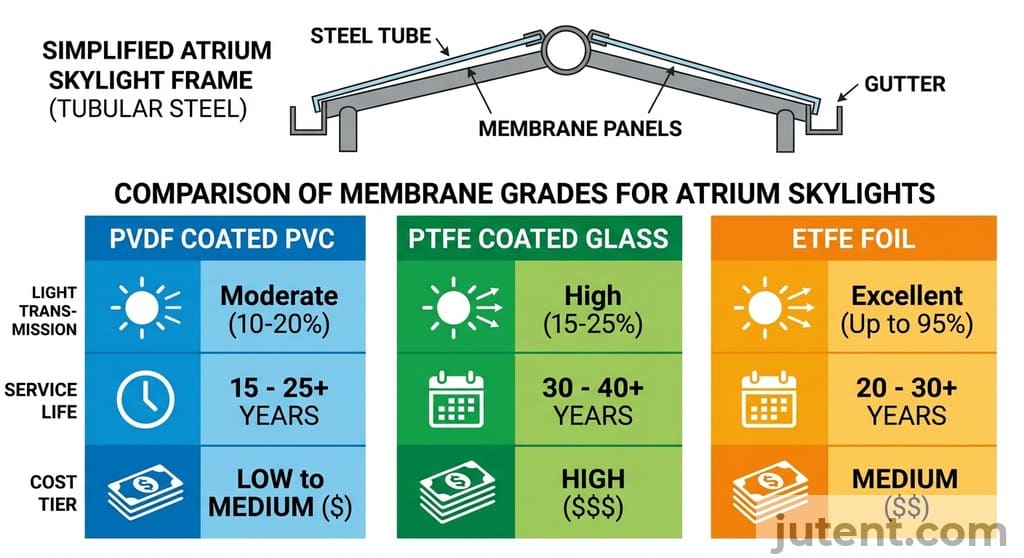
Membrane selection is the most direct lever for controlling your atrium tensile skylight budget. The material dictates not only the initial capital expenditure but also the design life and maintenance schedule of the structure.
Corrosion protection and service life should be described according to the selected protection system, project environment, and maintenance conditions rather than as an unconditional lifespan guarantee.
Corrosion protection and service life should be described according to the selected protection system, project environment, and maintenance conditions rather than as an unconditional lifespan guarantee.
ETFE (Ethylene Tetrafluoroethylene) film represents the top tier for skylights. Used in single-layer tensioned sheets or multi-layer pneumatic cushions, ETFE allows up to 95% light transmission. Specifying ETFE requires specialized aluminum extrusion tracks and continuous air supply units for cushion systems, which can double the overall system cost compared to standard PVDF.
Supply-Only vs Supply-and-Install: Understanding the Price Difference
Contractors must clearly define the procurement scope, as the difference between supply-only and supply-and-install drastically alters the final project budget.
The prefabricated system is designed to simplify on-site assembly, and Jutent can provide drawings, manuals, and free remote installation guidance. For more complex projects, experienced installers or on-site supervision support may be arranged on request.
Supply-and-install contracts include site labor, heavy lifting equipment, scaffolding, and specialized tensioning tools. Installing an atrium skylight often requires working at heights exceeding 15 meters, necessitating strict safety protocols, crane hire, and elevated work platforms, which add significant local costs.
A 40GP container typically supports about 21–28 tons of payload, while the actual covered area depends on structure type, steel quantity, and packing method.
How to Get an Accurate Quote
Securing an accurate atrium tensile skylight price requires submitting specific, measurable project data. Vague requests yield wide price brackets; precise engineering inputs yield exact manufacturing costs.
First, provide the exact plan dimensions and the required clearance height. A 20m × 20m opening requires entirely different steel profiles than a 40m × 10m opening, even though the total square meterage is identical. The clear span dictates the primary steel sizing and the tensioning loads.
Second, specify the project location. The location determines the local building code requirements for wind and snow loads. A structure designed for a 0.5 kN/m² snow load in a temperate climate will fail in a region requiring a 2.0 kN/m² snow load capacity.
Third, state your membrane grade preference—typically PVDF, PTFE, or ETFE—and the desired light transmission levels.
Finally, clarify the boundary conditions. Will the tensile skylight anchor to an existing concrete ring beam, or does it require independent steel columns? Anchoring to existing structures reduces steel tonnage but requires precise pull-out load calculations for the chemical anchors. Providing these four details ensures your quote is ready for immediate budget integration.
If you want an accurate budget reference for this project, share your dimensions, wind zone, and preferred membrane type with our team.
FAQ
- What is the cost per square metre for a atrium tensile skylight?
- Supply cost typically ranges from $25–$70/m² ex-factory, depending on structural form and membrane grade. Small custom projects with complex geometry sit at the higher end of this spectrum due to fixed engineering overheads and custom patterning requirements. Large, repetitive structures benefit from economies of scale, pushing the per-square-metre rate closer to the $25 baseline. Upgrading from standard 1050g/㎡ PVDF to premium PTFE or multi-layer ETFE materials will also shift the final calculation toward the upper limit, as will extreme wind or snow load specifications that demand heavier steel profiles.
- What information do I need to get an accurate atrium tensile skylight quote?
- Project dimensions, location (for wind load), preferred structural form, and membrane grade preference. Additionally, providing details about the existing boundary conditions—such as whether the structure will tie into an existing concrete ring beam or require independent steel columns—allows the engineering team to calculate the exact steel tonnage and tensioning hardware required. Clear architectural sketches or DWG files further eliminate guesswork, ensuring the pricing provided matches your exact site realities and local compliance codes.