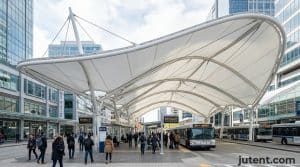

For any commercial atrium tensile skylight, Southeast Asia presents a severe structural reality: the system must survive 250 km/h (Category 4) typhoon wind loads in the Philippines while resisting year-round UV Index 12 degradation in Malaysia and Indonesia. Standard membrane specifications imported from temperate climates routinely fail under these extremes. The combination of high-velocity lateral uplift forces, intense solar radiation, and monsoon-level rainfall demands a highly localized, code-compliant engineering approach.
For retail centers, transit hubs, and commercial developments across the region, the skylight serves as both the primary weather envelope and the architectural focal point. A failure in the membrane tensioning or primary steel connections does not just cause localized leaking; it compromises the facility below, triggering massive operational downtime. This guide details the exact wind loading parameters, PTFE and advanced PVC membrane grading standards, and anti-ponding drainage geometries that contractors in the Philippines, Malaysia, and Indonesia must specify. By establishing these technical baselines prior to tender, project teams can ensure structural survivability, eliminate mid-project re-engineering, and guarantee long-term performance in one of the world’s most demanding climates.
Typhoon Wind Load Requirements in Southeast Asia
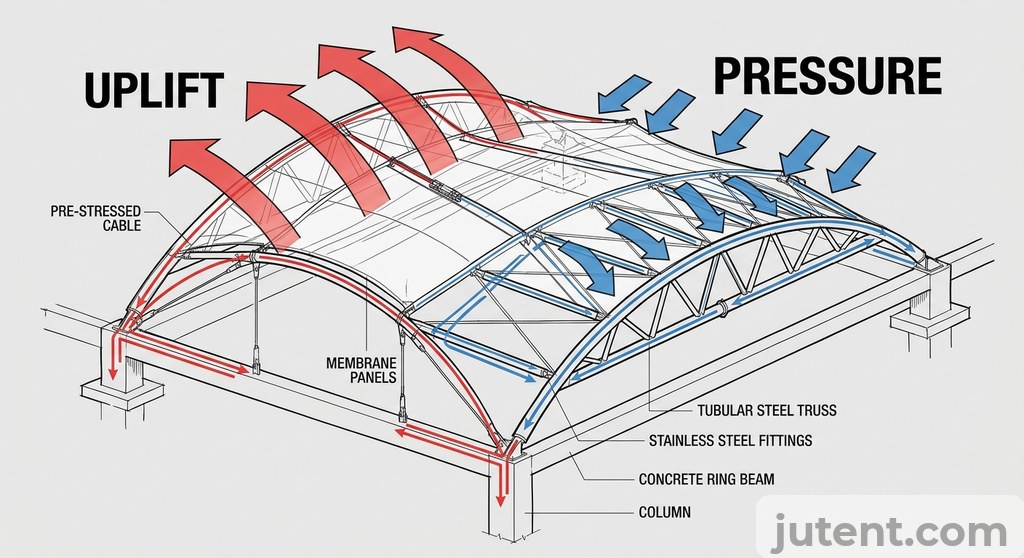
A typhoon rated atrium tensile skylight requires primary steel and membrane connections engineered for extreme uplift and lateral forces. In the Philippines, the National Structural Code of the Philippines (NSCP) mandates design wind speeds of 200 to 250 km/h for most coastal and central regions. Malaysia and Indonesia experience lower peak wind speeds—typically 120 to 150 km/h—but localized squalls still demand high-capacity structural detailing to prevent catastrophic failure.
The critical failure point in high-wind events is rarely the membrane itself; it is the perimeter connection plates and the primary steel deflection. For a standard 20m x 20m Atrium Skylights, we specify 200x200x8mm SHS (Square Hollow Section) perimeter ring beams with moment-connected base plates. Membrane tensioning hardware must utilize M20 or M24 hot-dip galvanized turnbuckles and stainless steel 316 catenary cables with a minimum 16mm diameter.
When specifying an atrium tensile skylight Philippines project, contractors must ensure the engineering submittal includes computational fluid dynamics (CFD) or localized wind tunnel data verifying uplift resistance. A standard 1050g/㎡ membrane tensioned to 3-4 kN/m at the perimeter will maintain its form under these loads. This precise pre-stress prevents the destructive flutter that tears lighter fabrics during a Category 4 or 5 typhoon, ensuring the building envelope remains intact when it matters most.
UV Protection in Tropical Climates: Membrane Grade Requirements
Tropical UV radiation degrades standard architectural fabrics within five years. For an atrium tensile skylight Malaysia or Indonesia project, where the UV Index regularly hits 12 to 13, membrane selection dictates the entire lifecycle of the structure.
PVDF (Polyvinylidene Fluoride) coated polyester at 1050g/㎡ or 1200g/㎡ is the baseline requirement for Southeast Asian atriums. The fluorocarbon surface layer reflects UV radiation rather than absorbing it. At UV Index 12, a 1050g/㎡ PVDF membrane maintains tensile strength within 10% of its original specification after 15 years. Specifying a lighter 700g/㎡ or 900g/㎡ membrane saves approximately $4 to $6/㎡ upfront but guarantees a complete replacement cycle at year seven. The math does not support the saving.
PTFE (Polytetrafluoroethylene) coated fiberglass offers superior UV resistance, achieving a 25-year lifespan with zero UV degradation. However, PTFE requires specialized handling during installation to prevent creasing the fiberglass yarns. For most commercial projects detailed in our Atrium Tensile Skylight Guide, heavy-grade PVDF provides the optimal balance of capital cost and tropical durability.
Light transmission is another critical factor. A 1050g/㎡ white PVDF membrane provides 7% to 12% natural light transmission. This eliminates solar glare and reduces the building’s HVAC cooling load, a major operational advantage in Jakarta or Kuala Lumpur.
Drainage Design for High-Rainfall Environments
Southeast Asia experiences intense monsoon seasons, with rainfall rates frequently exceeding 100mm per hour during peak weather events. An atrium tensile skylight Indonesia installation must shed water rapidly to prevent ponding, which adds massive dead loads to the structure and accelerates membrane degradation.
The fundamental rule for tropical tensile drainage is a minimum surface slope of 15 degrees (approximately 27%). Flat or low-pitch designs will fail under monsoon conditions. The membrane must be patterned with sufficient double curvature—an anticlastic shape—to maintain tension and direct water to designated perimeter collection points without pooling.
Gutter detailing requires specific sizing for monsoon volumes. Standard 150mm commercial gutters overflow during tropical downpours, causing water to cascade into the atrium below. We specify custom 300mm x 300mm minimum folded steel box gutters, hot-dip galvanized and lined with a waterproof membrane. Downpipes must be sized at 150mm diameter minimum, spaced no more than 10 meters apart along the collection edge.
To prevent water ingress at the building interface, the skylight perimeter must feature a continuous clamped aluminum extrusion with EPDM rubber gaskets. This mechanical seal accommodates the thermal expansion of the primary steel, which can fluctuate by 15mm to 25mm in tropical heat. It maintains a watertight barrier against wind-driven rain, ensuring the interior concourse remains dry during severe weather events.
Case Reference: Projects in Southeast Asia
Applying these specifications in the field requires precise engineering and fabrication. Across our project history in Southeast Asia, the most common installation error we see is under-tensioning the membrane at the perimeter to avoid wrinkles, rather than achieving the engineered pre-stress. This results in a structure that looks clean on day one but develops ponding during the first monsoon, leading to premature material failure.
In a recent commercial atrium project in Manila, the client required a 30m x 15m clear span over a central retail concourse. The site’s wind zone required compliance with NSCP 250 km/h design loads. We specified a flying-mast conical design using 1200g/㎡ PVDF membrane and 250mm diameter CHS (Circular Hollow Section) central masts.
Catching the wind load requirements at the design stage saved the project a complete re-engineering after permit submission. The primary steel was hot-dip galvanized to 85 microns and finished with a marine-grade fluorocarbon topcoat to resist the high coastal humidity. The structure was supplied as a complete kit with numbered components, allowing the local Philippine contractor to erect the primary steel in six days and tension the membrane in four, avoiding the peak typhoon season and keeping the overall development on schedule.
FAQ
- What wind speed should a atrium tensile skylight in the Philippines be designed for?
- NSCP requires design wind speeds of 200–250 km/h in most Philippine locations. Coastal and typhoon-prone provinces often sit at the absolute top of this range. Engineers must calculate localized wind pressures, including internal uplift if the atrium is partially open to the lower floors. The primary steel and membrane connection plates must be sized specifically for these extreme uplift forces, often requiring M24 hardware, heavy-duty corner plates, and reinforced concrete anchor blocks to prevent structural failure during severe weather events.
- How does tropical humidity affect a atrium tensile skylight steel structure?
- Hot-dip galvanising plus fluorocarbon topcoat is standard for Southeast Asian coastal projects. Untreated or standard painted steel will show surface rust within 12 months in environments like Malaysia or Indonesia, where humidity regularly exceeds 80%. We mandate hot-dip galvanizing to a minimum of 85 microns (ISO 1461 compliant) followed by a specialized architectural fluorocarbon topcoat. This duplex system provides a 20-year barrier against corrosion, even in coastal zones where airborne salinity accelerates steel degradation. Skipping this step leads to rapid structural deterioration and high maintenance costs over the lifespan of the building. Tell us your project location in Southeast Asia and we’ll provide a typhoon-rated specification.
Tell us your project location in Southeast Asia and we’ll provide a typhoon-rated specification.