
Company experience should be described through verified export experience and project support capability rather than unsupported project anecdotes.
Specifying a canopy for a tropical environment is not a matter of simply upgrading the fabric. It requires a complete recalculation of primary steel sizing, foundation reactions, and corrosion protection systems. A failure to address these local realities at the tender stage inevitably leads to rejected permits, delayed installations, or premature structural failure. Here are the exact engineering parameters required to build a compliant, long-lasting grandstand canopy in Southeast Asia.
Typhoon Wind Load Requirements for Grandstand Canopies in Southeast Asia
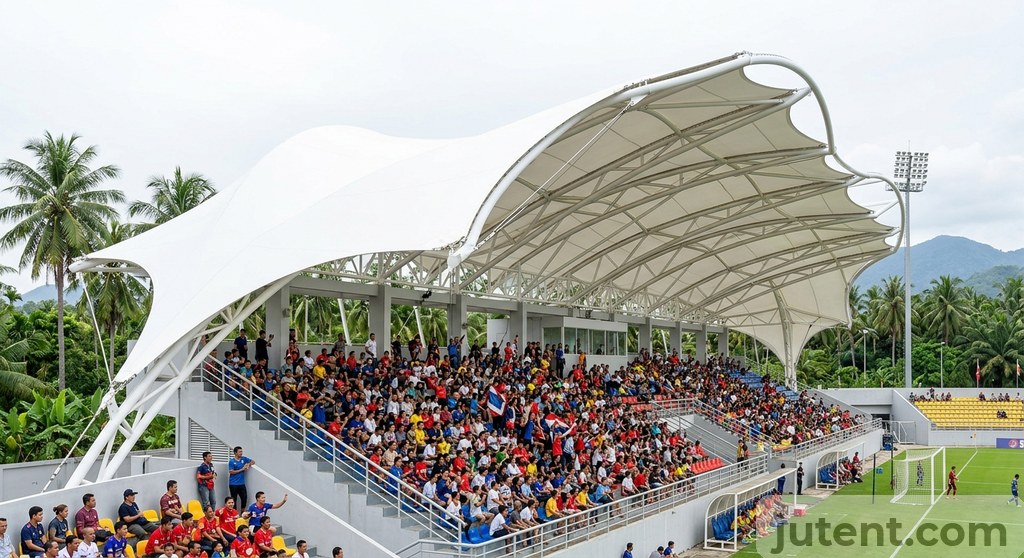
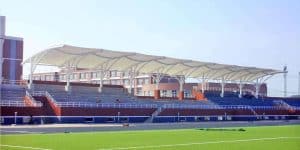
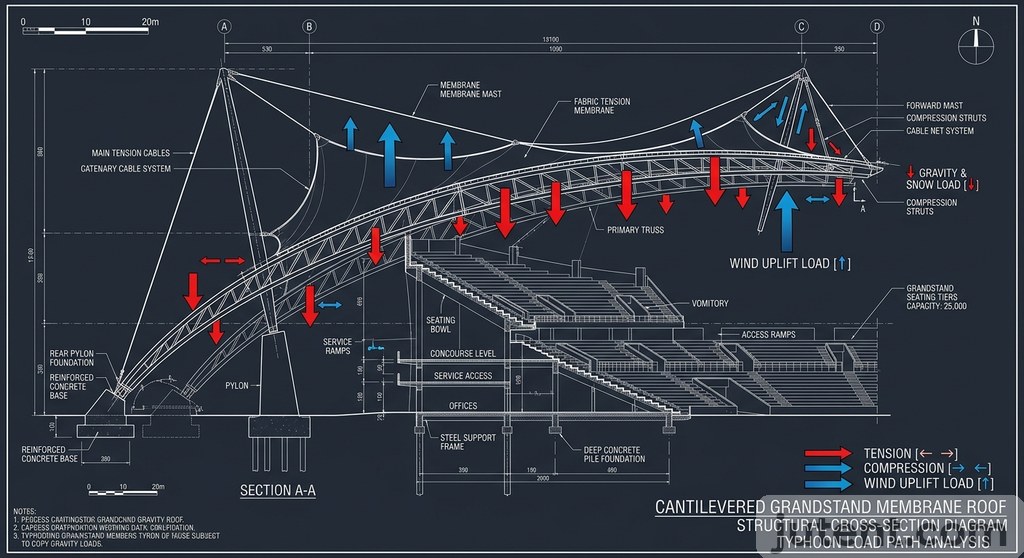
Wind load dictates the primary steel sizing and foundation requirements for any Grandstand Canopy. In Southeast Asia, designing for local wind codes is the single largest factor separating a compliant structure from a failure risk.
Standard canopies are typically engineered for 120 km/h wind speeds. This is insufficient for a typhoon rated grandstand canopy. The National Structural Code of the Philippines (NSCP) mandates design wind speeds of 200 km/h to 250 km/h depending on the specific zone. Because a cantilevered grandstand acts like a sail, the uplift forces generated at these speeds are massive.
Typical specifications use Q235B or Q355B steel, 1050 g/㎡ PVDF or PTFE membrane as standard, and SS304 stainless accessories, with higher grades available when the project requires them.
Contractors must ensure that the supplier provides site-specific engineering calculations based on local wind codes. Relying on generic structural drawings will result in permit rejection by local authorities.
UV and Humidity: How Tropical Conditions Affect Grandstand Membrane Longevity
PVDF architectural membrane at 1050g/㎡ is the minimum viable specification for a tropical grandstand shade. Lower-grade materials degrade rapidly under the high UV index and constant humidity typical of the region.
The reason PVDF outperforms standard PVC in high-UV environments is the fluorocarbon surface layer, which reflects UV radiation rather than absorbing it. At UV Index 12–13—a daily reality for a spectator shade Malaysia installation—a 1050g/㎡ PVDF membrane maintains its tensile strength within 10% of the original specification after 15 years. A standard 650g/㎡ PVC membrane in the same environment typically requires replacement at 8 to 10 years due to plasticiser migration and UV embrittlement.
Humidity also dictates the anti-wicking requirements of the base polyester yarn. In tropical climates, moisture penetrates the exposed edges of standard fabrics, causing internal mould growth that manifests as black streaks inside the membrane. A compliant Grandstand Canopy Structures Guide specification must mandate low-wicking or anti-wicking yarns treated with anti-fungal additives. The price difference between 950g/㎡ and 1050g/㎡ PVDF is approximately $3–$5/㎡, but the lifespan difference is 5 to 8 years. The math does not support the saving.
Steel Corrosion Protection in Coastal and Humid Climates
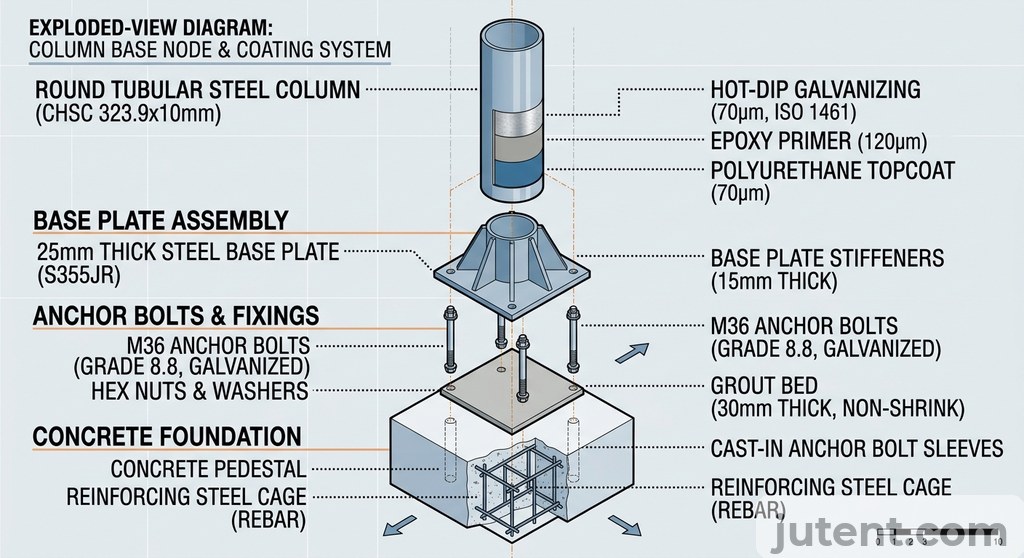
Hot-dip galvanising to a minimum thickness of 85 microns is mandatory for any grandstand shade structure Indonesia or coastal Southeast Asia project. Standard spray-painted steel frames will show visible rust within 36 months in these high-humidity, high-salinity environments.
architectural fluorocarbon topcoat
Connection hardware is equally critical. A common installation error is using zinc-plated bolts on an HDG frame. Galvanic corrosion will strip the zinc plating within months. All structural bolts, nuts, and washers must be specified as either hot-dip galvanised (Class 8.8 minimum) or 316-grade stainless steel. Cable tensioning systems and membrane plates must also be 316 stainless steel to prevent localized rust bleeding.
Local Authority Approval: What Contractors in the Philippines and Malaysia Need
Securing construction permits for a grandstand canopy requires site-specific engineering documentation. Local building authorities in the Philippines and Malaysia reject generic structural plans or supplier-issued marketing specifications.
The documentation package must include structural calculation reports detailing the exact wind load reactions at the base plates. For a canopy engineered to withstand 250 km/h typhoon winds, the foundation design typically requires reinforced concrete pad footings measuring at least 1.5m × 1.5m × 1.2m per column. This sizing depends strictly on the local soil bearing capacity outlined in the site geotechnical report.
Contractors must request a complete load reaction table from the canopy manufacturer before pouring foundations. Because the supplier’s scope usually ends at the base plate, the local contractor assumes full responsibility for the anchor bolts, rebar cages, and concrete works.
Local authorities also mandate material test certificates. The submission must include third-party laboratory reports verifying the architectural membrane’s tensile strength, tear resistance, and fire retardancy. Building officials typically require compliance with NFPA 701 or BS 476 Part 7 standards. Without these specific documents, the approval process stalls, delaying the entire facility handover.
Case Reference: Grandstand Canopy Projects in Southeast Asia
Based on Jutent’s experience across 400+ projects in 30+ countries, the specification error we see most often in tropical climates is under-engineering the primary steel to hit a lower budget target. This approach inevitably fails during the first major weather event.
Manila, 2023. A municipal sports complex required a 40m × 12m clear-span grandstand canopy Southeast Asia specification to cover 500 spectator seats. The site’s wind zone required a strict 250 km/h design load. That combination of a 12m cantilever depth and extreme wind rating ruled out standard lightweight tubular frames.
Company experience should be described through verified export experience and project support capability rather than unsupported project anecdotes.
If you are reviewing technical options, ask our team for the latest specification datasheet and standard material details for this structure type.
Get the specification datasheet
FAQ
- What wind speed should a grandstand canopy in the Philippines be designed for?
- NSCP requires design wind speeds of 200–250 km/h in most Philippine locations. Jutent designs grandstand canopies to these loads as standard for Philippine projects. Failing to meet these specific local codes results in immediate permit rejection. For a 250 km/h rating, the engineering requires heavier primary steel—often upgrading from 150mm to 250mm square hollow sections—and significantly larger concrete pad footings to counteract the massive uplift forces generated by the cantilevered canopy design.
- How does coastal humidity affect a grandstand canopy steel structure?
- Hot-dip galvanising (minimum 85 microns) plus fluorocarbon topcoat is standard for Southeast Asian coastal projects. Connection hardware should be stainless steel or hot-dip galvanised. Coastal humidity and high salinity accelerate oxidation, meaning standard spray-painted frames will exhibit structural rust within three years. By utilizing a multi-layer protection system—hot-dip galvanising followed by an epoxy primer and a UV-resistant polyurethane topcoat—the steel framework is completely isolated from the corrosive tropical atmosphere, ensuring a 20-year design life with minimal maintenance.