

La trajectoire de l'architecture sportive à grande échelle s'est définitivement déplacée des matériaux rigides et lourds vers des structures tendues en tissu hautement techniques. Pour les propriétaires d'installations, les promoteurs municipaux et les ingénieurs en structure, la transition du béton traditionnel et de la toiture en acier standard vers des membranes architecturales tendues est une réponse calculée aux exigences rigoureuses de l'ingénierie des grandes portées, de la gestion des charges dynamiques et de l'optimisation des coûts du cycle de vie.
Efficacité structurelle et atténuation des charges
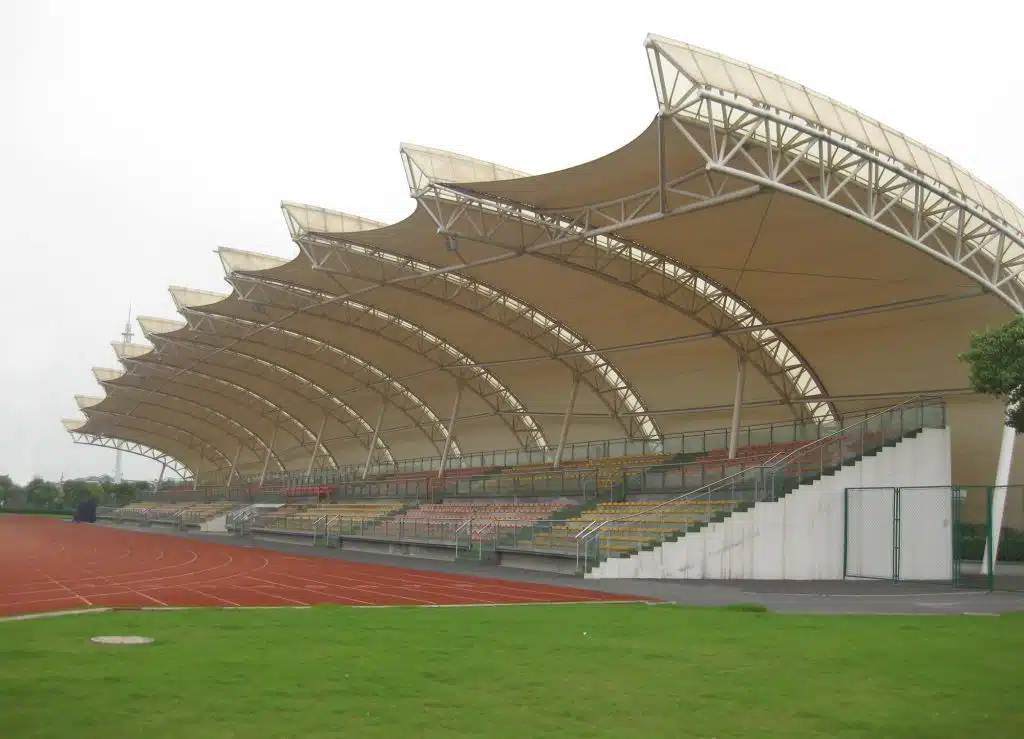
L'un des défis d'ingénierie les plus importants dans la conception de stades est de couvrir de vastes zones de sièges sans obstruer les lignes de vue. Les solutions de toiture traditionnelles imposent des charges mortes immenses, nécessitant des fondations en béton massives et de lourds supports de colonnes. Les structures légères contournent fondamentalement cette contrainte. Un stade toiture en membrane tendue pèse généralement une fraction d'une coque métallique ou en béton comparable.
By utilizing high-strength primary framework—often utilizing Q355B structural steel—combined with pre-tensioned cable-net systems, structural stress is distributed seamlessly across the geometric form. This minimizes the required foundation depth and allows architects to cover extensive grandstand seating zones with minimal material waste. The inherent flexibility of the tensioned fabric also provides superior seismic performance and dynamic responses to extreme wind loads.
Intégration avancée des matériaux : PVDF et PTFE
La viabilité commerciale des toitures en membrane de grande portée repose largement sur les progrès des matériaux membranaires architecturaux. Les stades modernes utilisent rarement une toile standard ; ils emploient plutôt des composites industriels hautement spécialisés conçus pour la longévité et la résistance environnementale.
- Membrane PTFE : Tissu en fibre de verre enduit de polytétrafluoroéthylène. Il offre une durée de vie exceptionnelle de plus de 30 ans, une résistance au feu de classe A et une surface autonettoyante qui repousse les polluants urbains.
- Membrane en PVC enduit de PVDF : Une alternative très rentable pour les auvents en membrane tendue des gradins. Le revêtement PVDF protège la base en PVC de la dégradation due aux UV, assurant l'intégrité structurelle et la rétention de la couleur pendant des décennies.
Acoustique et transmission de la lumière
Au-delà de la physique des structures, l'ingénierie des tissus a un impact direct sur l'environnement opérationnel du lieu. Les stades fermés traditionnels dépendent fortement de l'éclairage artificiel, ce qui augmente les frais généraux des services publics. Les membranes architecturales sont naturellement translucides. Pendant la journée, jusqu'à 20 % de la lumière naturelle du soleil pénètre la structure, fournissant un éclairage diffus et sans éblouissement au terrain de sport structure ci-dessous. Cela réduit la consommation d'énergie tout en maintenant une visibilité optimale pour les retransmissions sportives en haute définition.
Sur le plan acoustique, les formes géométriques courbes—telles que les paraboloïdes hyperboliques et les coniques—empêchent les échos durs couramment associés aux platelages métalliques plats. La membrane absorbe des fréquences sonores spécifiques, améliorant la clarté auditive des systèmes de sonorisation et amplifiant l'énergie ambiante de la foule sans distorsion.
Livraison accélérée du projet et retour sur investissement
Dans le développement commercial B2B, le temps équivaut directement au capital. Les structures tendues en membrane fonctionnent selon un modèle de fabrication pré-ingénierie. Alors que les fondations et la charpente métallique de base sont préparées sur site, la membrane et les systèmes de câbles sont fabriqués simultanément dans un environnement d'atelier contrôlé.
Ce flux de travail concurrent réduit considérablement le calendrier de construction. Une fois l'acier structurel érigé, le déploiement et la mise en tension de la membrane sont rapides. Pour les promoteurs immobiliers commerciaux et les conseils municipaux, cela signifie que le lieu atteint son statut opérationnel – et commence à générer des revenus – des mois avant les jalons de construction standard. Par rapport aux méthodes de construction conventionnelles, les dépenses totales en capital du projet peuvent être réduites jusqu'à 30 %.
Évolutivité pour une expansion future
Moderne installations sportives doit être adaptable. Un avantage majeur des systèmes tendus modulaires est leur évolutivité. Qu'il s'agisse de couvrir une zone localisée canopy de grandstand ou de s'étendre sur une place polyvalente complète, les structures peuvent être conçues en série. Cela permet aux chefs de projet d'exécuter une construction par phases ou d'étendre de manière transparente l'empreinte ombragée à mesure que les besoins en capacité du lieu augmentent à l'avenir.


