

Un extérieur canopy de scène installation involves foundation work, steel erection, membrane tensioning, and rigging hardware installation. This guide clarifies what the manufacturer provides and what your site team needs to prepare.
Successfully installing an outdoor stage canopy requires precise coordination between the manufacturer and the contractor's site team. Before commencing any work, it's crucial to understand the distinct phases of the project and the responsibilities associated with each. This decision framework outlines the typical scope of work, ensuring your project progresses efficiently and safely. From site preparation and foundation construction to the final tensioning of the membrane, each step is critical. Missteps in early phases can lead to delays and increased costs, making a clear understanding of the division of labor essential for project managers and site supervisors. This guide will walk you through the necessary preparations and the support you can expect from a manufacturer like Jutent Engineering, helping you anticipate challenges and streamline your installation process.
The Four Phases of an Outdoor Stage Canopy Installation
L'installation d'un auvent de scène extérieure, que ce soit pour un lieu permanent ou un espace événementiel semi-permanent, se déroule généralement en quatre phases distinctes. Comprendre cette séquence est fondamental pour une gestion de projet et une allocation des ressources efficaces. La phase initiale comprend tous les travaux de fondation nécessaires, essentiels pour l'intégrité structurelle et la longévité de l'auvent. Cela inclut l'excavation, la mise en place des armatures et le coulage du béton, le tout exécuté selon les plans de fondation détaillés du fabricant. Ensuite, commence le montage de la structure en acier, où le cadre principal des poteaux, poutres et fermes est assemblé et fixé. Cette phase nécessite des équipements de levage spécialisés et un personnel qualifié pour garantir un alignement précis et des connexions sécurisées.
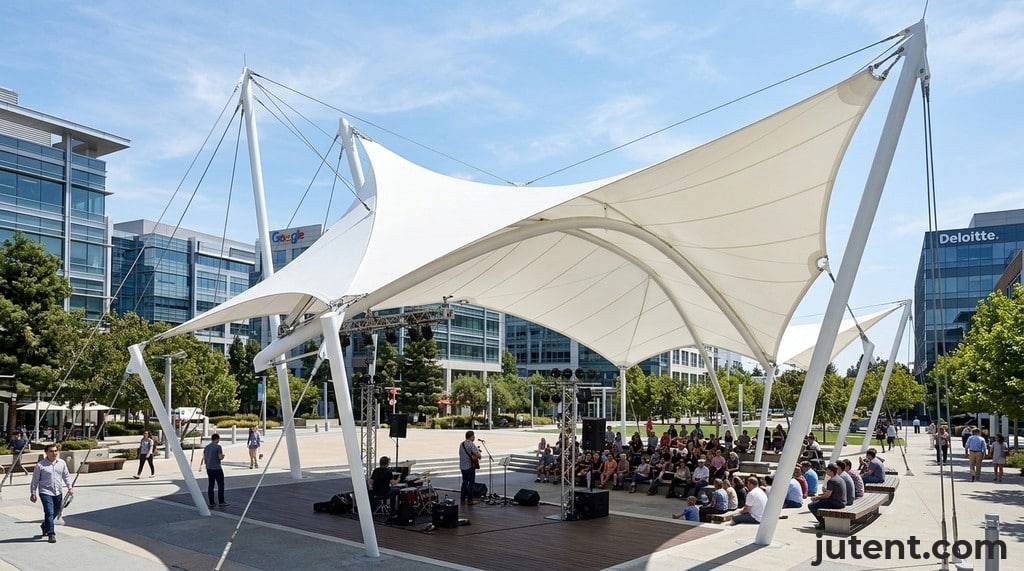
Once the steel framework is in place, the third phase focuses on the installation and tensioning of the membrane. This delicate process involves lifting the pre-fabricated membrane panels, attaching them to the steel structure, and then systematically tensioning them to achieve the designed form and stability. The final phase encompasses the installation of all rigging hardware, lighting, sound systems, and any other ancillary components required for the stage's full functionality. Each phase demands specific expertise and equipment, highlighting the importance of a well-coordinated team. Based on Jutent's experience across 400+ projects in 30+ countries, meticulous planning for each phase significantly reduces potential on-site complications. For more information on our product range, visit our Couvertures de scène page.
Foundation Work: What Your Civil Team Needs to Complete Before Delivery
The foundation work is arguably the most critical preliminary step for any outdoor stage canopy installation, directly impacting the structure's stability and safety. Your civil team is responsible for preparing the site and constructing the foundations well in advance of the steel and membrane delivery. This phase commences with thorough site surveying and excavation, ensuring the ground is level and stable. Detailed foundation drawings, provided by the manufacturer, will specify the exact dimensions, depths, and reinforcement requirements for each footing. These drawings are engineered to withstand the specific wind loads, snow loads, and seismic conditions of the project location, ensuring the long-term integrity of the structure.
Key tasks for your civil team include:
* Site Clearance and Leveling: Preparing the ground, removing obstructions, and ensuring a stable, level base.
* Excavation : Creusement de tranchées et de fosses aux profondeurs spécifiées pour les semelles et les points d'ancrage.
* Reinforcement Installation: Placing rebar cages according to the structural drawings, ensuring proper concrete cover.
* Formwork Construction: Building forms for concrete pouring that match the exact dimensions of the foundations.
* Placement des boulons d'ancrage : Precisely setting anchor bolts or plates into the concrete before it cures. These must be perfectly aligned and level to facilitate the subsequent steel erection.
* Coulage et cure du béton : Using the specified concrete mix and allowing adequate curing time before any structural loads are applied.
Le non-respect strict des plans de fondation peut compromettre l'ensemble de la structure. Il est essentiel de vérifier toutes les dimensions et tous les alignements avant le coulage du béton. Pour une compréhension plus approfondie des considérations de conception de ces structures, consultez notre Guide des auvents de scène extérieure.
Steel Structure Erection: Sequence and Equipment Requirements
Once the foundations have cured and are ready to bear load, the steel structure erection can commence. This phase involves assembling the primary framework that will support the tensile membrane. The sequence of erection is crucial for safety and efficiency, typically starting with the main columns, followed by the primary beams, and then the secondary structural elements. Each component is fabricated off-site and delivered ready for assembly, often with pre-drilled holes for bolted connections.
Équipement essentiel pour cette phase :
* Grues : Mobile cranes or telescopic handlers are indispensable for lifting heavy steel members into position. The crane's capacity and reach must be appropriate for the largest and heaviest components, considering the site layout and access.
* Scaffolding or Man Lifts: For safe access to connection points at height.
* Lifting Gear: Slings, shackles, and spreader bars designed for safe handling of steel sections.
* Torque Wrenches: For tightening high-strength bolts to specified torque values, ensuring secure connections.
* Surveying Equipment: Total stations or laser levels for verifying the plumb, level, and alignment of all steel members.
* Welding Equipment (if applicable): While most connections are bolted, some designs may require on-site welding.
The erection sequence typically involves:
1. Column Installation: Montage et contreventement temporaire des poteaux de support principaux sur les boulons d'ancrage dans les fondations.
2. Primary Beam Assembly: Lifting and bolting the main horizontal or curved beams between the columns.
3. Secondary Structure and Bracing: Installing purlins, trusses, and cross-bracing to complete the structural frame.
4. Vérification du raccordement : Vérification de tous les assemblages boulonnés pour un couple approprié et s'assurer que tous les éléments sont d'aplomb et de niveau.
Safety protocols are paramount during steel erection, including fall protection, proper rigging techniques, and clear communication among the crew.
Membrane Installation and Rigging Hardware: What Arrives Pre-Installed
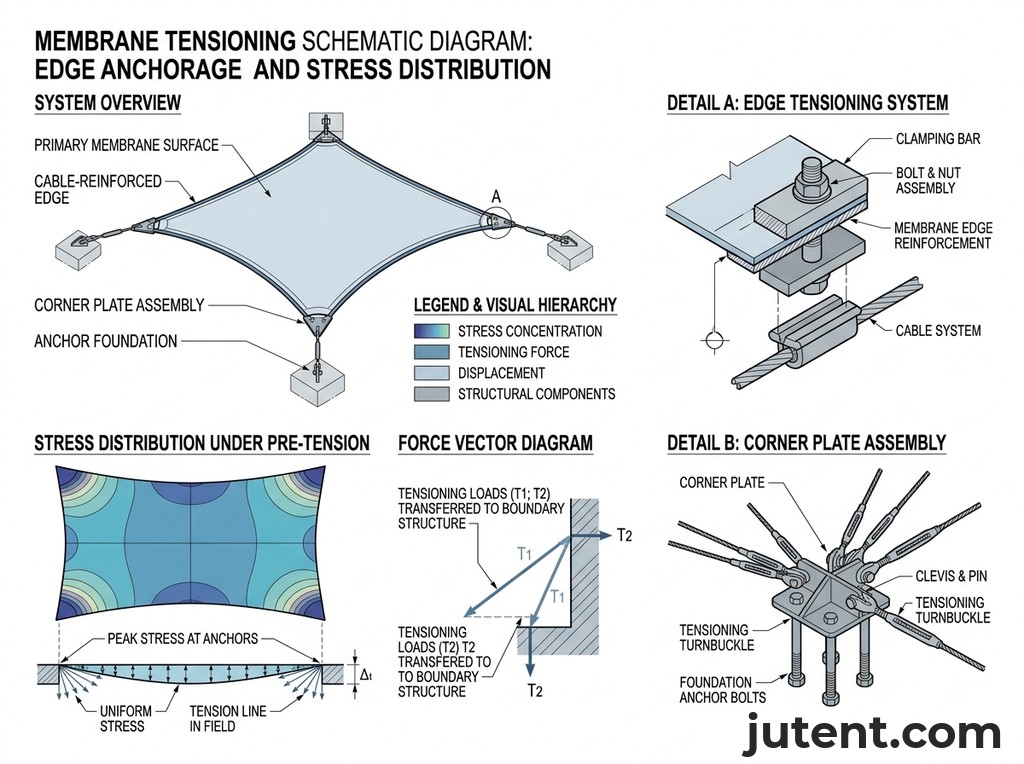
The membrane installation is a specialized process that gives the tensile structure its distinctive form and function. The membrane panels, typically made from high-quality PVDF or PTFE material, are pre-fabricated in controlled factory environments to precise dimensions. For export projects, Jutent can provide design drawings, calculations, material specifications, installation manuals, and free remote guidance, subject to project scope and contract terms. These panels arrive on-site folded and packaged, ready for deployment.
Au cours de cette phase, les panneaux de membrane sont soigneusement soulevés sur la structure en acier à l'aide d'équipements de levage spécialisés et de cordes, en évitant tout bord tranchant ou surface abrasive qui pourrait endommager le matériau. Les panneaux sont ensuite progressivement fixés au cadre en acier aux points de connexion désignés à l'aide d'une combinaison de pinces, de câbles et de quincaillerie spécialisée. L'étape critique est le processus de mise sous tension, où la membrane est systématiquement tendue pour obtenir sa courbure et sa stabilité structurelle conçues. Cela implique souvent des vérins hydrauliques ou des tendeurs, appliqués dans un ordre spécifique pour répartir la tension uniformément et éliminer les plis.
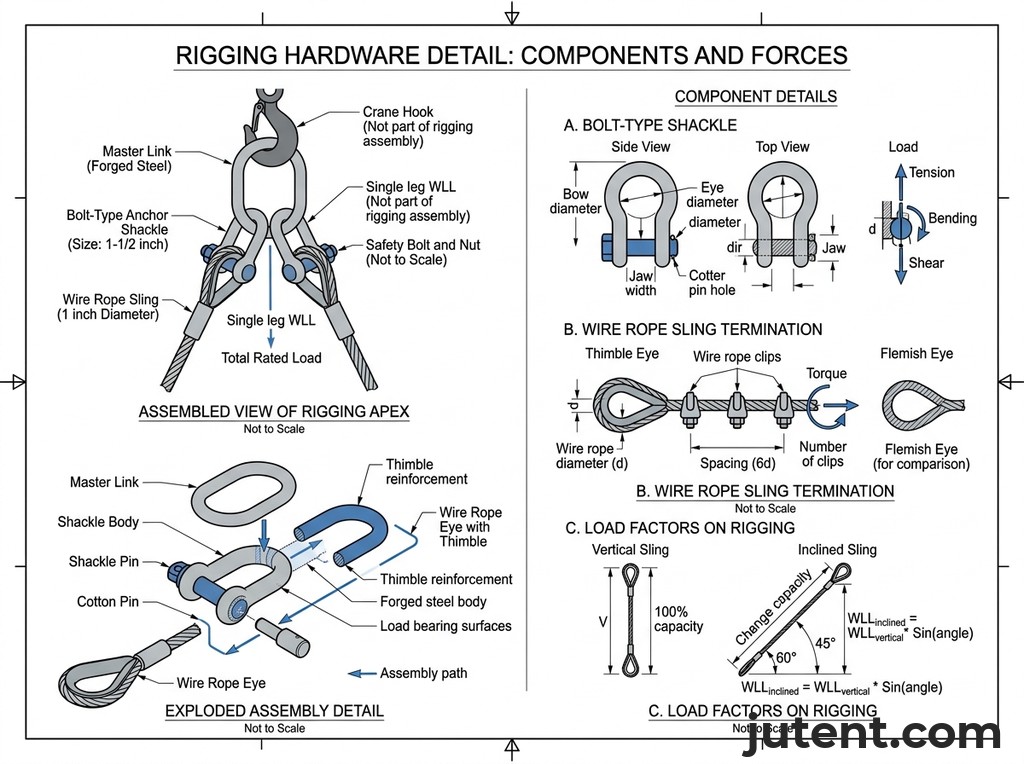
Regarding rigging hardware, Jutent Engineering ensures that many critical components arrive pre-installed or pre-assembled to streamline on-site work. This typically includes:
* Membrane Edge Cables: Often pre-threaded into the membrane's perimeter pockets or attached to the membrane edges.
* Plaques d'angle et œillets : Pre-welded or attached to the membrane for connection to the steel structure.
* Some Cable End Fittings: Swaged or crimped onto cables in the factory, ready for connection to turnbuckles or anchor points.
* Fabricated Steel Brackets: Tout support spécialisé pour la fixation de la membrane, faisant partie intégrante de la structure en acier, sera fourni avec le lot de charpente métallique.
This pre-installation reduces the complexity and time required for on-site assembly, allowing your team to focus on the precise positioning and tensioning of the membrane itself.
What Jutent Provides: Drawings, Instructions, and Remote Technical Support
Jutent Engineering is committed to supporting your installation team with thorough documentation and expert guidance throughout the project lifecycle. Our scope of work extends beyond manufacturing and delivery to ensure a smooth and successful installation.
We provide a complete package of technical documentation, which includes:
* Plans de fondations détaillés : These specify all dimensions, reinforcement schedules, and anchor bolt layouts required for your civil team.
* Steel Structure Erection Drawings: These illustrate the assembly sequence, connection details, and component numbering for efficient steel erection.
* Membrane Installation Manuals: Step-by-step instructions for lifting, attaching, and tensioning the membrane, including specific tensioning sequences and values.
* Rigging Hardware Schematics: Schémas détaillant le placement et le raccordement de tous les câbles, tendeurs et autres composants de gréement.
* Material Specifications: Documentation pour tout l'acier (Q235B, Q355B avec apprêt époxy riche en zinc + couche de finition acrylique ou galvanisation à chaud) et les matériaux de membrane (1050 g/m² PVDF ou PTFE, SS304 standard, SS316 en option améliorée).
* Structural Calculations: Rapports techniques vérifiant la conformité de la conception aux codes et exigences de charge applicables.
In addition to these critical documents, Jutent offers free remote technical support. Our engineering team is available to answer questions, clarify details, and provide guidance via phone or video conference, helping your site team troubleshoot any challenges that may arise during installation. For larger or more complex projects, on-site supervision is available as a paid service, providing direct expert oversight. Typical technical values should always be written conservatively and described as subject to project design. Our goal is to empower your team with the knowledge and support needed to install your outdoor stage canopy safely and efficiently, ensuring the final structure meets the highest standards of quality and performance.
FAQ
- Q: How long does it take to install an outdoor stage canopy?
- A : La durée d'installation d'un auvent de scène extérieur varie en fonction de la taille, de la complexité et de l'expérience de l'équipe. Un auvent de scène typique de 200m², par exemple, peut être installé par une équipe expérimentée de 4–6 personnes en 4–7 jours, en supposant que tous les travaux de fondation soient terminés au préalable et que les conditions météorologiques soient favorables. Les conceptions plus grandes ou plus complexes, en particulier celles avec un gréement complexe, peuvent nécessiter plus de temps. Une planification appropriée et le respect de la séquence d'installation fournie par Jutent sont essentiels pour une réalisation efficace.
- Q: Does Jutent provide on-site installation supervision for stage canopy projects?
- R : Oui, Jutent Engineering propose une supervision de l'installation sur site en tant que service payant pour les projets nécessitant une supervision directe par un expert. Bien que nous fournissions des manuels d'installation complets et une assistance technique à distance gratuite pour tous les projets, la supervision sur site peut être particulièrement bénéfique pour les installations grandes ou complexes, en particulier pour les commandes en Asie du Sud-Est. Ce service garantit que l'installation respecte strictement les spécifications de conception et les meilleures pratiques, offrant une couche supplémentaire d'assurance qualité et d'expertise en résolution de problèmes.
Request our stage canopy installation guide package — includes foundation drawings, erection sequence, and rigging hardware instructions.
 English
  Français
  Español de México
  Bahasa Melayu
  Tiếng Việt
  Português do Brasil
  Русский
  ไทย
ไทย  العربية