
“`html
Lors de l'évaluation des améliorations extérieures pour les développements commerciaux, la décision d'intégrer un auvent de passage piéton repose souvent sur l'équilibre entre l'attrait esthétique, les avantages fonctionnels et les contraintes budgétaires. Les promoteurs et entrepreneurs prennent en compte des facteurs tels que la protection contre les intempéries, la visibilité de la marque et l'entretien à long terme. Ce guide fournit un cadre pour comprendre ce qu'est un auvent de passage piétonnier commercial , comment il fonctionne, ses différents types, les coûts associés, et quand il représente un investissement stratégique pour votre projet.
Augmenter le ROI des centres commerciaux et des écoles avec des auvents de passage architecturaux : Un guide d'achat
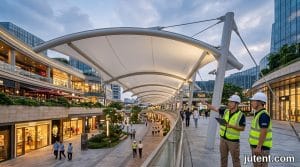
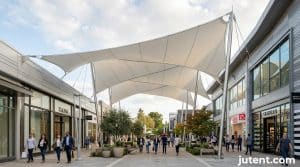
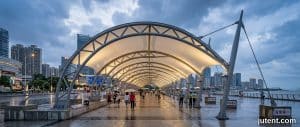
A auvent de passage piétonnier commercial est une structure tendue en membrane permanente et conçue pour fournir un abri aérien aux chemins piétonniers dans les environnements commerciaux. Sa fonction principale est d'améliorer l'expérience client en offrant une protection contre le soleil, la pluie et autres éléments, tout en rehaussant l'attrait esthétique et la présence de la marque d'une vitrine ou d'un complexe commercial. Ces structures se caractérisent par leurs membranes en tissu légères mais durables tendues sur une charpente en acier, créant des formes architecturales dynamiques et souvent emblématiques.
Crucialement, un auvent de passage piétonnier commercial se distingue des auvents temporaires ou des surplombs en porte-à-faux. Contrairement aux auvents, qui sont généralement plus petits, rétractables et fixés directement à la façade d'un bâtiment, un auvent de passerelle tendu est une structure autonome ou semi-autonome avec ses propres fondations et système de support. Il est conçu pour une performance à long terme, capable de résister aux charges de vent locales, aux charges de neige et aux conditions sismiques. Ce n'est pas une simple voile d'ombrage ; c'est un élément architectural méticuleusement conçu qui s'intègre à l'environnement environnant, offrant à la fois une utilité pratique et un impact visuel significatif. Pour approfondir nos offres, explorez notre auvent de passage piétonnier commercial projets.
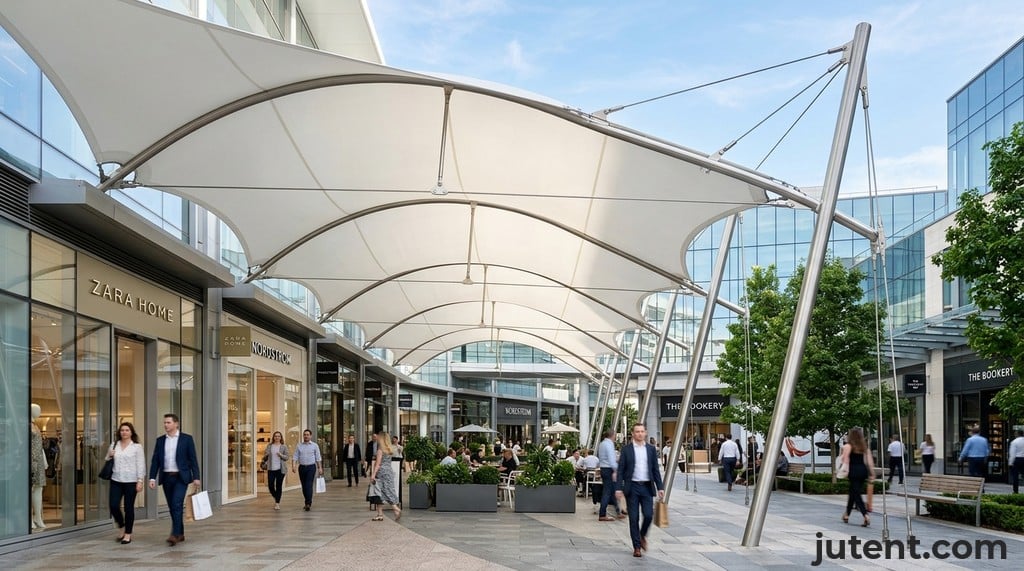
Comment fonctionnent les structures d'auvent de passage piéton commercial : acier, membrane et drainage
Le principe fondamental d'une auvent de passage piétonnier commercial réside dans la synergie entre sa charpente en acier structurel et la membrane en tissu tendu. La structure en acier, généralement fabriquée en acier de haute qualité Q235B ou Q355B, constitue le système de support principal. Cette charpente est méticuleusement conçue pour définir la forme de l'auvent et pour transférer toutes les charges – y compris le poids de la membrane, la pression du vent et la neige – en toute sécurité aux fondations. Les composants en acier subissent des traitements de surface rigoureux tels qu'une couche de fond époxy riche en zinc avec une couche de finition acrylique ou fluorocarbonée, ou une galvanisation à chaud, pour garantir une résistance à la corrosion et une intégrité structurelle à long terme.
La membrane, généralement un tissu enduit de PVDF ou PTFE de 1050 g/m², est ensuite étirée et mise sous tension sur cette charpente en acier. Cette tension est cruciale ; elle confère à la membrane sa rigidité structurelle, lui permettant de résister aux forces extérieures sans battement ni affaissement. La flexibilité inhérente de la membrane, combinée à la résistance de l'acier, crée une structure à la fois résiliente et visuellement légère. Un drainage efficace fait partie intégrante de la conception. Les structures tendues sont conçues pour évacuer efficacement l'eau grâce à leurs formes courbes, dirigeant l'eau de pluie vers des systèmes de gouttières intégrés ou des points de drainage spécifiques dans la charpente en acier, évitant ainsi les accumulations et garantissant le confort des piétons en dessous. Pour des spécifications techniques plus détaillées, consultez notre auvent de passage piétonnier commercial guide pour les spécifications techniques détaillées.
Types d'auvents de passerelle commerciale : formes structurelles courantes
Les auvents de passerelle commerciale se présentent sous diverses formes structurelles, chacune offrant des caractéristiques esthétiques et fonctionnelles distinctes. Le choix de la forme dépend souvent de la vision architecturale, de la portée requise et des conditions spécifiques du site.
- Auvents coniques : Ce sont sans doute les formes tensiles les plus reconnaissables, caractérisées par un point central élevé à partir duquel la membrane descend vers les supports périphériques. Les formes coniques sont excellentes pour évacuer l'eau et peuvent créer des espaces spectaculaires et imposants. Elles sont très efficaces pour couvrir de grandes zones ouvertes ou créer des points focaux.
- Auvents Hypar (paraboloïde hyperbolique) : Les structures Hypar présentent une forme en selle, avec deux points hauts et deux points bas. Cette géométrie crée une forme visuellement dynamique et souvent élégante, intrinsèquement stable sous tension. Les Hypars sont polyvalents et peuvent être combinés pour couvrir de longues passerelles linéaires ou des géométries complexes.
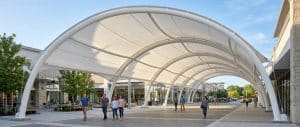
- Auvents supportés par arche : Dans cette configuration, la membrane est suspendue ou tendue sur une série d'arcs, souvent en acier. Les arcs fournissent un support principal, permettant de longues portées libres au-dessus des passerelles. Ce type peut créer une déclaration architecturale forte et rythmée, et est bien adapté aux chemins linéaires.
- Auvents en voûte en berceau : Semblables aux voûtes en berceau traditionnelles, ces structures tendues présentent une membrane courbe continue s'étendant entre des supports parallèles. Elles offrent une excellente couverture pour les passerelles linéaires et peuvent être conçues pour s'intégrer parfaitement aux lignes de construction existantes, pr
“`
Obtenez votre devis de canopy de passage piétonnier dès aujourd'hui