
“`html
When evaluating exterior enhancements for retail developments, the decision to incorporate a walkway canopy often hinges on balancing aesthetic appeal, functional benefits, and budget constraints. Developers and contractors consider factors like weather protection, brand visibility, and long-term maintenance. This guide provides a framework for understanding what a retail walkway canopy is, how it functions, its various types, associated costs, and when it represents a strategic investment for your project.
Boosting Mall & School ROI with Architectural Walkway Canopies: A Buyer's Guide
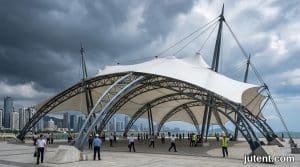
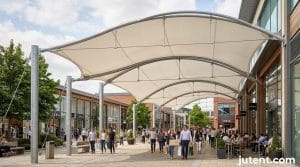
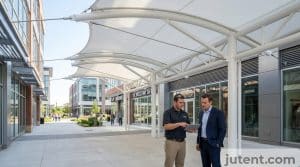
A retail walkway canopy is a permanent, engineered tensile membrane structure specifically designed to provide overhead shelter for pedestrian pathways in commercial environments. Its primary function is to enhance the customer experience by offering protection from sun, rain, and other elements, while simultaneously elevating the aesthetic appeal and brand presence of a storefront or retail complex. These structures are characterized by their lightweight yet durable fabric membranes stretched over a steel framework, creating dynamic and often iconic architectural forms.
Crucially, a retail walkway canopy is distinct from temporary awnings or cantilevered overhangs. Unlike awnings, which are typically smaller, retractable, and attached directly to a building facade, a tensile walkway canopy is a standalone or semi-standalone structure with its own foundation and support system. It is engineered for long-term performance, designed to withstand local wind loads, snow loads, and seismic conditions. It isn't a simple shade sail; it's a meticulously designed architectural feature that integrates with the surrounding environment, offering both practical utility and significant visual impact. For a deeper dive into our offerings, explore our retail walkway canopy projects.
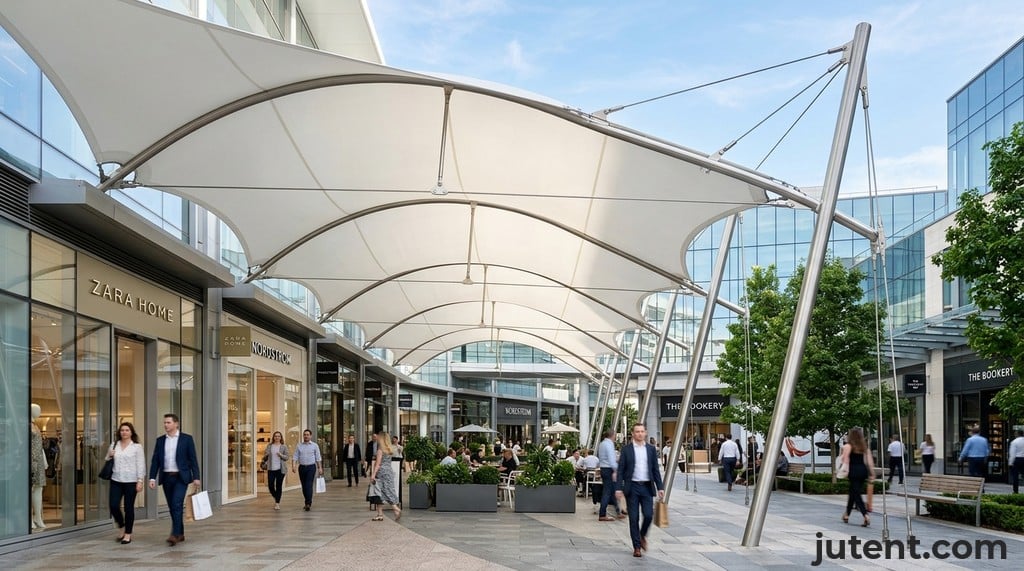
How Retail Walkway Canopy Structures Work: Steel, Membrane, and Drainage
The fundamental principle behind a retail walkway canopy lies in the synergy between its structural steel framework and the tensioned fabric membrane. The steel structure, typically fabricated from high-grade Q235B or Q355B steel, forms the primary support system. This framework is meticulously engineered to define the canopy's shape and to transfer all loads – including the weight of the membrane, wind uplift, and snow – safely to the foundations. Steel components undergo rigorous surface treatments such as epoxy zinc-rich primer with an acrylic or fluorocarbon topcoat, or hot-dip galvanizing, to ensure long-term corrosion resistance and structural integrity.
The membrane, usually a 1050 g/m² PVDF or PTFE coated fabric, is then stretched and tensioned across this steel framework. This tension is critical; it gives the membrane its structural rigidity, allowing it to resist external forces without fluttering or sagging. The inherent flexibility of the membrane, combined with the strength of the steel, creates a structure that is both resilient and visually light. Effective drainage is an integral part of the design. Tensile structures are inherently designed to shed water efficiently due to their curved forms, directing rainwater to integrated gutter systems or specific drainage points within the steel framework, preventing pooling and ensuring pedestrian comfort below. For more detailed technical specifications, see our retail walkway canopy guide for detailed technical specifications.
Types of Retail Walkway Canopy: Common Structural Forms
Retail walkway canopies come in various structural forms, each offering distinct aesthetic and functional characteristics. The choice of form often depends on the architectural vision, the span required, and the specific site conditions.
- Conical Canopies: These are perhaps the most recognizable tensile forms, characterized by a central high point from which the membrane slopes downwards to perimeter supports. Conical shapes are excellent for shedding water and can create dramatic, soaring spaces. They are highly effective for covering large, open areas or creating focal points.
- Hypar (Hyperbolic Paraboloid) Canopies: Hypar structures feature a saddle-like shape, with two high points and two low points. This geometry creates a visually dynamic and often elegant form that is inherently stable under tension. Hypars are versatile and can be combined to cover extensive linear walkways or complex geometries.
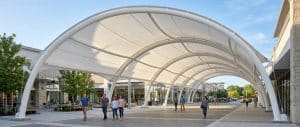
- Arch-Supported Canopies: In this configuration, the membrane is suspended from or stretched over a series of arches, often made of steel. The arches provide primary support, allowing for long, clear spans over walkways. This type can create a strong, rhythmic architectural statement and is well-suited for linear paths.
- Barrel Vault Canopies: Similar to traditional barrel vaults, these tensile structures feature a continuous, curved membrane spanning between parallel supports. They offer excellent coverage for linear walkways and can be designed to integrate seamlessly with existing building lines, pr
“`