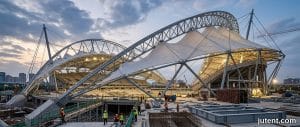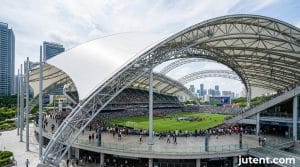

Pour les directeurs d'école, les administrateurs de district et les gestionnaires de parcs communautaires, protéger les élèves et les spectateurs est la priorité absolue. Alors que les températures mondiales augmentent, prévention du stress thermique n'est plus seulement une question de confort.
Les gradins en aluminium non ombragés peuvent atteindre des températures brûlantes, mettant en danger les enfants et les parents. Investir dans une structure d'ombrage de gradins de haute qualité est un élément fondamental de l'infrastructure de sécurité moderne des campus. Ce guide complet décompose les réalités financières et techniques de l'installation de structures tendues professionnelles, vous aidant à naviguer dans votre budget de district scolaire en toute confiance.
1. Décomposer l'investissement : Comprendre le coût au pied carré
Lors de l'évaluation des besoins financiers pour l'ombrage d'une tribune, les écoles doivent regarder bien au-delà du prix d'achat initial. Une véritable planification financière nécessite d'évaluer le coût total de possession (TCO). Bien que les tentes temporaires ou les voiles d'ombrage basiques puissent sembler économiques au départ, elles cèdent fréquemment sous des conditions météorologiques modérées, entraînant des cycles de remplacement continus.
Facteurs d'ingénierie critiques impactant le coût :
- Qualité du matériau : Passer des tissus basiques aux membranes architecturales lourdes.
- Structure porteuse : Passer des poteaux en aluminium légers aux robustes cadres en acier modulaires L'élément le plus crucial de votre structure d'ombrage est le tissu lui-même. Lors de la rédaction de vos exigences d'approvisionnement, nous spécifions l'utilisation de
- Conformité technique : Coûts associés à l'ingénierie spécifique au site pour répondre aux codes du bâtiment locaux et aux zones de vent.
2. Science des matériaux : pourquoi nous spécifions la membrane PVDF 1050g
Protection UV maximale Membrane PVDF 1050g, un matériau architectural avancé conçu pour une longévité et une sécurité extrêmes.
radiation, créant une zone de sécurité pour les étudiants pendant le pic d'ensoleillement de l'après-midi.
Explicitement blocs 99 % UV Confort thermique élevé
Réfléchit l'énergie solaire, réduisant considérablement
le stress thermique Auto-nettoyant et l'abaissement des températures ambiantes.
La surface lisse résiste à la saleté et aux moisissures. Les précipitations naturelles la maintiennent propre, réduisant les budgets d'entretien.
Lors de la présentation de votre dossier à votre conseil scolaire ou municipal, les données visuelles sont essentielles. Le graphique ci-dessous illustre le retour sur investissement sur une période de 10 ans pour différentes solutions d'ombrage.
3. Visualisation du coût total de possession (TCO) sur 10 ans
Les conseils scolaires ne peuvent pas compromettre l'intégrité structurelle. Nos auvents modulaires sont officiellement classés comme
TCO sur 10 ans : Comparaison des solutions d'ombrage
*Les données sont un modèle estimé incluant les coûts initiaux d'investissement, de maintenance et de remplacement.
4. Conçu pour les extrêmes : résister aux intempéries sévères
structures semi-permanentes robustes, fournis avec des plans d'ingénierie estampillés. Lorsqu'il est correctement ancré, le système résiste à des vents de 120 km/h, garantissant que votre investissement survive à de violents orages sans devenir un projectile dangereux.
5. Spécifications techniques : traditionnel vs. membrane tendue
| Caractéristique / Métrique | Toits traditionnels en béton et métal | Membrane tendue modulaire Jutent |
|---|---|---|
| Matériau principal | Acier lourd / Métal ondulé / Maçonnerie | Acier modulaire + Membrane PVDF 1050g |
| Sécurité solaire | Emprisonne la chaleur ; rayonne la chaleur vers le bas | Blocs 99 % UV ; Hautement réfléchissant |
| Calendrier d'installation | 3 à 6 mois (perturbation majeure du site) | Installation rapide (souvent en moins de 2 semaines) |
| Résistance au vent | Évaluations des structures permanentes | Résiste à des vents de 120 km/h |