

La protection contre la corrosion et la durée de vie doivent être décrites en fonction du système de protection choisi, de l'environnement du projet et des conditions de maintenance, et non comme une garantie de durée de vie inconditionnelle.
Gulf Climate: Why Standard School Walkway Specs Don't Apply
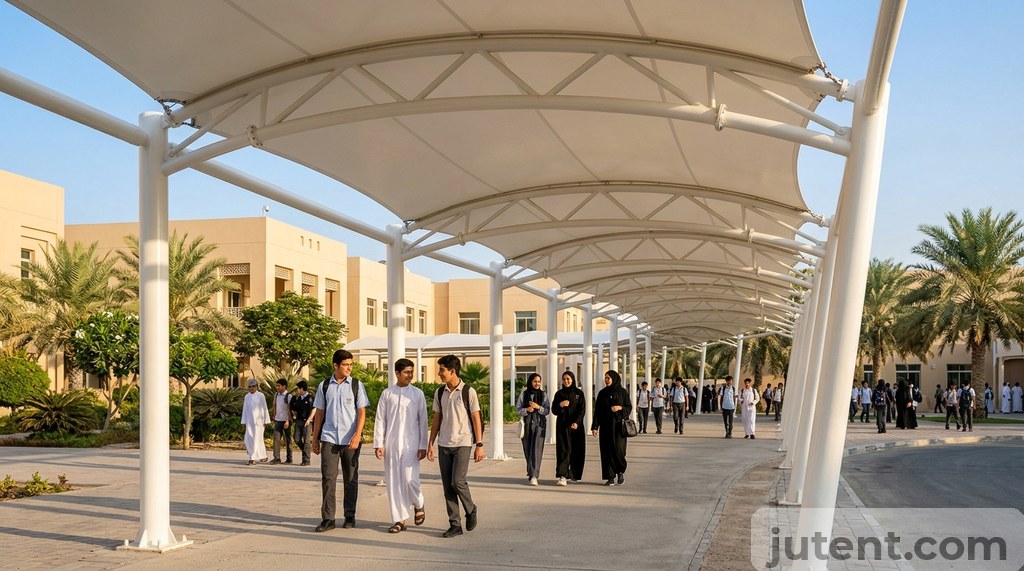
Un auvent de passage piétonnier scolaire résistant à la chaleur dans la région du Golfe nécessite une approche d'ingénierie fondamentalement différente de celle d'une spécification européenne ou nord-américaine standard. Les principaux modes de défaillance dans les pays du CCG sont la dégradation de la membrane par les UV et la corrosion de la structure en acier due à la forte salinité dans les zones côtières comme Doha, Dubaï et Djeddah.
Les entrepreneurs qui spécifient des passerelles scolaires doivent tenir compte de trois facteurs de stress environnementaux distincts. Premièrement, les températures ambiantes dépassent régulièrement 45°C, poussant la température de surface de la membrane au-dessus de 70°C. Deuxièmement, le sable en suspension dans l'air agit comme un abrasif, dépouillant les couches de finition fluorocarbonées standard des poteaux en acier en trois à cinq ans. Troisièmement, l'humidité côtière combinée à des températures élevées accélère l'oxydation sur toutes les connexions structurelles exposées, en particulier au niveau des plaques de base.
To prevent premature failure, the specification must mandate hot-dip galvanized steel (minimum 85 microns thickness) for the primary framework, rather than standard cold-rolled steel with a basic primer. Base plates must be elevated at least 50mm above the finished floor level and encased in non-shrink grout to prevent water pooling during routine maintenance washdowns. Ignoring these specific environmental factors inevitably leads to rust bleeding down the columns and early structural fatigue, resulting in rejected inspections by local educational authorities and costly remediation work.
UV and Heat Protection: Membrane Grade for Middle East School Walkways
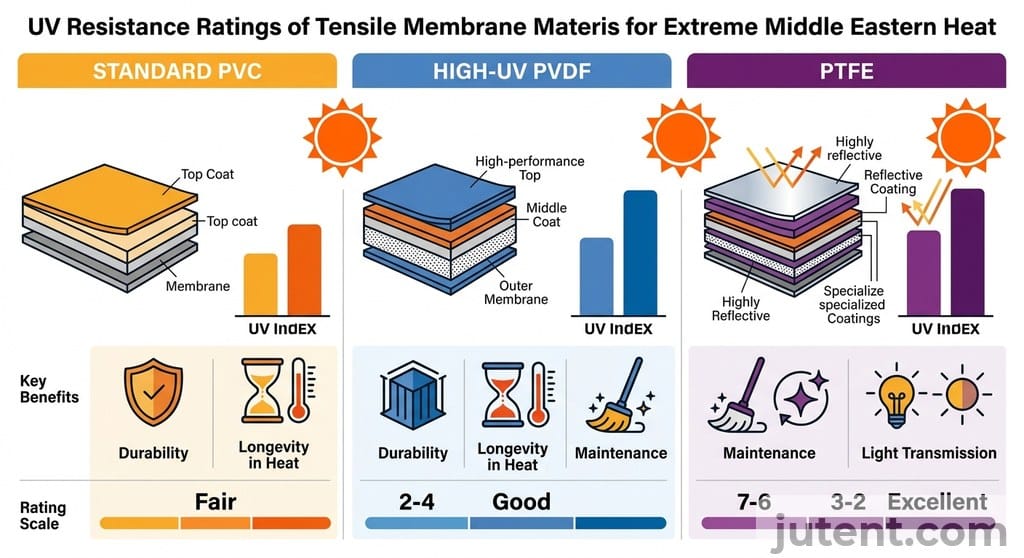
High-grade PVDF handles 95% of school walkway shade Qatar and UAE projects. Standard PVC or HDPE mesh fails in the Gulf; these materials degrade rapidly under continuous UV Index 11+ exposure, losing tensile strength, becoming brittle, and discoloring within 36 months of installation.
For a school walkway canopy UAE specification, the membrane must be a Type II PVDF-coated fabric weighing at least 900g/㎡. The primary component is the fluorocarbon surface layer. This topcoat reflects UV radiation rather than absorbing it, keeping the structural polyester base yarn intact. At 45°C ambient temperatures, a 900g/㎡ PVDF membrane maintains its tensile strength within 10% of the original specification after 10 years of continuous exposure, securing long-term structural stability.
The membrane must also provide a UPF 50+ rating to protect students during transit between buildings. As detailed in our School Walkway Canopy Guide, specifying a highly translucent white PVDF (typically 12-15% light transmission) reduces the need for artificial daytime lighting under the canopy while reflecting thermal energy away from the pedestrian zone. This lowers the perceived temperature at ground level, creating a safer environment for students.
Wind Load: UAE and Saudi Standards for School Walkway Structures
A school covered walkway Saudi Arabia project must comply with the Saudi Building Code (SBC) Chapter 7, while UAE projects typically follow the Dubai Municipality or Abu Dhabi IBC adaptations. The critical engineering metric is the basic wind speed, which dictates the sizing of the primary steel members, the tensioning cables, and the concrete footings.
L'expérience de l'entreprise doit être décrite par une expérience d'exportation vérifiée et une capacité de soutien de projet, plutôt que par des anecdotes de projet non étayées.
Sur la base de l'expérience de Jutent dans plus de 400 projets dans plus de 30 pays, des problèmes de spécification similaires apparaissent souvent lorsque des hypothèses de stade précoce sont faites avant que les conditions d'ingénierie soient confirmées.
Safety and Drainage Considerations for Gulf School Walkways
Les hauteurs de dégagement et la gestion des eaux dictent la conception géométrique des auvents de passerelles scolaires au Moyen-Orient. La structure doit permettre le passage sécurisé des étudiants tout en gérant les pluies intenses et peu fréquentes caractéristiques de la région.
The minimum clearance height at the lowest point of the canopy edge (the eaves) must be 2.5 meters. This prevents accidental contact, limits vandalism by students, and allows clearance for maintenance equipment. The central apex of the walkway should rise to at least 3.5 meters to ensure adequate air circulation and prevent heat trapping beneath the membrane during peak summer months.
For drainage, flat or low-pitch designs fail during Gulf winter downpours. The membrane must be engineered with a minimum 15-degree pitch to ensure rapid water runoff and prevent ponding. Ponding adds severe dead load to the structure and accelerates dirt accumulation, which degrades the PVDF topcoat. Water should be directed to specific low points equipped with PVC downpipes integrated into the steel columns. This system discharges water directly into the school's surface water drainage network rather than spilling it onto the pedestrian path, preventing slip hazards for students and staff.
Référence de cas : Projets de passage couvert scolaire dans la région du Golfe
In a recent school campus project in Sharjah, the contractor required a 120-meter continuous covered walkway connecting the main academic block to the sports hall. The site constraint was an existing underground utility corridor that prevented standard 5-meter column spacing.
We engineered a custom cantilevered structural system using 200×200×8mm SHS columns spaced at 8-meter intervals, bridging the utility lines without requiring foundation relocation. The canopy utilized a 1050g/㎡ PVDF membrane tensioned with 12mm stainless steel edge cables. The entire steel framework was hot-dip galvanized and finished with a marine-grade polyurethane topcoat to resist the coastal humidity.
This configuration provided a 4-meter wide clear path for student transit, completely free of structural obstructions. By supplying the steel pre-cut, pre-drilled, and clearly marked, the local installation team erected the primary framework in six days during the school's summer closure. This modular approach eliminates on-site welding, preserving the integrity of the galvanized coating and ensuring strict compliance with local fire safety regulations during the construction phase. The result is a highly durable, code-compliant structure delivered ahead of the academic year.
Si vous souhaitez une référence budgétaire précise pour ce projet, partagez vos dimensions, votre zone de vent et votre type de membrane préféré avec notre équipe.
Demander un devis personnalisé
FAQ
- What membrane grade is recommended for a school walkway canopy in the UAE?
- High-grade PVDF (1050 g/m² architectural grade) with UPF 50+ rating is standard for UAE school projects. This specification ensures the fabric can withstand the extreme summer temperatures and high UV index without degrading, tearing, or losing its structural pre-stress over a 15-year design life.
- Les auvents de passage piétonnier scolaire en Arabie Saoudite doivent-ils respecter des codes de construction spécifiques ?
- Yes. Saudi Building Code (SBC) Chapter 7 covers wind loads. Contractors must ensure that the primary steel framework, base plates, and concrete footings are engineered to handle the specific regional wind speeds, which dictate the structural sizing required for municipal permit approvals and safe student transit.
- How long does it take to install a heat resistant school walkway canopy?
- Un système de passerelle modulaire standard de 50 mètres nécessite généralement 7 à 10 jours pour être installé sur site, en supposant que les semelles en béton aient déjà durci. L'utilisation de connexions boulonnées préfabriquées élimine le besoin de soudure sur site, ce qui accélère le calendrier, réduit les coûts de main-d'œuvre et minimise les perturbations sur le campus scolaire actif pendant les périodes de cours.
 English
  Français
  Español de México
  Bahasa Melayu
  Tiếng Việt
  Português do Brasil
  Русский
  ไทย
ไทย  العربية