
“`html
Le climat aux Philippines, en Malaisie et en Indonésie impose une base d'ingénierie stricte pour les structures industrielles. Lors de la spécification d'un auvent de quai de chargement, L'Asie du Sud-Est oblige les ingénieurs à prendre en compte deux extrêmes distincts : les charges de vent de typhon de catégorie 5 dépassant 250 km\/h et un rayonnement UV d'indice 12+ toute l'année. Les auvents commerciaux standard conçus pour les zones tempérées échouent régulièrement dans cette région en moins de trois ans. Les modes de défaillance courants incluent le délaminage de la membrane PVC, la formation de flaques hydrostatiques sous de fortes averses de mousson, et le flambage du cadre en acier sous cisaillement dynamique du vent. Pour les opérateurs logistiques, ces défaillances structurelles perturbent les chaînes d'approvisionnement, compromettent les marchandises sensibles à l'humidité et créent des risques sérieux de glissade pour le personnel de chariots élévateurs travaillant sur des aires en béton humides.
La spécification d'une structure résistante aux typhons nécessite des calculs précis de charge aérodynamique, une sélection spécialisée des matériaux et une adhésion stricte aux normes régionales telles que le Code national des structures des Philippines (NSCP) ou le SNI de l'Indonésie. Les entrepreneurs ne peuvent pas se fier à des kits génériques de fourniture uniquement ; le cadre structurel doit être conçu pour la catégorie d'exposition côtière spécifique du site, la capacité portante du sol et les dégagements opérationnels. Ce guide détaille les spécifications exactes dont les entrepreneurs et les gestionnaires d'installations ont besoin pour se procurer un auvent en haute ténacité conforme, qui protège la cargaison sans obstruer les véhicules de transport lourd (HGV) ni les opérations de quai de chargement.
Exigences de charge de vent de typhon en Asie du Sud-Est
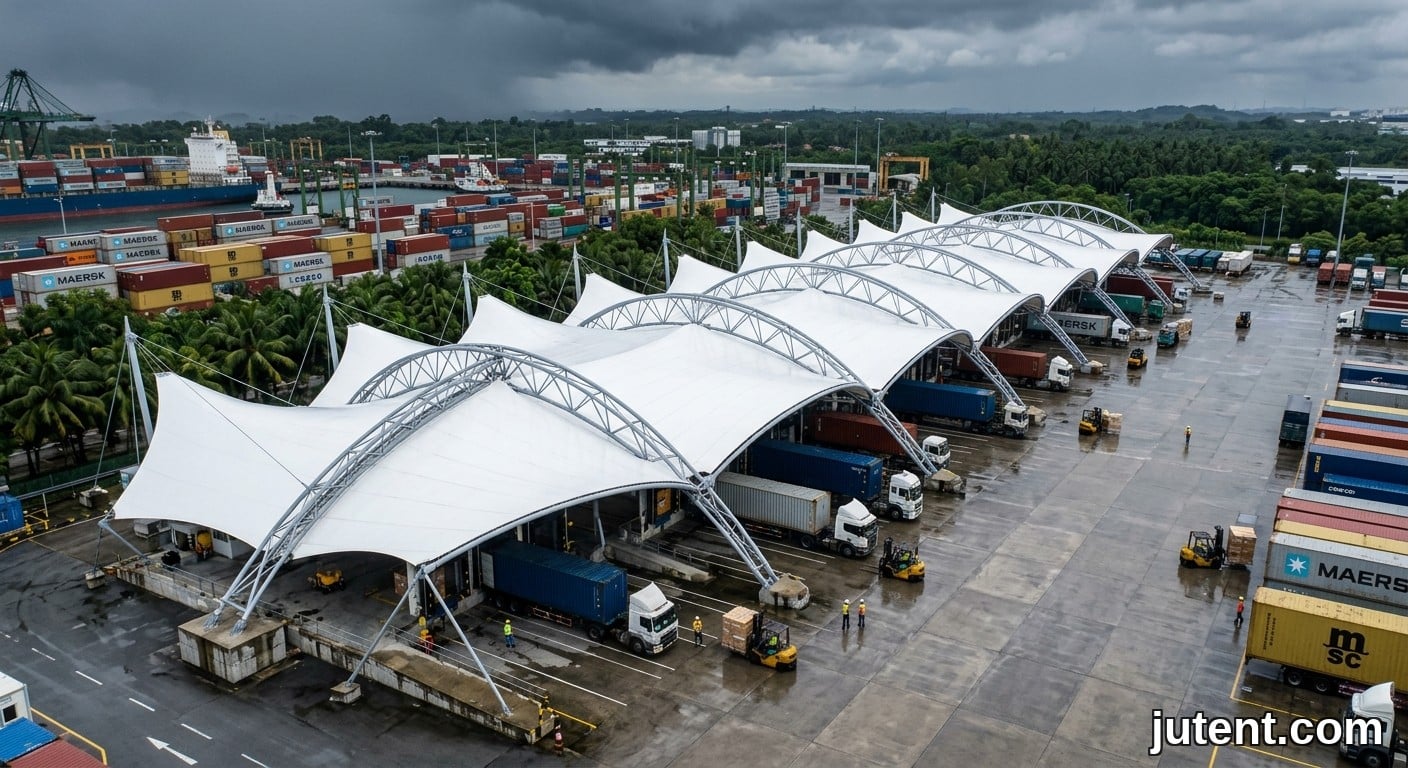
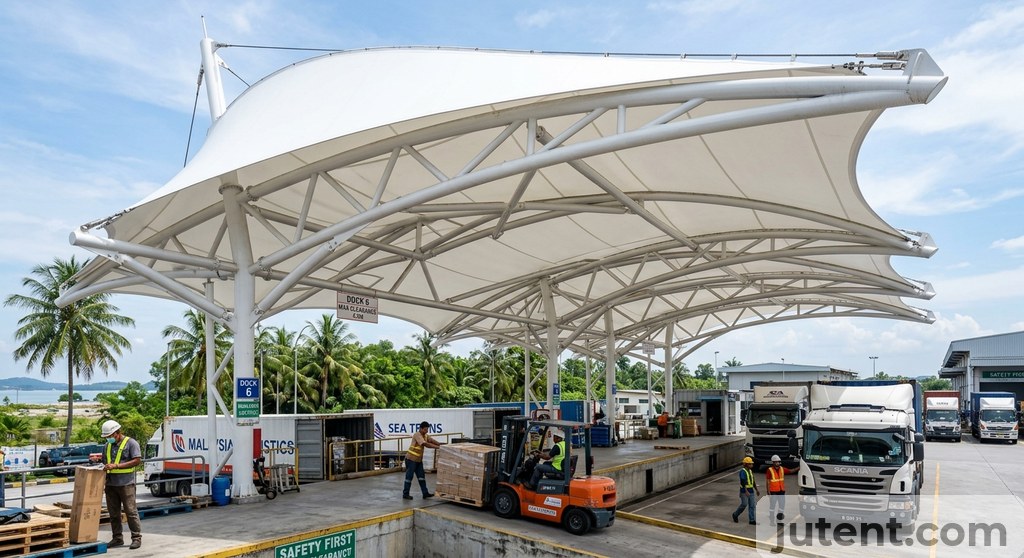
La charge de vent dicte le dimensionnement de l'acier primaire pour tout auvent de quai de chargement aux Philippines. Le Code national de structure des Philippines (NSCP) exige que les structures industrielles côtières résistent à des vitesses de vent de calcul de 200 à 250 km/h. Un auvent de quai de chargement en Malaisie ou en Indonésie est confronté à des vitesses de vent de base légèrement inférieures, généralement conçues pour 120 à 160 km/h selon l'exposition côtière, mais les rafales soudaines de mousson exigent toujours des connexions rigides et un ancrage lourd.
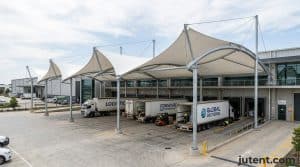
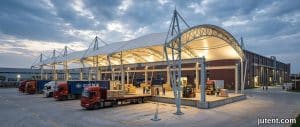
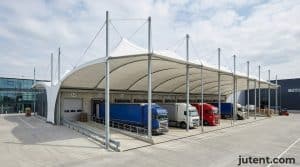
Pour répondre à ces charges extrêmes sans entraver les rayons de braquage des camions, le cadre structurel nécessite des profilés en acier substantiels. Un auvent multi-travées standard de 20 mètres de large nécessite des poteaux principaux utilisant des profilés creux carrés (SHS) de 200×200×8 mm ou des poutres en I équivalentes, ancrés avec des plaques de base à connexion par moment sur des semelles en béton armé. Les structures tendues haubanées sont très efficaces ici, car la membrane tendue transfère efficacement le cisaillement du vent au cadre en acier primaire plutôt que de lutter statiquement contre la pression du vent.
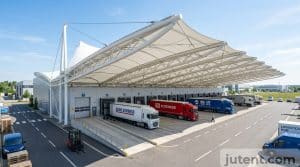
Les entrepreneurs doivent s'assurer que la conception de l'auvent s'intègre directement à l'existant Quais de chargement sans entrer en conflit avec les niveleurs de quai, les pare-chocs d'impact ou les zones de recul des camions. La hauteur libre standard est de 5,5 mètres pour accueillir les conteneurs maritimes high-cube. La spécification d'un auvent de quai de chargement résistant aux typhons nécessite de soumettre des calculs de vent spécifiques au site et des rapports d'analyse par éléments finis (FEA) aux autorités locales avant le début du coulage des fondations.
Protection UV en climat tropical : exigences de qualité de membrane
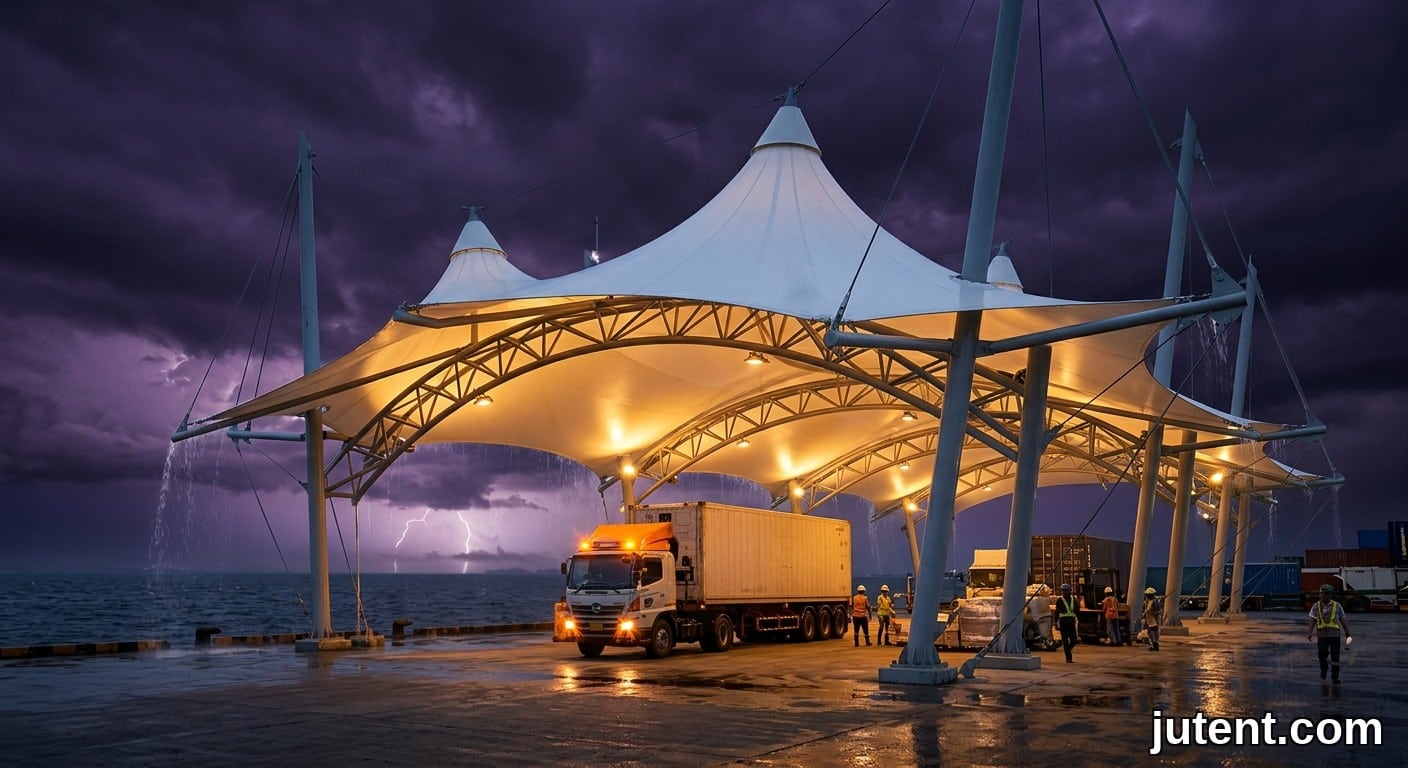
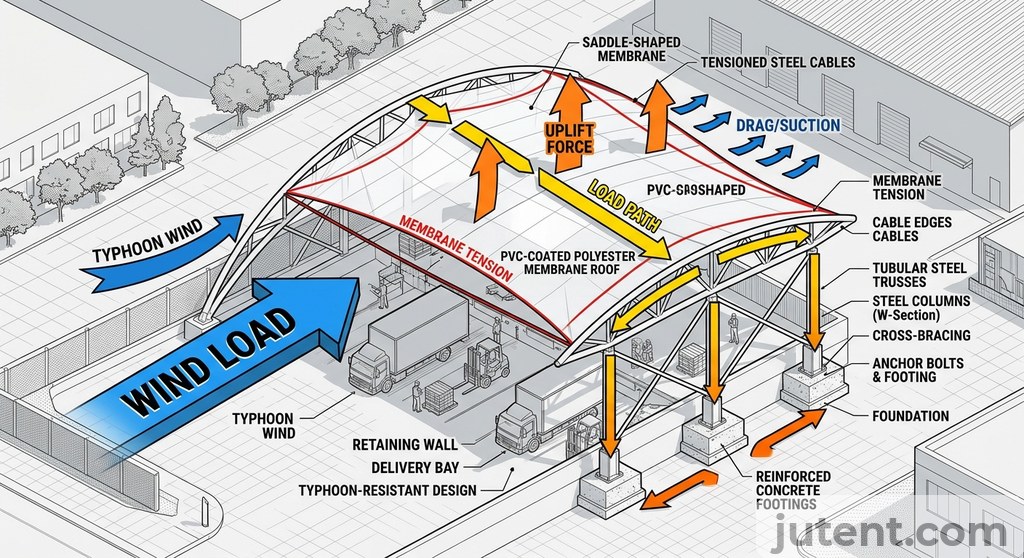
Une membrane PVDF de 1050 g/m² — un type de structure membranaire tendue avec un revêtement fluorocarboné — constitue la spécification minimale viable pour les applications industrielles tropicales. Contrairement au tissu PVC standard, le PVDF réfléchit le rayonnement UV plutôt que de l'absorber, ce qui en fait le matériau privilégié pour les auvents de quais de chargement dans les régions à fort ensoleillement UV.
L'erreur de spécification que nous voyons le plus souvent dans les climats tropicaux est la sélection de PVDF 950g/㎡ au lieu de 1050g/㎡ pour réduire les dépenses d'investissement initiales. La différence de prix est d'environ 3 à 5 $/㎡. La différence de durée de vie est de 5 à 8 ans. Le calcul ne justifie pas l'économie. À 1050g/㎡, la membrane maintient sa résistance à la traction à moins de 10 % de la spécification d'origine après 15 ans d'exposition au soleil équatorial.
PVDF vs. PTFE : Quelle membrane tendue pour les quais de chargement tropicaux ?
Le PVDF est économique pour les auvents industriels, offrant une excellente résistance aux UV et des propriétés autonettoyantes à un prix inférieur. Le PTFE, quant à lui, est une structure permanente ignifugée pouvant durer plus de 30 ans, mais à un coût nettement plus élevé. Pour la plupart des applications de quais de chargement en Asie du Sud-Est, le PVDF offre le meilleur équilibre entre durabilité et budget, tandis que le PTFE est réservé aux installations haut de gamme et critiques en matière de sécurité incendie.
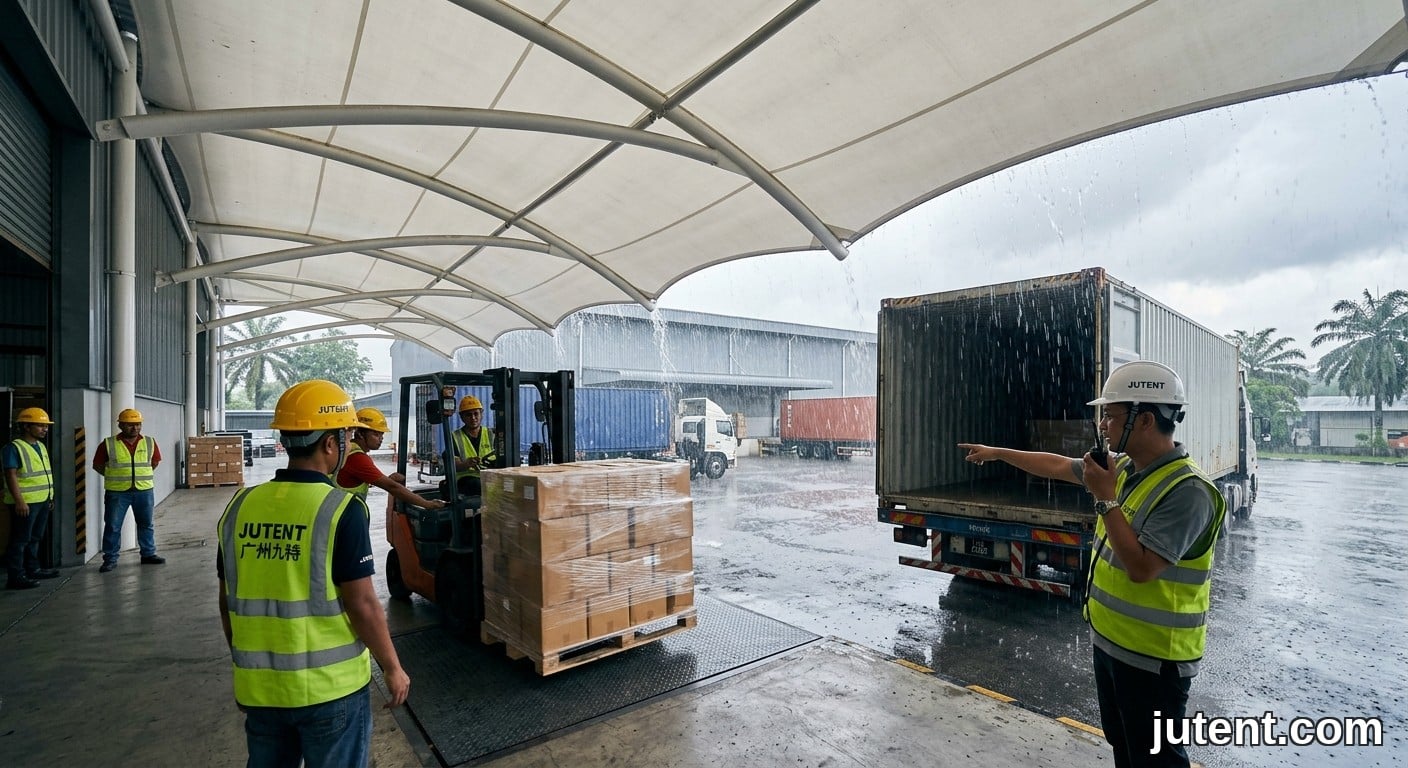
Pour une auvent de quai de chargement En Indonésie, où l'humidité élevée s'associe à un soleil intense, les propriétés autonettoyantes de la couche de finition PVDF empêchent la croissance fongique et l'accumulation de saleté provenant des gaz d'échappement diesel. Les entrepreneurs examinant les options d'approvisionnement devraient consulter notre guide des structures de tension pour auvents de quai de chargement afin d'obtenir des spécifications détaillées vérifiant l'épaisseur exacte du revêtement de la membrane et les traitements anti-mèche. Le tissu doit être tendu à un minimum de 2,5 kN/m pour éviter le battement au vent, ce qui accélère l'usure du revêtement et compromet l'intégrité structurelle de l'ensemble du système d'auvent.
Conception du drainage pour environnements à fortes précipitations
Les saisons de mousson en Asie du Sud-Est produisent des intensités de précipitations dépassant fréquemment 150 mm par heure lors des événements météorologiques extrêmes. Un auvent de quai de chargement doit évacuer cette eau instantanément pour éviter la formation de flaques sur la membrane, ce qui ajoute une charge permanente catastrophique à la structure en acier. L'eau pèse 1 000 kg par mètre cube ; même une flaque de 50 mm de profondeur sur une travée structurelle standard de 10 m × 10 m ajoute 5 000 kg de charge permanente non intentionnelle, suffisante pour déformer définitivement l'acier.
“`