
“`html
Dubaï, juillet. Les températures ambiantes atteignent 48°C, les températures de surface sur l'acier exposé dépassent 65°C et l'indice UV reste à 11+ pendant six mois de l'année. Spécifier un guide de conception d'auvent tendu pour hôtel avec membranes PVDF et PTFE Les entrepreneurs du Moyen-Orient peuvent en fait garantir qu'il faut abandonner les hypothèses standard sur les matériaux européens ou nord-américains. Une membrane résistante à la chaleur auvent en toile pour hôtel dans cette région ne concerne pas seulement l'esthétique architecturale ; il s'agit de prévenir la dégradation thermique rapide, de gérer la perte de précontrainte de la membrane sous une chaleur extrême et d'assurer la conformité aux charges de vent dans les expositions côtières ou désertiques ouvertes.
Lorsqu'un client du secteur hôtelier investit dans un ombrage extérieur pour les abords de piscine, les espaces de restauration ou les zones d'entrée, il attend une structure qui conserve son intégrité structurelle et son aspect impeccable pendant des décennies, et non seulement quelques saisons. Les spécifications standard ne tiennent souvent pas compte de la combinaison agressive de salinité élevée, de sable soufflé et de rayonnement solaire incessant propre au Golfe. Ce guide détaille les spécifications techniques exactes requises pour les auvent en toile pour hôtel projets aux Émirats Arabes Unis, en Arabie Saoudite et au Qatar afin d'éviter une défaillance prématurée. Nous aborderons la sélection des membranes, la protection de la structure en acier et les codes spécifiques de charge de vent municipaux qui dictent le dimensionnement des fondations, fournissant aux entrepreneurs les chiffres exacts pour bien spécifier avant de soumissionner.
Climat du Golfe : pourquoi les spécifications standard des auvents tendus pour hôtels (张拉膜结构) ne s'appliquent pas aux membranes PVDF/PTFE
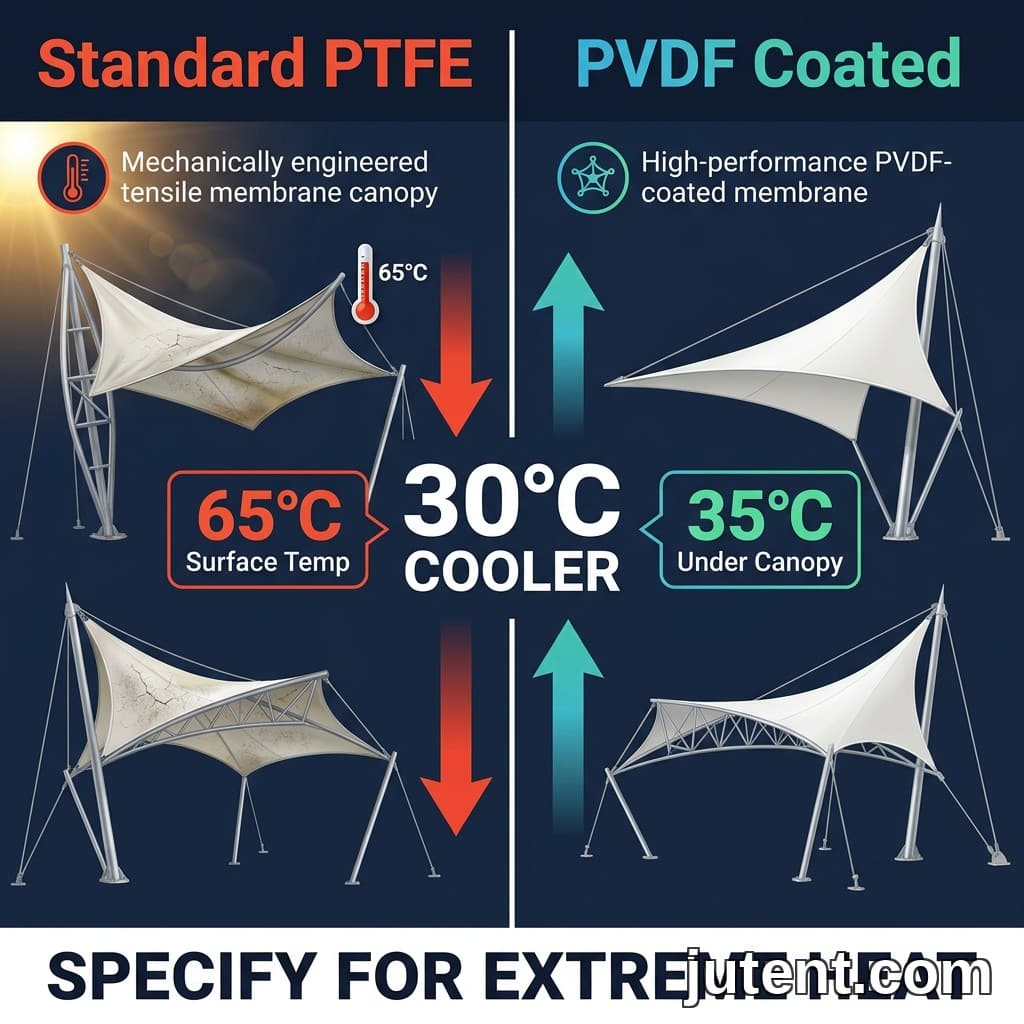
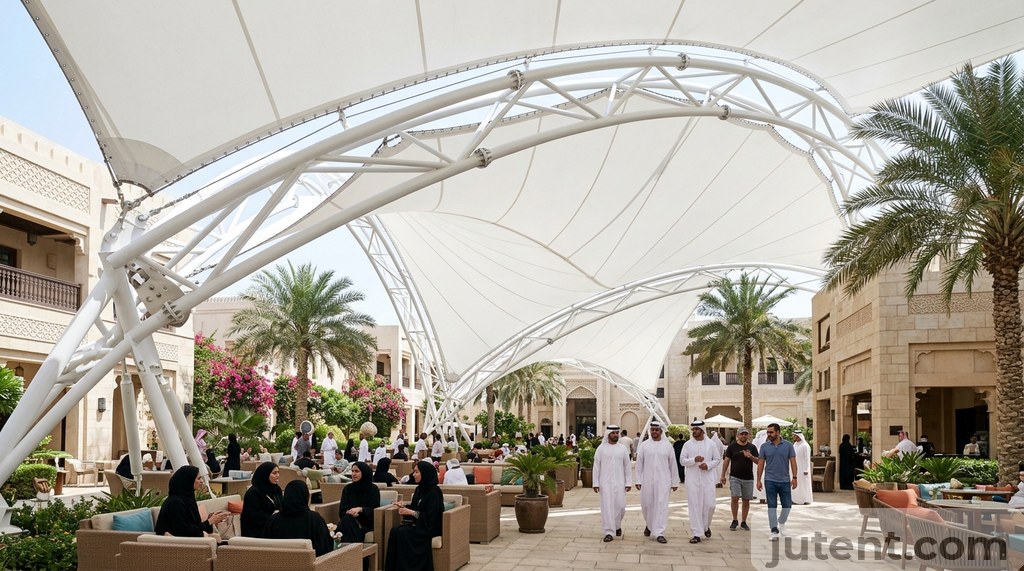
L'environnement opérationnel dans le Conseil de coopération du Golfe (CCG) impose des décisions structurelles et matérielles qui vont bien au-delà des exigences standard d'ombrage. Lorsqu'un entrepreneur spécifie une structure de loisirs hôtelière pour un complexe de luxe à Doha ou Abu Dhabi, le principal mode de défaillance est rarement l'usure mécanique — il s'agit d'une grave dégradation thermique.
Les membranes PVC standard de 700 g/m² à 900 g/m² (sans revêtement PVDF) se dégradent rapidement dans le Golfe — en 24 à 36 mois — en raison de la migration des plastifiants. Les membranes premium revêtues de PVDF (1050 g/m²) durent 15 à 20 ans, tandis que les membranes PTFE durent 25 à 30 ans. À une température ambiante de 45 °C, les plastifiants des PVC de qualité inférieure migrent vers la surface. En 24 à 36 mois, la membrane devient cassante, perd ses propriétés autonettoyantes et commence à se décolorer à cause de l'accumulation de poussière et de sable. L'écart de température diurne extrême — passant de 45 °C le jour à 25 °C la nuit — provoque une dilatation et une contraction constantes. Si le cadre en acier et la quincaillerie de mise en tension ne sont pas conçus pour ce cycle thermique quotidien, la membrane perd sa précontrainte, entraînant une accumulation d'eau dangereuse lors des rares mais intenses pluies hivernales.
Les spécifications typiques utilisent de l'acier Q235B ou Q355B. Pour les projets côtiers du Golfe, nous recommandons de l'acier Q355B galvanisé à chaud avec une épaisseur de revêtement minimale de 85 microns pour résister à la corrosion par pulvérisation saline, une membrane PVDF ou PTFE de 1050 g/m² en standard, et des accessoires en acier inoxydable SS304, avec des qualités supérieures disponibles lorsque le projet l'exige.
Protection UV et thermique : qualité de membrane pour les projets du Golfe
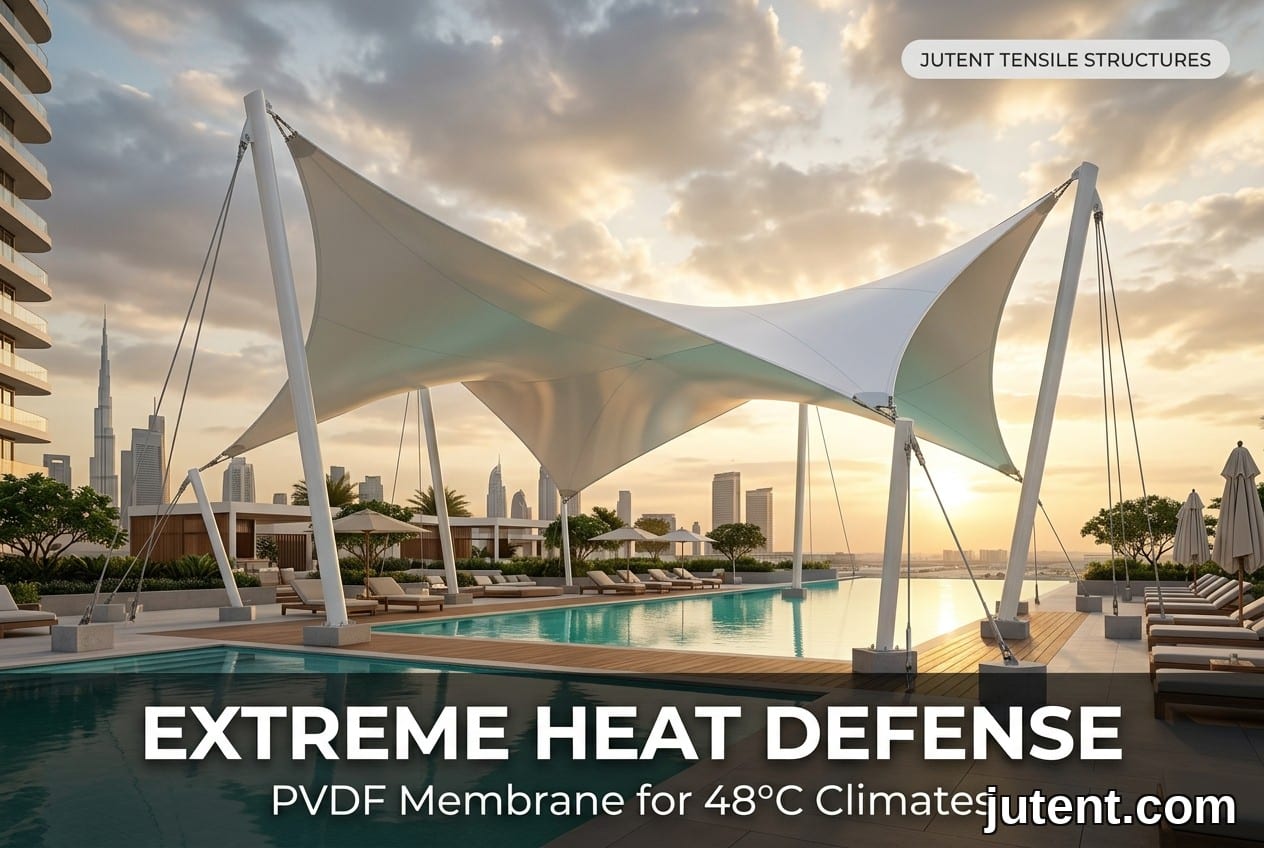
La protection contre la corrosion et la durée de vie doivent être décrites en fonction du système de protection choisi, de l'environnement du projet et des conditions de maintenance, et non comme une garantie de durée de vie inconditionnelle.
La planification budgétaire doit être basée sur le type de structure, la portée libre, la résistance au vent, le grade de membrane, le tonnage d'acier et la portée du projet. Pour un devis précis EXW, FOB, CIP ou DDU, les dimensions du projet et les exigences d'ingénierie doivent être examinées en premier.
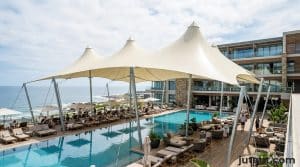
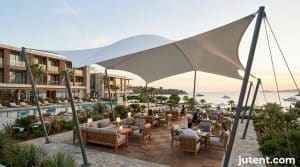
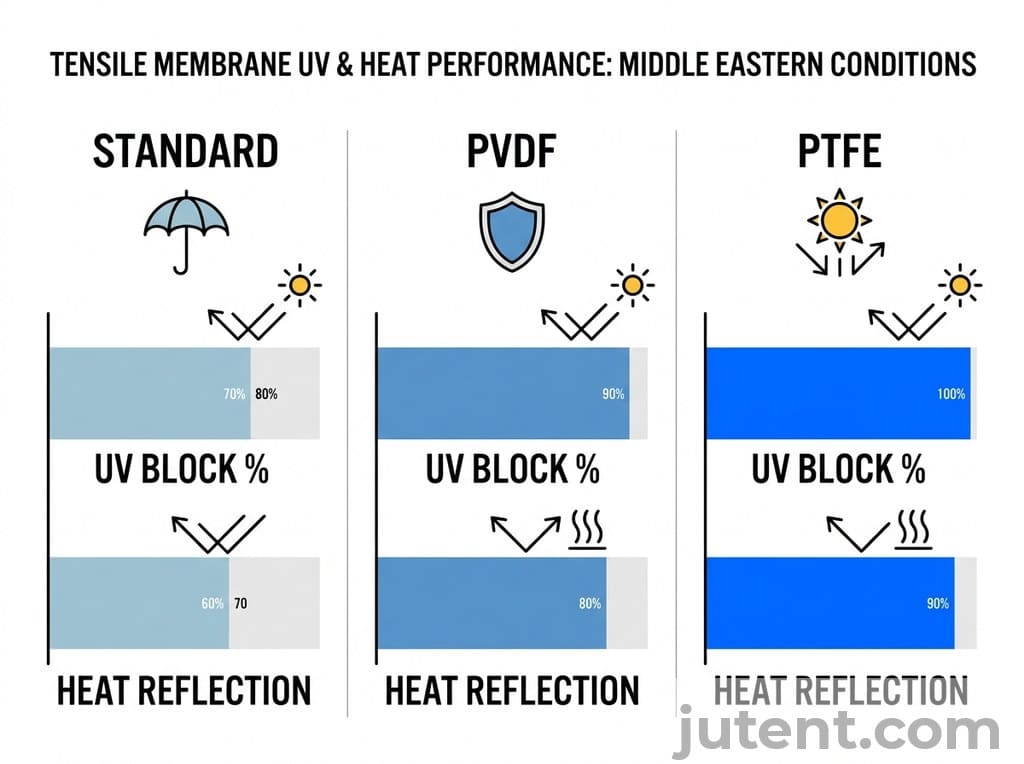
Pour un dimensionnement structurel détaillé et des comparaisons de matériaux, les entrepreneurs devraient consulter notre Auvents tendus pour hôtels Guide. La spécification de la membrane doit également imposer une finition blanche hautement réfléchissante pour minimiser le gain de chaleur solaire. Les membranes PVDF premium réfléchissent jusqu'à 73 % de l'énergie solaire. Ce rejet thermique abaisse la température ambiante dans la zone ombragée en dessous, une exigence de base pour le confort des clients dans les environnements hôteliers de luxe.
Charge de vent : normes des Émirats Arabes Unis et d'Arabie Saoudite
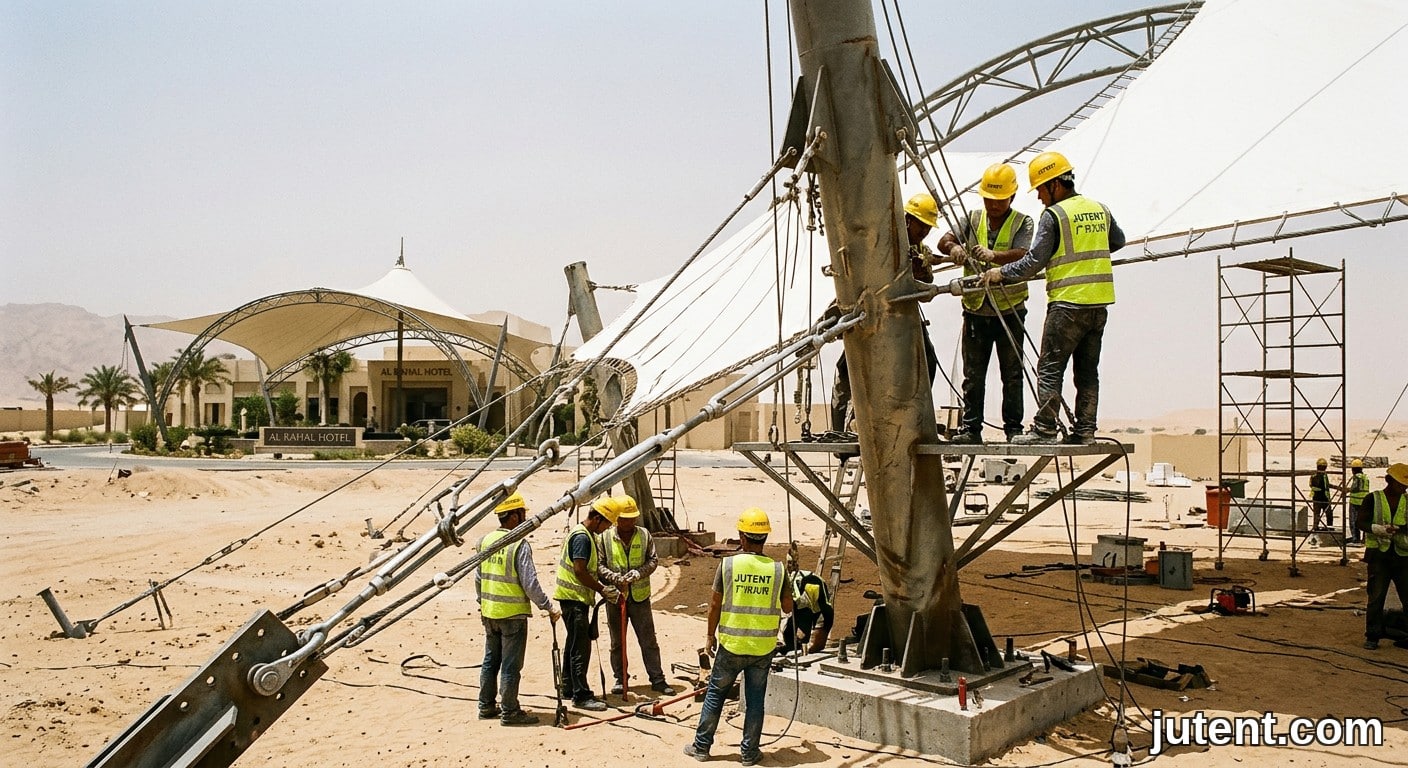
Bien que la chaleur extrême soit le principal moteur de la dégradation des matériaux, le vent dicte le tonnage d'acier et le dimensionnement des fondations. Un auvent en toile pour hôtel projet en Arabie Saoudite ou aux Émirats Arabes Unis doit se conformer aux codes municipaux locaux stricts, qui sont devenus de plus en plus rigoureux concernant les structures ouvertes.
L'expérience de l'entreprise doit être décrite par une expérience d'exportation vérifiée et une capacité de soutien de projet, plutôt que par des anecdotes de projet non étayées.
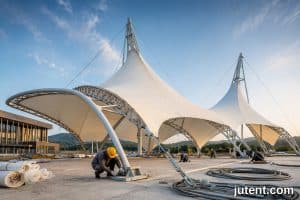
En Arabie Saoudite, le Code du Bâtiment Saoudien (SBC 301) régit les charges structurelles. Le chapitre 6 du SBC 301 (basé sur l'ASCE 7-16) traite des charges de vent pour les structures tendues. Pour un complexe à Djeddah ou dans la zone de développement de la mer Rouge, les charges de vent doivent tenir compte des rafales côtières soudaines. Nous constatons fréquemment que les entrepreneurs sous-spécifient l'épaisseur de la plaque de base et la profondeur d'ancrage des boulons lors de la phase initiale d'appel d'offres. Un auvent conique standard de 400 mètres carrés dans ces zones de vents forts nécessite généralement des plaques de base de 25 mm à 30 mm d'épaisseur et des ancrages chimiques M24 ou M30 encastrés d'au moins 400 mm dans les semelles en béton armé pour résister en toute sécurité à la force de soulèvement massive générée par le profil aérodynamique de la membrane.
Référence de cas : Projets dans la région du Golfe
Sur plus de 420 projets dans le monde, y compris un travail approfondi dans des climats extrêmes, l'erreur d'installation la plus courante que nous observons au Moyen-Orient
Obtenez dès maintenant votre fiche technique d'auvent pour hôtel
“`