
“`html
Lorsqu'on envisage un nouveau développement ou une rénovation d'espace public, l'intégration de structures d'ombrage est souvent une décision précoce cruciale. Pour les promoteurs et entrepreneurs cherchant à améliorer le confort des utilisateurs, à prolonger l'utilisabilité et à ajouter une distinction architecturale, comprendre les nuances des différentes solutions d'ombrage est primordial. Ce guide se concentre sur qu'est-ce qu'un parc structure d'ombrage tensiles, offrant une compréhension fondamentale de leur conception, de leur fonction et de leur application. Nous expliquerons comment ces structures fonctionnent, leur coût typique et les spécifications clés à considérer, vous aidant à faire des choix éclairés pour votre prochain projet.
Ce qu'est une structure d'ombrage tendu pour parc et ce qu'elle n'est pas
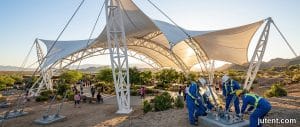
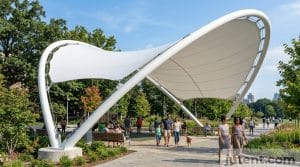
Un parc structure d'ombrage tensiles est une structure de membrane tendue permanente, conçue architecturalement et spécifiquement conçue pour des applications commerciales dans des environnements de parcs publics. Ces structures utilisent la résistance et la flexibilité inhérentes des membranes en tissu tendu, soutenues par une charpente en acier fiable, pour créer de vastes zones ombragées sans colonnes. Contrairement aux auvents temporaires ou aux structures de toit rigides traditionnelles, un parc structure d'ombrage tensiles offre un mélange unique d'attrait esthétique, de durabilité et de performance fonctionnelle. Ils sont conçus pour résister à diverses conditions météorologiques, y compris les vents forts et les fortes pluies, offrant une protection et un confort à long terme.
Qu'est-ce qu'un parc structure d'ombrage tensiles n'est cependant pas une solution temporaire. Ce sont des installations techniques nécessitant une conception détaillée, des calculs structurels et une installation professionnelle. Il ne s'agit pas de kits prêts à l'emploi pour un assemblage DIY, ni adaptés à des événements de courte durée où la portabilité est une préoccupation principale. Au contraire, ils représentent un investissement significatif dans les infrastructures publiques, destiné à servir les communautés pendant des décennies. Leur conception privilégie la longévité, la sécurité et un entretien minimal, ce qui les rend idéaux pour les espaces publics très fréquentés tels que les aires de jeux, les zones de repos et les places ouvertes. Pour des applications spécifiques en les paysages de parcs, Jutent propose des solutions sur mesure. Paysages de Parc
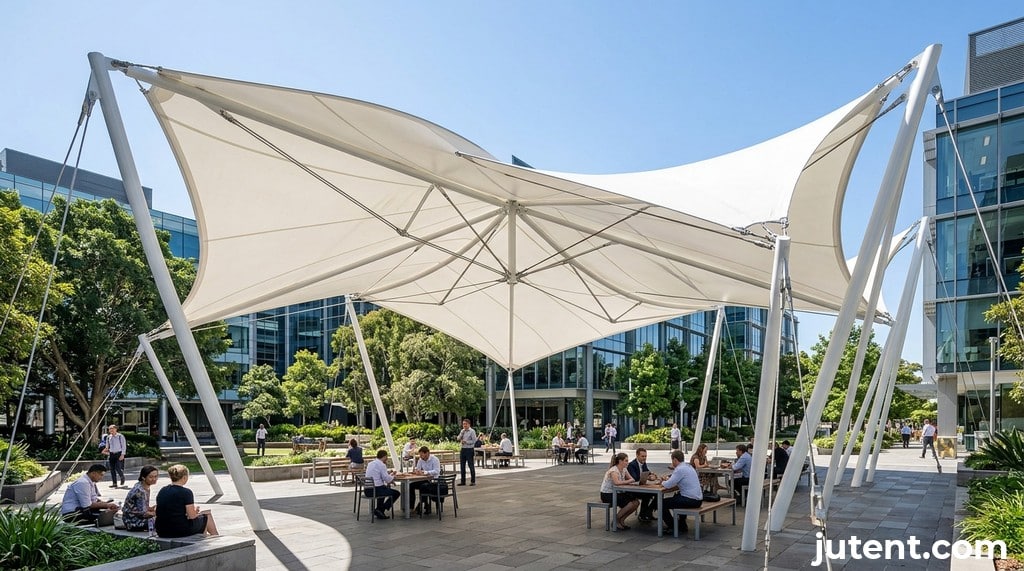
Comment fonctionnent les structures d'ombrage tendues pour parc : acier, membrane et drainage
Le principe fondamental d'une structure d'ombrage en membrane tendue pour parc structure réside dans la synergie entre ses composants principaux : la structure de support en acier et la membrane tendue. Le cadre en acier, généralement fabriqué en acier de haute qualité Q235B ou Q355B (normes chinoises GB/T ; équivalentes aux S235JR et S355JR selon EN 10025, disponibles sur demande pour les projets internationaux), fournit les points d’ancrage nécessaires et l’intégrité structurelle. Cet acier est méticuleusement fabriqué et traité avec des finitions de surface approuvées telles qu’une couche de fond époxy riche en zinc + couche de finition acrylique, une couche de fond époxy riche en zinc + couche de finition fluorocarbone, ou une galvanisation à chaud pour garantir une résistance à la corrosion à long terme et un attrait esthétique.
La membrane, généralement un tissu en PVDF ou PTFE de 1050 g/m², est ensuite étirée et mise sous tension sur ce cadre. Cette tension est cruciale ; elle donne à la membrane sa forme structurelle et sa rigidité, lui permettant de couvrir de grandes distances sans supports intermédiaires. La forme spécifique de la membrane, souvent anticlastique (courbant dans des directions opposées), est conçue pour répartir efficacement les charges, résister au soulèvement dû au vent et évacuer l'eau de pluie.
Un drainage efficace est une considération de conception cruciale. Les structures tendues sont intrinsèquement conçues pour gérer efficacement les eaux de pluie. La courbure de la membrane, combinée à des points bas stratégiquement placés et à des systèmes de gouttières intégrés, dirige l'eau vers des points de drainage spécifiques, empêchant la formation de flaques et assurant la longévité de la structure. Cette conception intelligente les rend particulièrement adaptées aux environnements soumis à de fortes précipitations. Pour une analyse plus approfondie des aspects techniques, référez-vous à notre structure d'ombrage en membrane tendue pour parc guide des structures. Parc Structure d'ombrage tendue Guide
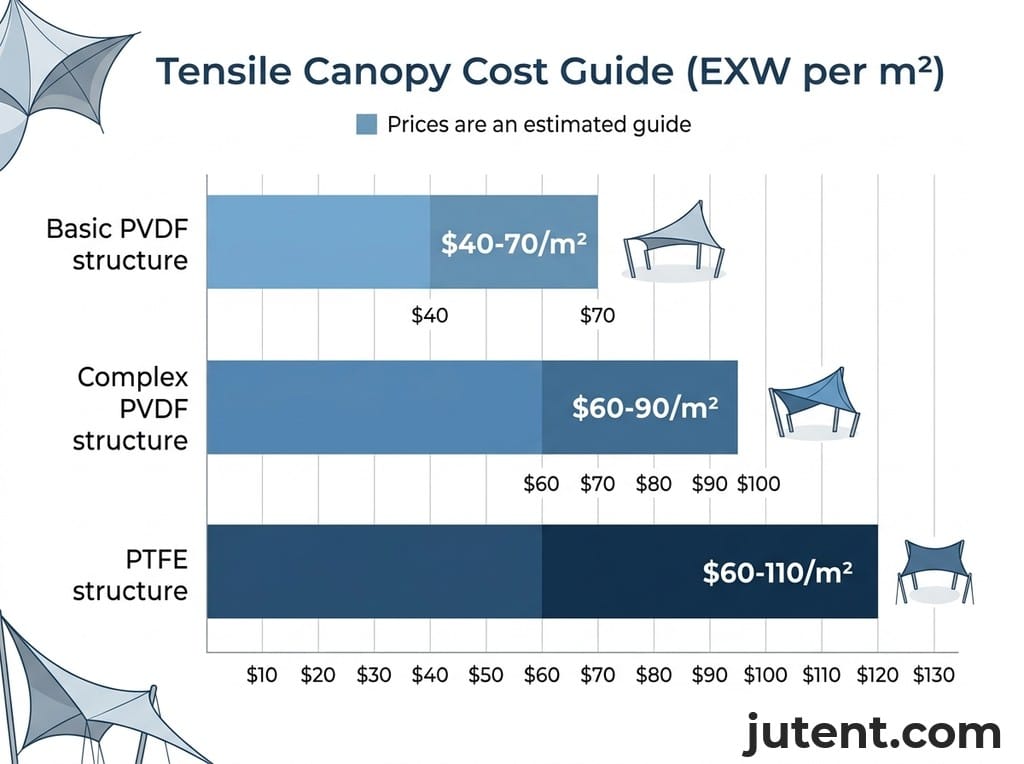
Types de structures d'ombrage tendues pour parc : formes structurelles courantes
La polyvalence de l'architecture tendue permet une grande variété de formes structurelles, chacune offrant des caractéristiques esthétiques et fonctionnelles distinctes. Comprendre ces types courants aide à sélectionner la conception la plus appropriée pour un environnement de parc spécifique.
Structures coniques
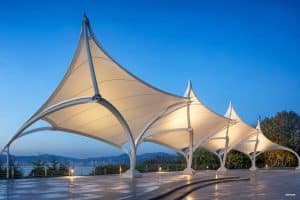
Les structures coniques sont caractérisées par un mât central qui pousse la membrane vers le haut, créant une forme conique ou de paraboloïde hyperbolique. Cette forme est excellente pour évacuer l'eau et peut créer des effets visuels spectaculaires et élancés. Elles sont souvent utilisées pour de grandes zones ouvertes où un seul point focal important est souhaité.
Structures en Arche
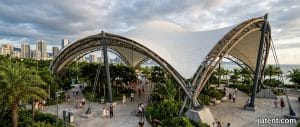
Les structures en arche utilisent des arches en acier pour soutenir et tendre la membrane. La membrane s'étend généralement entre des arches parallèles ou radiales, créant une apparence voûtée ou ondulée. Cette forme offre de bonnes portées libres et peut être particulièrement efficace pour couvrir des passerelles ou des espaces linéaires, procurant une sensation d'enfermement tout en conservant une ouverture.
Structures Hypar (Paraboloïde Hyperbolique)
Les structures hypar sont peut-être
“`