
“`html
When considering a new public space development or renovation, the integration of shade structures is often a critical early decision. For developers and contractors aiming to enhance user comfort, extend usability, and add architectural distinction, understanding the nuances of various shade solutions is paramount. This guide focuses on what is a park tensile shade structure, providing a foundational understanding of their design, function, and application. We'll explain how these structures work, what they typically cost, and key specifications to consider, helping you make informed choices for your next project.
What a Park Tensile Shade Structure Is and What It Isn't
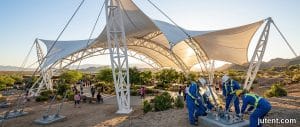
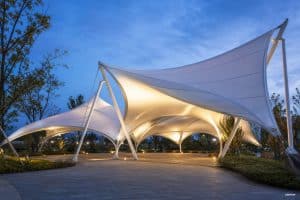
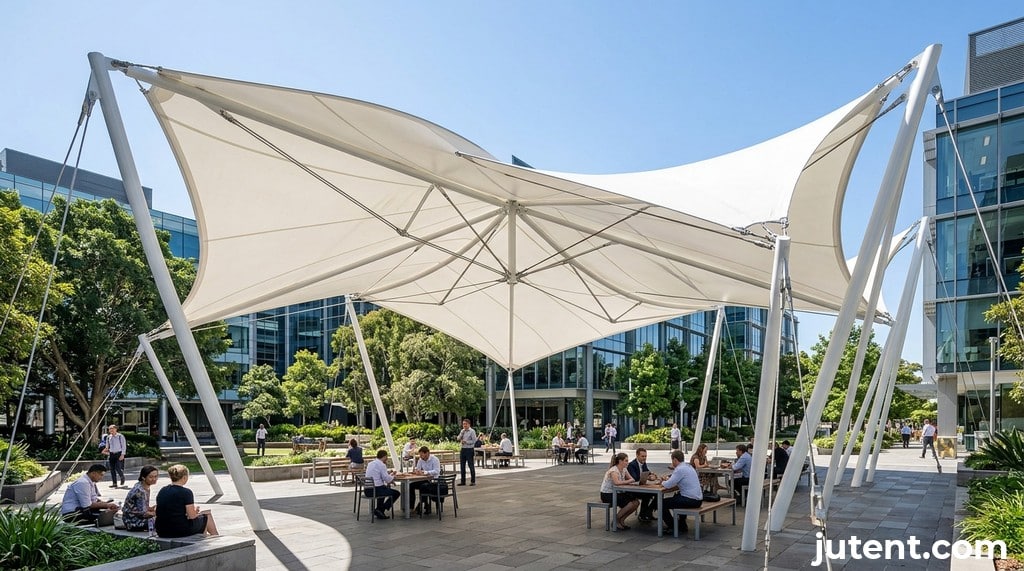
A park tensile shade structure is a permanent, architecturally designed tensile membrane structure specifically engineered for commercial applications within public park environments. These structures utilize the inherent strength and flexibility of tensioned fabric membranes, supported by a reliable steel framework, to create expansive, column-free shaded areas. Unlike temporary canopies or traditional rigid roof structures, a park tensile shade structure offers a unique blend of aesthetic appeal, durability, and functional performance. They are designed to withstand diverse weather conditions, including high winds and heavy rainfall, providing long-term protection and comfort.
What a park tensile shade structure isn't, however, is a temporary solution. These are engineered installations, requiring detailed design, structural calculations, and professional installation. They are not off-the-shelf kits for DIY assembly, nor are they suitable for short-term events where portability is a primary concern. Instead, they represent a significant investment in public infrastructure, intended to serve communities for decades. Their design prioritizes longevity, safety, and minimal maintenance, making them ideal for high-traffic public spaces suchike playgrounds, seating areas, and open plazas. For specific applications in park landscapes, Jutent offers tailored solutions. Park Landscapes
How Park Tensile Shade Structure Structures Work: Steel, Membrane, and Drainage
The fundamental principle behind a park tensile shade structure lies in the synergy between its primary components: the steel support structure and the tensioned membrane. The steel framework, typically constructed from high-grade Q235B or Q355B steel (Chinese GB/T standards; equivalent to S235JR and S355JR under EN 10025, available on request for international projects), provides the necessary anchor points and structural integrity. This steel is meticulously fabricated and treated with approved surface finishes such as epoxy zinc-rich primer + acrylic topcoat, epoxy zinc-rich primer + fluorocarbon topcoat, or hot-dip galvanizing to ensure long-term corrosion resistance and aesthetic appeal.
The membrane, usually a 1050 g/m² PVDF or PTFE fabric, is then stretched and tensioned across this framework. This tension is crucial; it gives the membrane its structural form and rigidity, allowing it to span large distances without intermediate supports. The specific shape of the membrane, often anticlastic (curving in opposite directions), is engineered to distribute loads effectively, resisting wind uplift and shedding rainwater.
Effective drainage is a critical design consideration. Tensile structures are inherently designed to manage rainwater efficiently. The membrane's curvature, combined with strategically placed low points and integrated gutter systems, directs water flow to specific drainage points, preventing ponding and ensuring the longevity of the structure. This intelligent design makes them highly suitable for environments with heavy rainfall. For a deeper dive into the technical aspects, refer to our park tensile shade structure guide. Park Tensile Shade Structure Guide
Types of Park Tensile Shade Structure: Common Structural Forms
The versatility of tensile architecture allows for a wide array of structural forms, each offering distinct aesthetic and functional characteristics. Understanding these common types helps in selecting the most appropriate design for a specific park environment.
Cone Structures
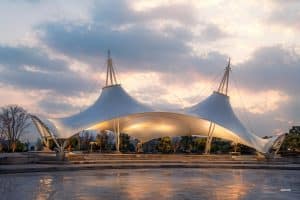
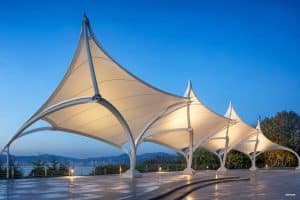
Cone structures are characterized by a central mast that pushes the membrane upwards, creating a conical or hyperbolic paraboloid shape. This form is excellent for shedding water and can create dramatic, soaring visual effects. They are often used for large, open areas where a single, prominent focal point is desired.
Arch Structures
Arch structures utilize steel arches to support and tension the membrane. The membrane typically spans between parallel or radial arches, creating a vaulted or wave-like appearance. This form offers good clear spans and can be particularly effective for covering walkways or linear spaces, providing a sense of enclosure while maintaining openness.
Hypar (Hyperbolic Paraboloid) Structures
Hypar structures are perhaps
“`