
“`html
Grandstand Canopy Wind Load: Critical Design Considerations for Engineers & Contractors
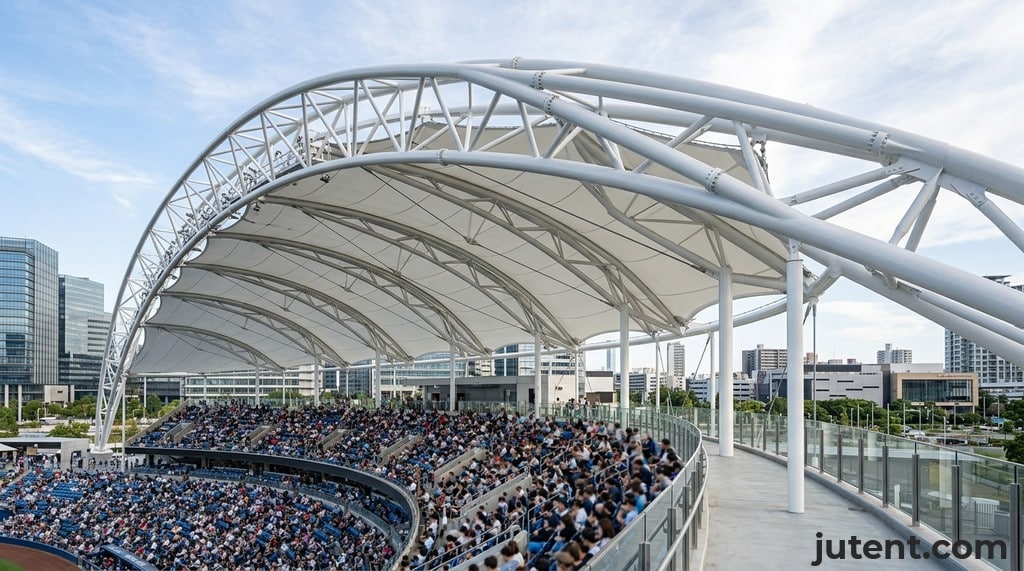
When designing or specifying a grandstand canopy, engineers and contractors face a critical decision framework: prioritize structural integrity against environmental forces, particularly wind. Unlike many building structures where gravity loads are paramount, a grandstand canopy's expansive, often curved surface makes it highly susceptible to wind uplift. Understanding the nuances of wind load calculation, regional standards, and the specific data provided by manufacturers like Jutent is not just good practice—it's essential for ensuring safety, longevity, and compliance. Wind uplift is the critical load case for grandstand canopies — not downward pressure. Understanding how wind load is calculated and what standards apply in your region is essential before specifying a grandstand canopy structure.
Why Wind Uplift Is the Critical Load Case for Tensile Membrane Grandstand Canopies
For any large-span, lightweight structure like a tensile grandstand canopy, wind forces are the primary design driver. While snow and live loads are considered, it's the dynamic and often unpredictable nature of wind that dictates the structural form and material specifications. Specifically, wind uplift—the suction force created by wind flowing over and around the canopy—is typically the most critical load case. This phenomenon occurs because air pressure above the canopy decreases as wind speed increases, while pressure below remains relatively higher, creating a net upward force.
This uplift can be significantly greater than any downward pressure exerted by wind. If not adequately accounted for, uplift can lead to catastrophic structural failure, tearing membranes, or even dislodging entire steel frameworks. Therefore, the design must ensure that all connections, from the membrane attachment points to the foundation anchors, can resist these powerful upward forces. Jutent's grandstand canopies, designed with a service life of 15+ years for PVDF membranes and 25+ years for PTFE under standard maintenance conditions (regular cleaning and inspection), are engineered to withstand these specific uplift pressures, ensuring long-term performance and safety. Grandstand Canopy
How Wind Load Is Calculated: Pressure Coefficients and Design Wind Speed
Calculating wind load on a grandstand canopy involves a systematic approach that combines site-specific environmental data with structural geometry. The fundamental equation for wind pressure involves the air density, the square of the design wind speed, and a series of coefficients that account for terrain, height, and the structure's shape.
Key components in this calculation include:
- Design Wind Speed (V_des): This is the maximum wind speed expected at the project site within a specified return period (e.g., 50-year or 100-year return period). It's derived from basic wind speeds provided in regional codes, adjusted for factors like terrain category (e.g., open country, suburban, urban), height above ground, and topographic features (e.g., hills, escarpments).
- Pressure Coefficients (C_p): These dimensionless coefficients describe how wind pressure distributes over the surface of a structure. For grandstand canopies, both external pressure coefficients (C_pe) and internal pressure coefficients (C_pi) are crucial. Uplift is often governed by negative external pressure coefficients on the upper surface and positive internal pressure coefficients if the underside is exposed or semi-enclosed. These coefficients are typically derived from wind tunnel tests or codified values in regional standards, which account for the specific geometry and orientation of the canopy.
The interplay of these factors determines the ultimate wind pressure (P) acting on the canopy, which is then used to calculate the forces on individual structural elements. Based on Jutent's experience across 400+ projects in 30+ countries, we understand the critical importance of accurate wind load assessment for every unique project location. Grandstand Canopy Structures Guide
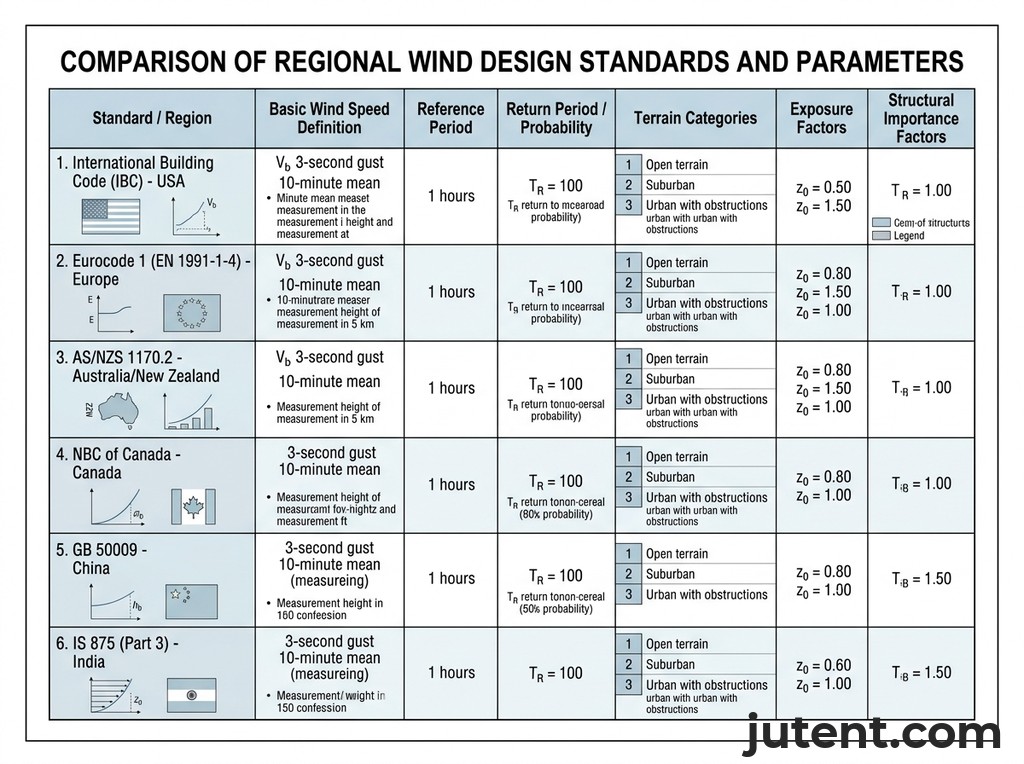
Regional Standards: AS/NZS, SBC, NSCP, and Other Applicable Codes
Our rigorous engineering processes and project track record underscore our commitment to quality and engineering excellence in every project.
For more on PVDF membrane specifications, see our PVDF Membrane Technical Data Sheet.
View our Grandstand Canopy Project Gallery for real-world applications.
1050 g/m² PVDF membrane (standard grade) or PTFE membrane (customizable weight based on project requirements).
Get Your Wind-Loaded Grandstand Quote
“`