

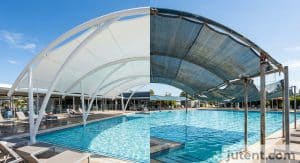
Une piscine tensile shade structure has to do more than cast shade over water. For contractors and aquatic facility developers, the right pool tensile shade structure must withstand chlorine-laden air, resist UV exposure, manage wind loads, and protect swimmers, spectators, and circulation zones without creating long-term maintenance problems. In practice, most specification mistakes come from four decisions: membrane grade selection, structural form, wind load compliance, and budget planning. This guide follows those decisions in order so project teams can compare options faster and lock the correct design approach before tender.
What Makes Pool Tensile Shade Structure Specification Different
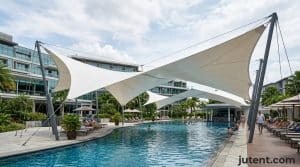
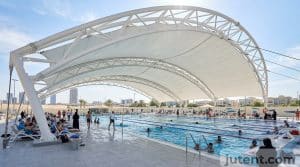
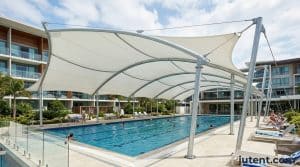
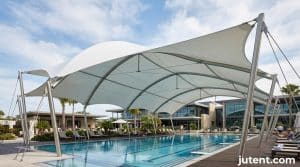
Pool tensile shade structures must withstand a unique combination of environmental stresses: chlorine-laden air, intense UV exposure, and dynamic wind loads. Unlike typical outdoor tensile canopies, the membrane and structural components face accelerated degradation if not specified correctly.
The membrane must resist chlorine vapors that can cause premature material breakdown, while the structure requires corrosion-resistant finishes due to the humid, chemically aggressive atmosphere. Clearance heights over pools must also accommodate diving boards and spectator sightlines, often requiring minimum clearances of 3.5 to 5 meters.
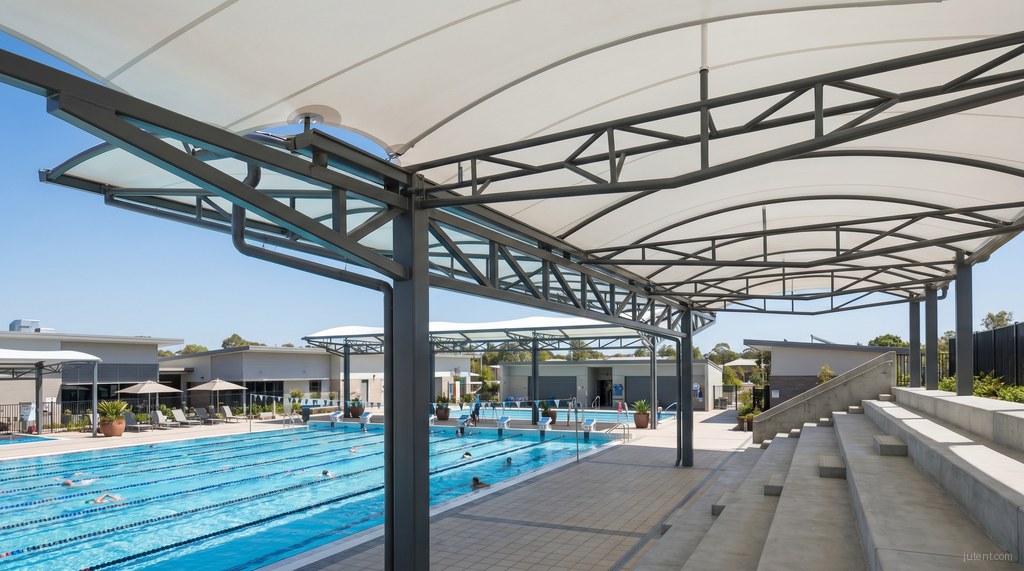
These factors distinguish pool tensile shade structures from standard commercial tensile canopies and demand a tailored specification approach. For a detailed overview of pool shade options, see Pool Shade.
Résistance au chlore : pourquoi la qualité de la membrane est importante pour les environnements de piscine
La résistance au chlore est la propriété membranaire déterminante pour les structures de stores tendus de piscine. L'exposition aux vapeurs de chlore peut dégrader les chaînes polymères, réduisant la résistance à la traction et la durée de vie de la membrane.
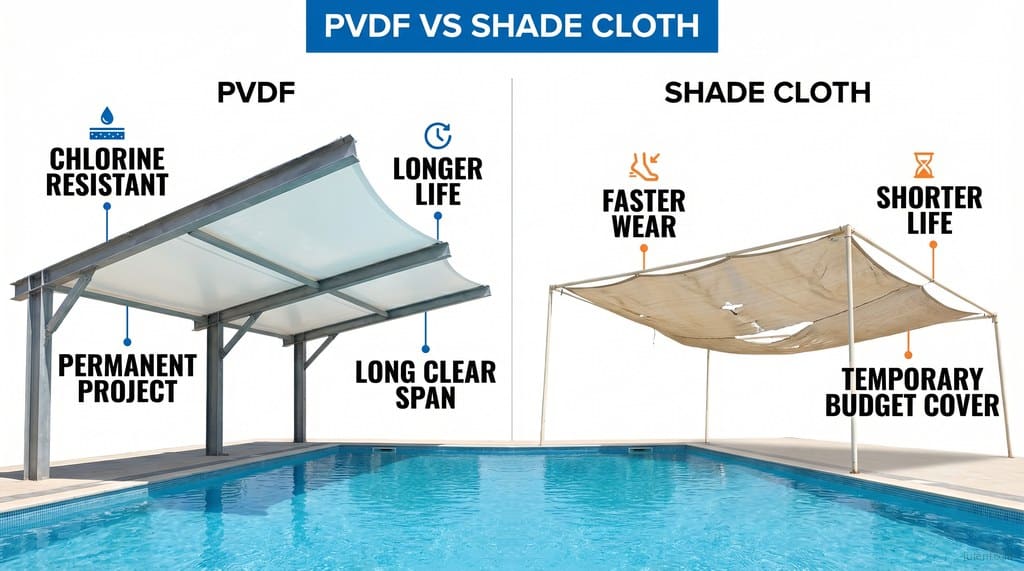
High-grade PVDF membranes at 1050g/㎡ are industry standard for pool environments, offering chlorine resistance that extends service life beyond 15 years under typical outdoor pool conditions. Lower-grade membranes (e.g., 650–800g/㎡ PVC) may cost less upfront but often require replacement within 7–10 years due to chlorine-induced embrittlement.
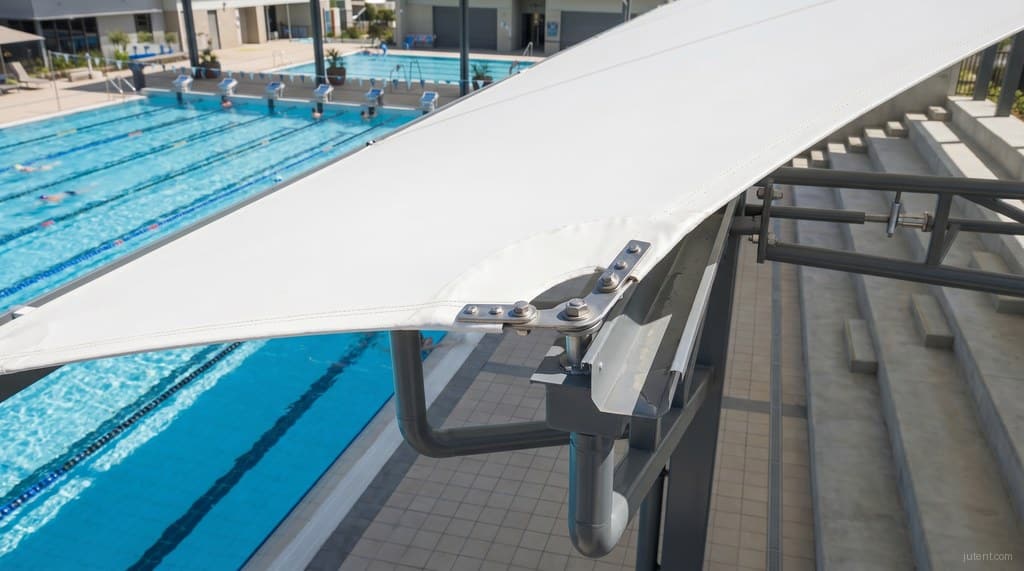
PVDF's fluorocarbon surface layer resists chemical attack and UV degradation simultaneously. For a technical comparison of PVDF versus PTFE membranes in pool applications, refer to Pvdf Vs Ptfe Membrane Comparison.
Structural Forms: Tensile Canopy, Hip Roof, and Sail Shade for Pools
Selecting the structural form impacts both aesthetics and engineering performance. The three common forms for pool tensile shade structures are:
| Forme structurelle | Portée typique (m) | Hauteur de dégagement (m) | Structural Weight (kg/m²) | Remarques |
|---|---|---|---|---|
| Tensile canopy | 15–30 | 3,5–5 | 25–35 | Haubané, colonnes minimales, courbes élégantes |
| Hip Roof | 10–20 | 4–6 | 40–50 | Pitched roof, rigid frame, better rain runoff |
| Sail Shade | 8–15 | 3–4,5 | 15–25 | Minimal structure, tensioned membrane, artistic |
Tensile canopies provide the largest clear spans with fewer columns, critical for unobstructed pool decks. Hip roofs offer increased rigidity and water shedding but add weight and cost. Sail shades are suitable for smaller pools or spectator areas but may require more frequent maintenance.
Wind Load and Structural Compliance for Aquatic Facilities
Wind load is a primary design driver for pool tensile shade structures, especially in coastal or tropical regions. Structures must comply with local codes, typically referencing ASCE 7 or equivalent standards.
Les vitesses de conception du vent pour les installations aquatiques varient souvent de 120 km/h à 200 km/h, selon l'emplacement. Par exemple, une pool tensile canopy in Southeast Asia must be engineered for at least 160 km/h wind speed with a minimum safety factor of 1.5.
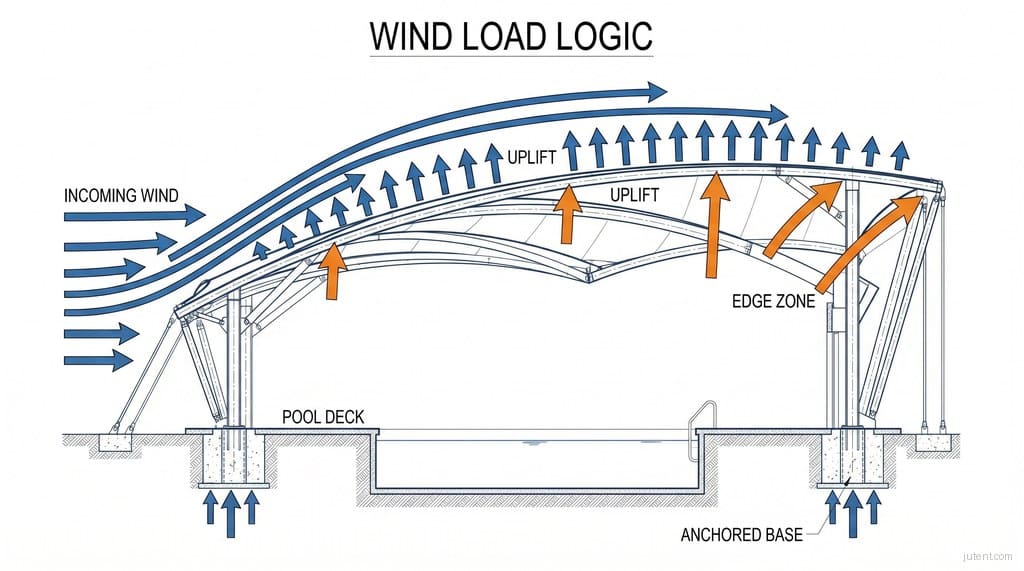
Structural members are sized accordingly; typical primary columns use 150×150×6mm SHS steel with hot-dip galvanizing plus fluorocarbon topcoat for corrosion resistance. Base plates are moment-connected to resist uplift and lateral forces. Clearance heights must consider wind pressure zones, with a recommended minimum of 4 meters to reduce vortex shedding effects.
Ombrage de piscine commerciale : ce que signifie ‘de qualité commerciale' pour les projets de piscine
‘Les structures d'ombrage pour piscine de 'qualité commerciale' spécifient des matériaux et des normes de fabrication qui garantissent durabilité, sécurité et conformité sur une durée de vie de conception de 15+ ans.
Key commercial-grade criteria include:
- Membrane: Minimum 1050g/㎡ PVDF with chlorine and UV resistance
- Steel: Hot-dip galvanized to 275g/m² minimum, powder-coated finish
- Structural design: Engineered for local wind and seismic loads with certified calculations
- Classement au feu : Conforme aux réglementations locales, généralement Classe B ou équivalent
- Warranty: Minimum 10 years on membrane and structure
These specifications distinguish commercial pool shade from residential or temporary solutions, which often use lighter membranes and less rigorous structural design.
Pool Tensile Shade Structure Cost: What Drives the Budget
Une structure d’ombrage tendue de 20 m × 10 m pour piscine en Asie du Sud-Est coûte généralement entre 45 000 et 70 000 dollars en fourniture seule. Les principaux facteurs de coût sont les suivants :
| Facteur de coût | Impact sur le budget |
|---|---|
| Membrane Grade | +3–5 $/㎡ pour le PVDF 1050g par rapport aux qualités inférieures |
| Structural Steel Size | Larger columns increase cost by 15–25% |
| Classement de charge de vent | Higher design wind speeds add 10–20% |
| Finish Quality | La couche de finition fluorocarbonée ajoute 5 à 8 % par rapport à la galvanisation seule |
| Géométrie personnalisée | Les formes complexes augmentent le temps de fabrication |
Selecting a lower-grade membrane or undersized structure may reduce initial cost but increase lifecycle expenses due to premature replacement or repairs.
Ce que fournit Jutent : Fourniture d'usine, documentation et logistique
Jutent supplies pool tensile shade structures with full factory fabrication, including:
- Pre-cut, pre-drilled steel components ready for site assembly without welding
- Calculs structurels et dessins d'ingénierie certifiés
- Membrane pre-tensioned and factory-sewn with reinforced edges and stainless-steel fittings
- Packaging optimized for sea freight with clear component labeling
- Installation manuals with step-by-step procedures and quality control checklists
In a recent aquatic facility project, Jutent delivered a 25m × 12m tensile canopy engineered for 180 km/h wind load, with a 1050g/㎡ PVDF membrane and hot-dip galvanized steel. The structure was erected on site within five days, meeting all local compliance requirements.
FAQ
- What membrane is best for a pool tensile shade structure?
- For pool tensile shade structures, a high-grade PVDF (Polyvinylidene Fluoride) coated membrane is the optimal choice. This material offers superior resistance to the corrosive effects of chlorine and other pool chemicals, which is crucial for long-term durability in such environments. Furthermore, its excellent UV stability ensures the membrane maintains its color and structural integrity against prolonged sun exposure, minimizing degradation and extending the lifespan of the shade structure. Specifying a high-grade PVDF membrane mitigates maintenance concerns and provides lasting aesthetic appeal.
- What is the typical lead time for a pool tensile shade structure from Jutent?
- The typical lead time for a pool tensile shade structure from our factory is approximately 20–35 days for production. Following production, sea freight to destinations in Southeast Asia generally adds another 7–14 days. Therefore, contractors and project managers should anticipate an overall project timeline of 5–8 weeks from order confirmation to delivery for many export projects. This timeframe allows for meticulous fabrication and efficient logistics planning.
Send us your pool dimensions and we'll provide a chlorine-resistant specification and indicative cost within 48 hours.
 English
  Français
  Español de México
  Bahasa Melayu
  Tiếng Việt
  Português do Brasil
  Русский
  ไทย
ไทย  العربية