

Specifying an lanterneau tendu d'atrium involves five decisions that most contractors and developers get wrong the first time: membrane material selection, structural form, light transmission targets, thermal performance requirements, and structural load distribution. This guide covers each one, with the numbers you need to get the specification right before you go to tender.
What Makes Atrium Tensile Skylight Specification Different
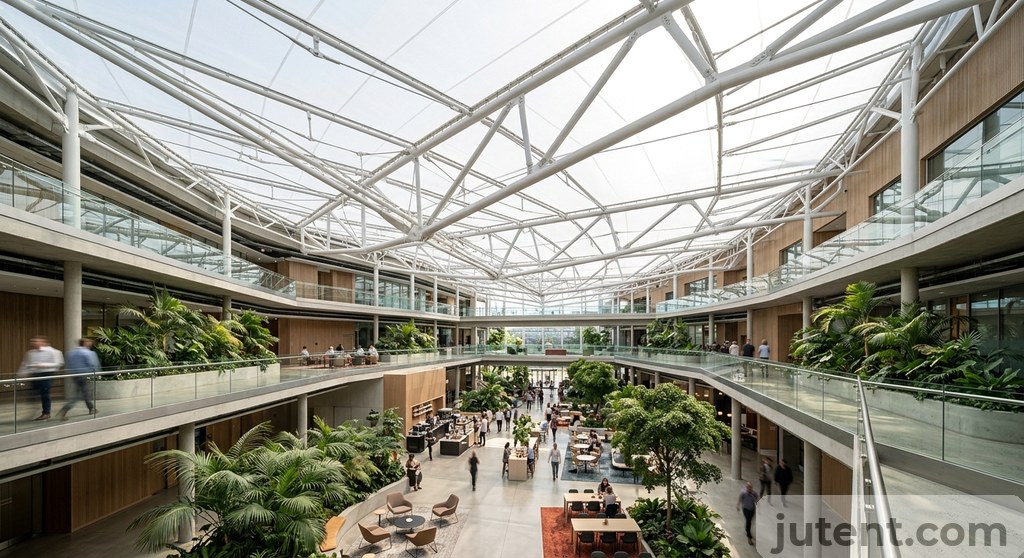
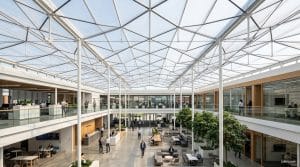
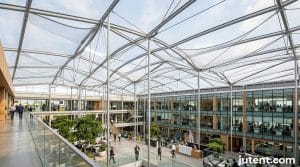
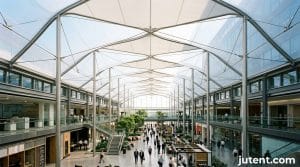
Un puits de lumière commercial pour atrium n'est pas un auvent extérieur. Parce qu'il enferme ou semi-enferme l'intérieur d'un bâtiment, les conditions limites d'ingénierie changent complètement. La structure doit gérer les pressions internes du bâtiment, des codes de sécurité incendie stricts et des risques complexes de condensation que les structures en plein air ne rencontrent jamais.
Sur la base de l'expérience de Jutent dans plus de 400 projets dans plus de 30 pays, des problèmes de spécification similaires apparaissent souvent lorsque des hypothèses de stade précoce sont faites avant que les conditions d'ingénierie soient confirmées.
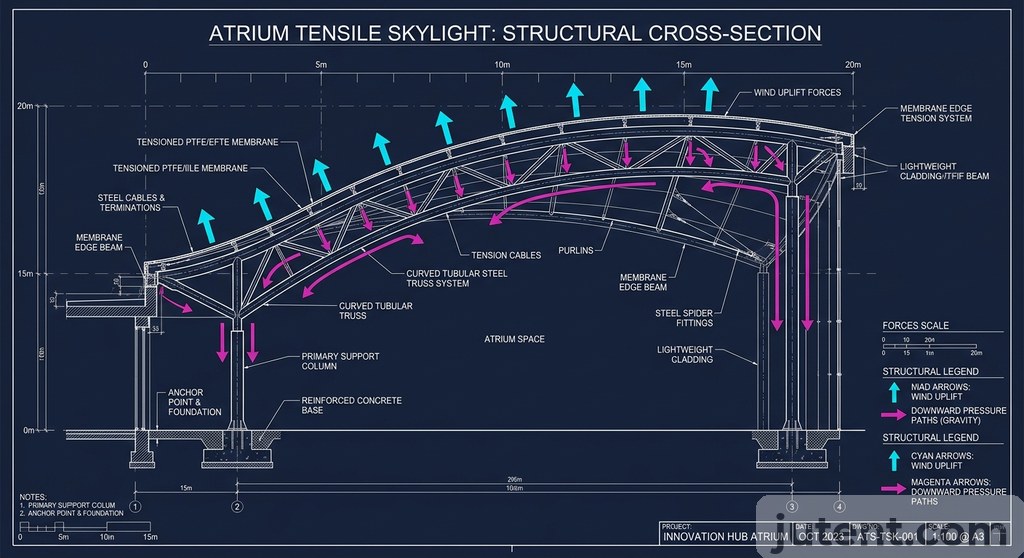
When a tensile membrane seals an atrium, it becomes a critical part of the building envelope. Wind load calculations must account for internal pressure coefficients (Cpi). If the building features large operable doors at ground level, a sudden wind event can pressurize the atrium, creating a massive uplift force on the skylight. Engineers must design the primary steel framing and the membrane pre-stress to handle simultaneous external suction and internal pressurization, often resulting in design uplift loads exceeding 1.5 kPa.
La conformité incendie est le deuxième différenciateur majeur. Les auvents ouverts passent souvent avec des matériaux ignifuges standard. Un auvent fermé toit tendu d'atrium structure typically requires materials that meet EN 13501-1 B-s1,d0 (for PVDF) or A2-s1,d0 (for PTFE). The material must not produce flaming droplets that could ignite the interior space below.
Enfin, la gestion de la condensation dicte les détails du périmètre. Dans un bâtiment climatisé avec une température interne de 22 °C et une humidité relative de 60 %, une chute soudaine de la température extérieure fera descendre la surface intérieure d'une membrane monocouche en dessous du point de rosée. L'eau se condensera sur la face inférieure de la verrière. La conception doit intégrer une pente minimale de 15 degrés pour garantir que cette condensation s'écoule le long de la membrane plutôt que de goutter sur le sol en dessous, se terminant par un canal d'égouttement continu en aluminium de 50 mm intégré dans la plaque de serrage du périmètre.
Puits de Lumière pour Atrium
Membrane Options: ETFE, PTFE, and PVDF for Atrium Applications
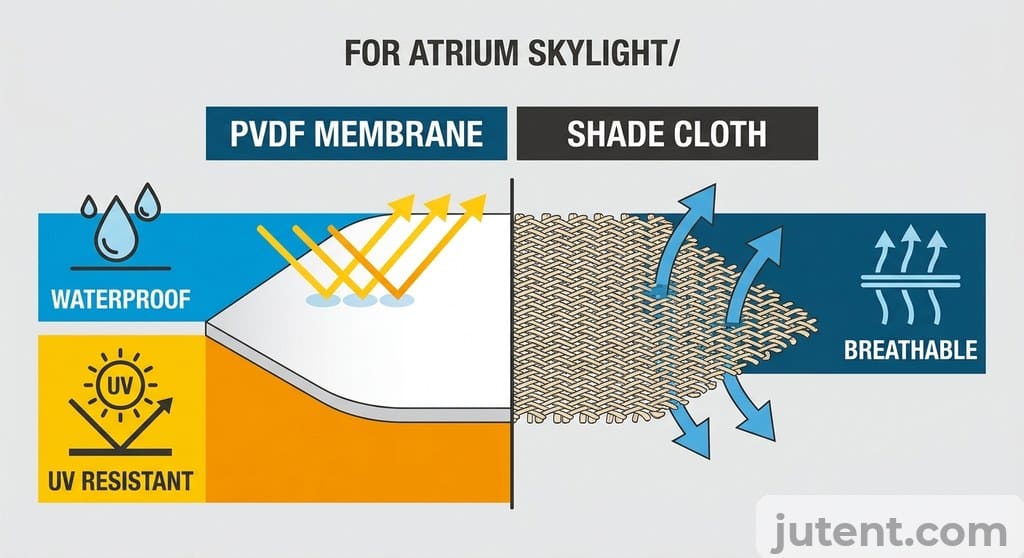
High-grade PVDF handles 80% of standard commercial atrium skylight projects. PTFE is the right choice only when the project specifies a 25+ year design life with strict non-combustible requirements. An atrium ETFE membrane is required when the space demands maximum natural light transmission approaching that of glass.
La protection contre la corrosion et la durée de vie doivent être décrites en fonction du système de protection choisi, de l'environnement du projet et des conditions de maintenance, et non comme une garantie de durée de vie inconditionnelle.
La protection contre la corrosion et la durée de vie doivent être décrites en fonction du système de protection choisi, de l'environnement du projet et des conditions de maintenance, et non comme une garantie de durée de vie inconditionnelle.
L'ETFE (éthylène tétrafluoroéthylène) est un système complètement différent. Contrairement au PVDF ou au PTFE tissé, l'ETFE est un film plastique extrudé, généralement d'une épaisseur de 200 à 300 microns. Comme une seule couche offre une faible résistance thermique et vibre au vent, l'ETFE est généralement déployé sous forme de coussin pneumatique multicouche. Deux ou trois couches de film sont serrées dans un périmètre d'extrusion en aluminium et continuellement gonflées par une unité de traitement d'air basse pression à environ 250 Pa. Cela crée un coussin rigide et hautement transparent qui s'étend sur les grilles en acier structurel.
Pvdf Vs Ptfe Membrane Comparison
Light Transmission: How Membrane Type Affects Natural Daylight
Visual light transmittance (VLT) targets dictate the membrane choice before any structural engineering begins. If the atrium requires 500 lux of natural daylight at floor level to sustain indoor plant life, a standard PVDF membrane will fail the specification.
L'ETFE offre la plus haute transmission lumineuse de tous les matériaux tendus. Un film d'ETFE clair monocouche transmet jusqu'à 95 % de la lumière visible, ce qui en fait un remplacement direct des lourdes verrières en verre. Même dans une configuration de coussin à trois couches, l'ETFE maintient un VLT de 70 à 75 %. Comme ce niveau de lumière peut provoquer un éblouissement sévère et une surchauffe dans les espaces commerciaux, l'ETFE est presque toujours spécifié avec un motif de frittage imprimé. Un frittage argenté couvrant 50 % de la surface de la couche supérieure réduit la transmission lumineuse à un confortable 35-40 % tout en diffusant la lumière pour éliminer les ombres dures sur le sol de l'atrium.
PTFE membranes offer a VLT of 10% to 15%. While this sounds low compared to glass, it is highly effective for large volume spaces. On a clear day with 100,000 lux of exterior sunlight, a 12% VLT PTFE membrane still allows 12,000 lux to enter the building. The woven fiberglass base cloth acts as a massive diffuser. The light entering the atrium is completely shadowless and perfectly even, making PTFE ideal for shopping malls, airport terminals, and office building atriums where glare on computer screens or retail displays must be avoided.
PVDF membranes transmit the least amount of light, typically ranging from 7% to 12% depending on the base cloth thickness and the density of the block-out layers. A 1050g/㎡ Type II PVDF membrane will generally yield around 8% VLT. This is sufficient for ambient daytime navigation in a transit hub or sports facility, but it will require supplementary artificial lighting to meet the 300-500 lux standard required for detailed commercial tasks. If higher light levels are needed with PVDF, engineers can specify a high-translucency variant, which reduces the titanium dioxide in the coating to push VLT up to 15%, though this slightly reduces the material's UV blocking efficiency.
Thermal Performance: What Atrium Skylights Need to Achieve
Thermal performance in an atrium tensile skylight is governed by two metrics: the Solar Heat Gain Coefficient (SHGC) and the U-value. Failing to calculate these accurately will result in an atrium that acts as a greenhouse, overwhelming the building's HVAC system and driving up operational costs.
Single-skin membranes like PVDF and PTFE are excellent at reflecting solar radiation, but they are poor insulators. A standard white PTFE membrane reflects approximately 73% of solar energy, absorbs 15%, and transmits 12%. This gives it a highly favorable SHGC of around 0.18, meaning only 18% of the sun's heat enters the space. However, the U-value (thermal transmittance) of a single-skin membrane is approximately 5.5 W/m²K. In cold climates, this means heat from the building's interior will rapidly escape through the roof during winter.
To solve the U-value problem in single-skin structures, engineers specify a double-skin system. By installing a highly translucent, lightweight liner membrane (such as a 400g/㎡ PVC or a specialized low-E fabric) 200mm to 300mm below the primary exterior membrane, a trapped air cavity is created. This dead air space drops the U-value from 5.5 W/m²K down to approximately 2.5 W/m²K. For extreme climates, aerogel insulation blankets can be suspended between the two layers, pushing the U-value as low as 1.2 W/m²K, though this reduces light transmission to near zero.
Les coussins en ETFE gèrent différemment les performances thermiques. Un coussin standard à trois couches en ETFE emprisonne intrinsèquement deux poches d'air, offrant une valeur U de base de 1,9 W/m²K. Pour gérer le gain de chaleur solaire, le système pneumatique peut être conçu comme un dispositif d'ombrage actif. En imprimant des motifs de frittage décalés sur les couches intermédiaire et supérieure, l'unité de traitement d'air peut modifier la pression dans les chambres pour pousser la couche intermédiaire vers le haut ou vers le bas. Lorsque les couches imprimées se touchent, elles bloquent le soleil (réduisant le SHGC). Lorsqu'elles sont séparées, elles laissent passer la lumière. Ce contrôle thermique dynamique fait de l'ETFE la norme pour les atrium commerciaux climatisés haute performance.
Structural Forms: Barrel Vault, Pyramid, and Flat Tensile Skylights
The architectural form of an atrium tensile skylight is not just an aesthetic choice; it is a strict engineering requirement dictated by the rules of pre-tension. Tensile membranes cannot carry compressive loads. They must be tensioned into an anticlastic (double-curved) shape to resist wind uplift and snow accumulation.
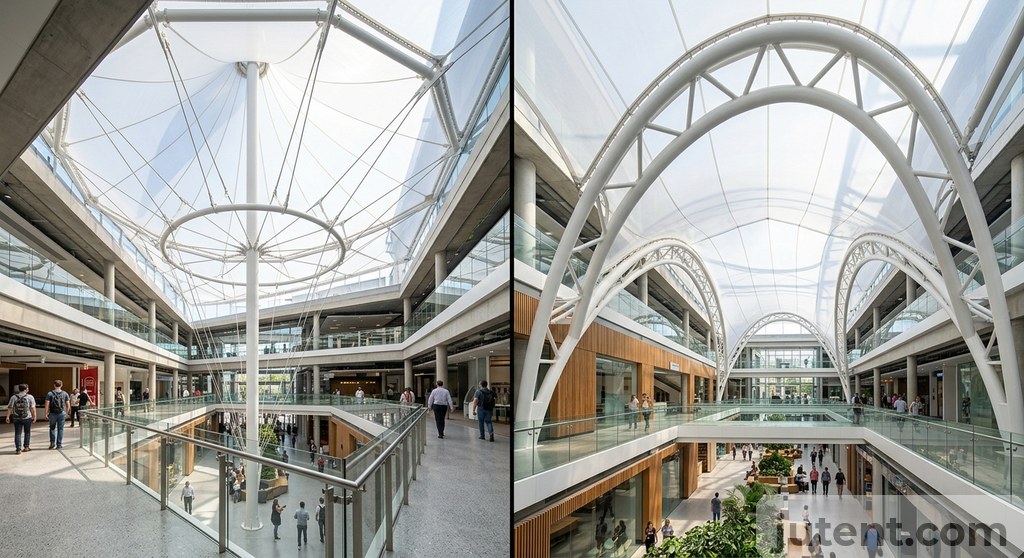
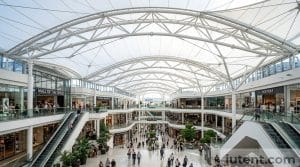
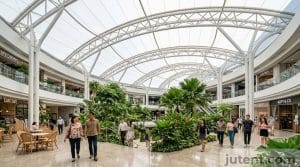
The Barrel Vault is the most common structural form for linear atriums, such as shopping mall concourses. It relies on a series of parallel steel arches, typically fabricated from rolled Circular Hollow Sections (CHS) like 168.3x6mm steel pipe. The membrane is tensioned over these arches and clamped continuously along the parallel perimeter beams. To maintain the required double curvature, the membrane is patterned with a slight negative curve between the arches. This form is highly efficient for spans between 10 and 20 meters and sheds water perfectly, provided the arches have a minimum rise-to-span ratio of 1:5.
The Pyramid or Conical form is used for square or circular atrium openings. This form requires a central high point to push the membrane upward while the perimeter is pulled downward. The high point can be achieved with a central steel mast resting on the atrium floor, but in commercial spaces where floor area is valuable, engineers use a “flying mast.” A flying mast is a short steel strut suspended in mid-air by a network of high-tensile stainless steel cables (e.g., 16mm 1×19 strand) anchored to the perimeter building structure. The membrane is pulled up to a bail ring at the top of the mast, creating a striking, column-free interior.
Les lucarnes tendues plates (formes Hypar ou Crête-et-Vallée) sont les plus difficiles à réaliser. Une membrane vraiment plate accumulera immédiatement de l'eau, entraînant une défaillance catastrophique car le poids de l'eau étire le tissu. Pour obtenir un aspect bas profil, la membrane doit être conçue avec des points hauts et bas alternés, créant une forme de selle. Même dans ces conceptions bas profil, une pente minimale de 15 degrés (ou une pente de 25 %) est obligatoire pour garantir que l'eau s'écoule rapidement lors d'un épisode de pluie de 50 mm/h.
Coût d'un lanterneau tendu d'atrium : ce qui détermine le budget
La planification budgétaire doit être basée sur le type de structure, la portée libre, la résistance au vent, le grade de membrane, le tonnage d'acier et la portée du projet. Pour un devis précis EXW, FOB, CIP ou DDU, les dimensions du projet et les exigences d'ingénierie doivent être examinées en premier.
Membrane selection sets the baseline price. High-grade PVDF is the most economical, ranging from $120 to $180 per square meter for the fabricated membrane and standard aluminum extrusion hardware. PTFE doubles this baseline, costing between $250 and $350 per square meter due to the higher raw material cost, the specialized high-temperature welding required in the factory, and the slower, more complex installation process. ETFE cushion systems are the most expensive, ranging from $500 to $800 per square meter. This premium accounts for the multi-layer film fabrication, the specialized aluminum framing system, and the continuous air handling units and sensors required to maintain cushion pressure.
Steel weight is the second major driver. A tensile membrane exerts massive lateral pull forces on its boundary supports. If the existing building structure (concrete ring beam or steel primary frame) can absorb these reaction forces, the skylight only requires lightweight secondary framing, keeping steel costs below $80 per square meter. However, if the building cannot handle the lateral loads, the skylight must include a self-supporting compression ring. For a 20m x 20m atrium, a heavy steel compression ring can push the structural steel requirement to 45 kg/㎡, adding $150 to $200 per square meter to the budget.
Perimeter interface complexity drives the final cost. An atrium skylight must tie into the existing building envelope flawlessly. Custom flashings, integrated 50mm condensation gutters, and specialized EPDM weather seals require precision engineering and fabrication. If the atrium opening is perfectly square and level, perimeter costs are minimal. If the opening is irregular, stepped, or requires tying into multiple different facade materials, the custom detailing and complex installation logistics will add 15% to 20% to the total project cost.
Ce que fournit Jutent : Fourniture d'usine, documentation et logistique
Procuring an atrium tensile skylight requires a supplier capable of managing the entire critical path from form-finding to final logistics. Jutent operates as a complete factory-direct engineering partner, ensuring that the structure arriving on site matches the exact tolerances of the building envelope.
The scope begins with structural engineering and form-finding. Using specialized membrane software like NDRO or EASY, we calculate the exact pre-stress requirements and generate the cutting patterns. We provide the contractor with comprehensive reaction force data, detailing the exact kN loads at every connection point so the base building engineers can verify their concrete or steel supports. Shop drawings are submitted for approval, detailing every weld, bolt, and clamping plate.
Un conteneur 40GP supporte typiquement environ 21–28 tonnes de charge utile, tandis que la surface couverte réelle dépend du type de structure, de la quantité d'acier et de la méthode d'emballage.
Our factory handles the complete fabrication scope. Primary steel is fabricated from Q355B grade steel and hot-dip galvanized to a minimum of 85 microns for corrosion resistance. The membrane is cut using automated CNC plotters and joined using high-frequency welding machines to create 50mm structural seams that are stronger than the base cloth itself.
Logistics are managed entirely in-house. Steel components are designed to fit within standard 40ft shipping containers, or 40ft open-top containers for oversized curved arches. The membrane is carefully folded, wrapped in heavy-duty PVC protective layers, and crated in timber boxes to prevent any abrasion during transit. Every shipment includes the required aluminum extrusions, stainless steel tensioning bolts, EPDM gaskets, and custom flashings required to seal the atrium.
Si vous souhaitez une référence budgétaire précise pour ce projet, partagez vos dimensions, votre zone de vent et votre type de membrane préféré avec notre équipe.
Demander un devis personnalisé
FAQ
- What is the typical lead time for a atrium tensile skylight from Jutent?
- For an atrium tensile skylight, the typical lead time from order confirmation to site delivery is generally between 5 to 8 weeks. This timeframe includes approximately 20 to 35 days for factory production, covering material fabrication, welding, and quality control checks specific to your project's specifications. Following production, sea freight to Southeast Asian destinations typically takes an additional 7 to 14 days. Project managers should factor in these durations when planning their construction schedules and procurement timelines.
- What membrane grade is recommended for a atrium tensile skylight?
- For atrium tensile skylights, a high-grade PVDF (polyvinylidene fluoride) coated polyester membrane is generally recommended for most commercial applications. This material offers superior long-term UV resistance, excellent self-cleaning properties, and robust durability against environmental factors, ensuring sustained light transmission and aesthetic appeal over the structure's lifespan. Its enhanced performance characteristics contribute to lower maintenance requirements and a longer service life, providing significant value for B2B buyers focused on lifecycle costs and operational efficiency.
 English
  Français
  Español de México
  Bahasa Melayu
  Tiếng Việt
  Português do Brasil
  Русский
  ไทย
ไทย  العربية