

Sports court canopy costs vary widely — from $15,000 for a small recreational court to over $120,000 for a multi-court complex. This guide breaks down what drives the price and what a realistic budget looks like for different project types.
Contractors and developers often face a common challenge: accurately budgeting for a sports court canopy. The initial sticker shock or an unexpectedly low quote can both lead to project delays or budget overruns if the underlying cost drivers aren’t understood. This article demystifies the factors influencing sports court canopy cost, helping you plan with confidence.
The 5 Factors That Drive Sports Court Canopy Cost
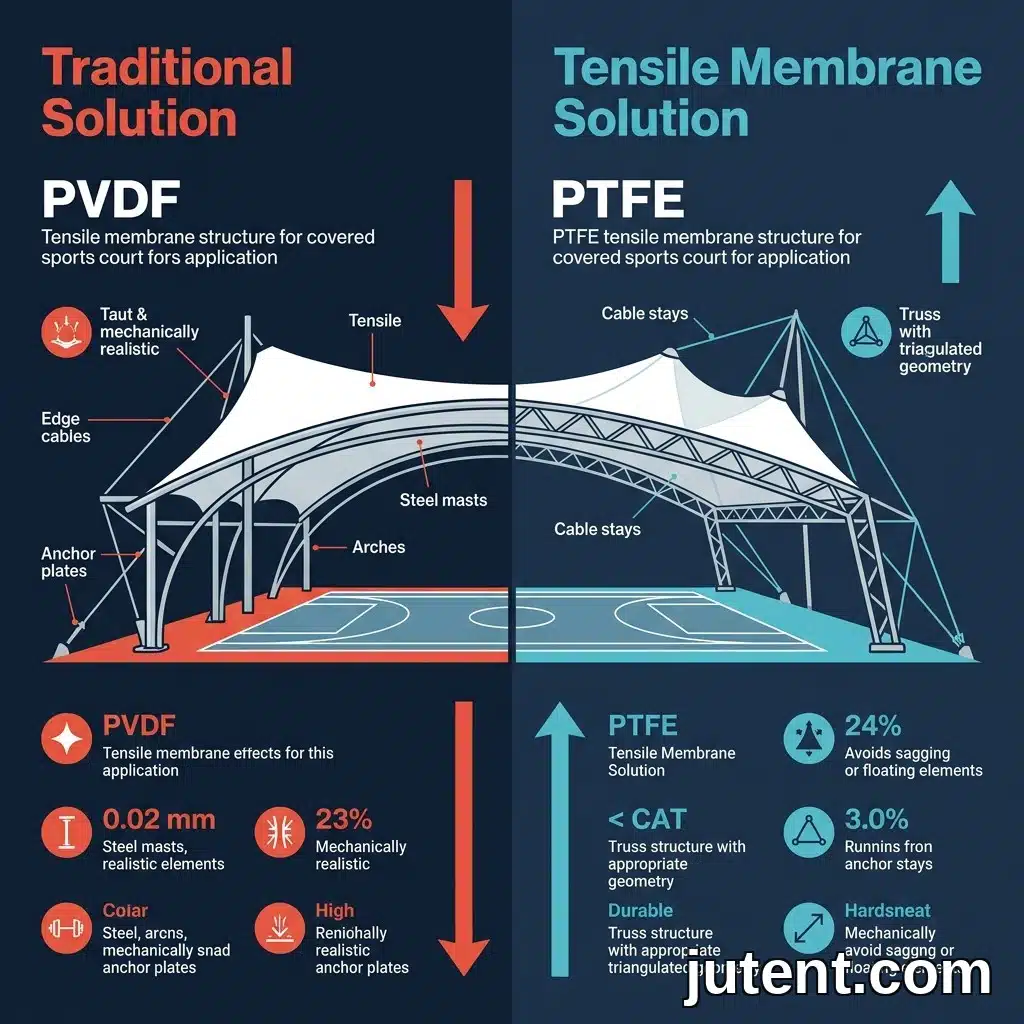
Understanding the core elements that dictate the final sports court canopy cost is crucial for any project. These five factors are interconnected and collectively determine the overall tensile shade structure price.
- Project Scope and Size: This is the most significant driver. A single basketball court canopy will naturally cost less than a multi-court complex covering several tennis or padel courts. Larger spans require more reliable steel structures and greater membrane surface area, increasing material and fabrication costs. The minimum project scope for a tensile membrane structure is typically 100 m².
- Membrane Material: The choice between PVDF and PTFE membrane significantly impacts the tensile canopy budget. PVDF (Polyvinylidene Fluoride) is a common, cost-effective choice with a 10-year warranty and 15+ years service life. PTFE (Polytetrafluoroethylene) offers superior durability, a 15-year warranty, and 25+ years service life, but adds approximately $20/m² to the PVDF range.
- Steel Structure Design and Specification: The complexity of the steel frame, the grade of steel (Q235B or Q355B), and the surface treatment (epoxy zinc-rich primer + acrylic topcoat, epoxy zinc-rich primer + fluorocarbon topcoat, or hot-dip galvanizing) all influence cost. More intricate designs or higher wind load requirements necessitate heavier gauge steel and more complex fabrication.
- Location and Environmental Loads: Wind, snow, and seismic loads vary by geographical location. Structures in high-wind zones, for instance, require more substantial engineering and material specifications, directly impacting the sports court shade cost per sqm.
- Installation Complexity: Factors like site accessibility, ground conditions, and the need for specialized equipment or on-site supervision from the manufacturer can add to the overall sports canopy installation cost. While remote guidance is often free, on-site supervision is a paid service.

Sport Court Shade
Cost by Court Type: Basketball, Tennis, Futsal, Padel
The specific sport dictates court dimensions and, consequently, the required canopy size and structural design. This directly influences the sports court canopy cost.
- Basketball Court Canopy: A standard full-size basketball court (approx. 28m x 15m) requires a canopy of around 420-500 m². For a simple PVDF membrane structure, supply costs might range from $40–$70/m², placing the ex-factory supply cost for the membrane and steel structure in the $16,800–$35,000 range.
- Tennis Court Canopy: A single tennis court (approx. 23.77m x 10.97m playing area, plus run-offs) typically needs a canopy covering 600-800 m². Due to the larger span, the steel structure might be more substantial. Supply costs for a PVDF membrane structure could be $50–$80/m², translating to an ex-factory cost of $30,000–$64,000.
- Futsal Court Canopy: Futsal courts are smaller than basketball courts (approx. 38m x 20m to 42m x 25m for international play, often smaller for recreational). A canopy for a typical futsal court might be 400-600 m². Supply costs for a PVDF membrane structure would be similar to basketball, around $40–$70/m², resulting in an ex-factory cost of $16,000–$42,000.
- Padel Court Canopy: Padel courts are compact (10m x 20m). A canopy for a single padel court would be around 200-250 m². Given the smaller span, a simpler structure might be feasible, with supply costs for a PVDF membrane structure ranging from $35–$60/m², leading to an ex-factory cost of $7,000–$15,000. Multi-court padel complexes will scale these costs.
These figures represent ex-factory supply costs for the membrane and steel structure. Installation, shipping, and other local costs would be additional.

Tensile Shade Structures Sports Courts Guide
Supply-Only vs Supply-and-Install: Understanding the Price Difference
When budgeting for a sports court canopy, a critical decision is whether to opt for a supply-only package or a supply-and-install service. This choice significantly impacts the overall tensile shade structure price.
Supply-Only: This option means the manufacturer provides all the necessary components – the fabricated steel structure, the tensile membrane, connection hardware (typically SS304 standard, SS316 optional upgrade), and detailed installation manuals. The contractor is then responsible for all aspects of installation, including sourcing local labor, equipment, and managing the construction process.
- Advantages for Contractors: Greater control over the installation schedule, potential cost savings if local labor is cheaper, and the ability to integrate the canopy installation with other site works.
- Cost Implications: The ex-factory cost for the structure and membrane will be lower, as it excludes installation labor and equipment. However, contractors must factor in their own installation costs, which can vary widely based on local labor rates, equipment rental, and project management overhead. For export projects, Jutent can provide design drawings, calculations, material specifications, installation manuals, and free remote guidance, subject to project scope and contract terms.
Supply-and-Install: In this scenario, the manufacturer not only supplies the materials but also undertakes the installation of the canopy. This typically involves sending a specialized installation team or supervisor to the site.
- Advantages for Contractors/Developers: A single point of contact, reduced project management burden, and assurance that the canopy is installed by experienced professionals who understand the specific requirements of tensile structures. This can minimize risks and ensure adherence to design specifications.
- Cost Implications: The overall project cost will be higher than supply-only, as it includes the manufacturer’s installation labor, travel, accommodation, and potentially equipment costs. This option is often preferred for complex designs or when local expertise in tensile structure installation is limited.
The price difference can be substantial. For example, while the supply cost per square meter might be $40–$70/m² ex-factory, adding installation services can increase the total project cost by 20-50% or more, depending on location and complexity.

What’s Included in a Tensile Shade Structure Price from a Chinese Manufacturer
When you receive a quote for a tensile shade structure from a Chinese manufacturer like Jutent Engineering, it’s important to understand what components and services are typically encompassed in the quoted sports court canopy cost. This clarity helps in comparing offers and avoiding surprises.
A standard supply-only quote from Jutent Engineering will generally include:
- Tensile Membrane Fabric: This is the core shading material. Quotes specify the type (e.g., 1050 g/m² PVDF or PTFE), color, and any specific coatings. The membrane is custom-fabricated to the project’s design.
- Steel Structure: This includes all primary and secondary steel members, custom-fabricated according to the approved engineering drawings. The steel grade (Q235B or Q355B) and surface treatment (epoxy zinc-rich primer + acrylic topcoat, epoxy zinc-rich primer + fluorocarbon topcoat, or hot-dip galvanizing) will be clearly stated.
- Connection Hardware: All necessary bolts, nuts, cables, clamps, and tensioning devices required to assemble the steel structure and attach the membrane. These are typically SS304 standard, with SS316 available as an optional upgrade for enhanced corrosion resistance.
- Engineering Design and Shop Drawings: The quote includes the cost of structural analysis, detailed design drawings, and shop drawings for fabrication. These ensure the structure meets specified load requirements (wind, snow, seismic) for the project’s location.
- Fabrication and Quality Control: The cost covers the manufacturing process, including cutting, welding, surface treatment, and rigorous quality checks at each stage. Jutent is ISO 9001 and SGS certified, ensuring adherence to international quality standards.
- Packaging: Components are carefully packaged for international shipping to prevent damage during transit.
- Installation Manuals and Remote Guidance: Detailed instructions for assembly are provided. For export projects, free remote guidance from Jutent’s engineering team is available to assist your local installation crew, subject to project scope and contract terms.
What is typically not included in a supply-only ex-factory price:
- Shipping costs (freight, insurance, customs duties)
- Local taxes and import tariffs
- Foundation work and civil engineering
- On-site installation labor, equipment, or supervision (unless explicitly quoted as a separate service)
- Local permits and approvals
Based on Jutent’s experience across 400+ projects in 30+ countries, understanding these inclusions and exclusions is vital for accurate tensile canopy budgeting.
Hidden Costs Contractors Often Miss
Even with a detailed quote, contractors can encounter unexpected expenses that inflate the overall sports court canopy cost. Being aware of these potential “hidden” costs is essential for realistic budgeting and project success.
- Foundation and Civil Works: The tensile structure requires reliable foundations to anchor the steel columns and withstand uplift forces. The cost of excavation, concrete pouring, rebar, and any necessary ground preparation is often overlooked in the canopy budget itself. This can be a significant expense, especially on sites with challenging soil conditions or where extensive earthworks are required.
- Shipping, Customs, and Local Logistics: While the ex-factory price covers the product, the journey from the manufacturer to the site can be costly. This includes international freight, marine insurance, customs duties, import taxes, and local transportation from the port to the project site. These costs can vary significantly based on the country and current shipping rates.
- Local Permits and Approvals: Obtaining necessary building permits, zoning approvals, and environmental clearances can involve fees, engineering reviews, and potential delays. These administrative costs and associated timeframes must be factored into the project schedule and budget.
- Specialized Equipment Rental: Even for supply-only projects, installing a large tensile structure often requires specialized equipment such as cranes, scissor lifts, and tensioning tools. Rental costs for these items, along with operator fees, can add up quickly.
- Site Preparation and Access: Ensuring the site is clear, level, and accessible for heavy machinery and material delivery is critical. Costs associated with site clearing, temporary roads, or creating safe working platforms can be substantial.
- Contingency for Unforeseen Issues: Unexpected site conditions, weather delays, or minor design adjustments can lead to additional costs. A contingency fund, typically 10-15% of the total project budget, is highly recommended to absorb these unforeseen expenses.
- Local Labor and Supervision (for supply-only): If you opt for supply-only, the cost of skilled labor for assembly and erection, along with your own project management and supervision, must be accurately estimated. This includes wages, benefits, and any necessary safety training or equipment.
By proactively identifying and accounting for these hidden costs, contractors can develop a more accurate and realistic tensile canopy budget, minimizing financial surprises down the line.
How to Get an Accurate Quote: What Information You Need to Provide
To receive a precise and competitive sports court canopy cost quote, providing thorough and accurate information to the manufacturer is paramount. The more detail you offer, the less guesswork is involved, leading to a more tailored and reliable price.
Here’s a checklist of essential information to include in your inquiry:
- Project Location: This is critical for calculating environmental loads. Provide the full address, including city and country. This allows the manufacturer to determine specific wind load, snow load, and seismic requirements for structural design, which directly impacts the steel specification and overall sports court shade cost per sqm.
- Court Dimensions and Number of Courts: Clearly state the exact length and width of each court, and how many courts the canopy needs to cover. Specify if run-off areas also need to be shaded. A simple sketch or site plan is extremely helpful.
- Desired Coverage Area: Beyond court dimensions, indicate the total area (in square meters) you intend to cover. This helps confirm the overall scale of the project.
- Preferred Membrane Material: Specify whether you prefer PVDF (10-year warranty, 15+ years service life) or PTFE (15-year warranty, 25+ years service life). If unsure, state your budget or performance priorities, and the manufacturer can recommend the most suitable option.
- Desired Membrane Color: While white is standard, other colors may be available and can sometimes influence cost.
- Steel Surface Treatment Preference: Indicate your preference for epoxy zinc-rich primer + acrylic topcoat, epoxy zinc-rich primer + fluorocarbon topcoat, or hot-dip galvanizing. Each has different cost and durability implications.
- Installation Requirements: Clearly state whether you require a supply-only package with remote guidance, or if you need on-site supervision from the manufacturer’s team. If on-site supervision is needed, specify the duration.
- Project Timeline: Providing an estimated project start and completion date helps the manufacturer assess their capacity and provide realistic lead times.
- Any Specific Design Preferences or Constraints: If you have a particular aesthetic in mind, or if there are site-specific constraints (e.g., existing structures, height restrictions), communicate these upfront.
- Budget Range (Optional but Recommended): While not strictly necessary, providing a realistic budget range can help the manufacturer tailor their proposal to meet your financial parameters, suggesting appropriate material and design choices.
By furnishing these details, you enable manufacturers like Jutent Engineering to provide an accurate, detailed, and competitive tensile shade structure price, streamlining the quotation process and ensuring your tensile canopy budget aligns with expectations.
FAQ
- Q: What is the cost per square metre for a sports court tensile canopy?
- A: The supply cost for a sports court tensile canopy typically ranges from $35–$75/m² ex-factory. This variation depends on several factors, including the grade of the tensile membrane (PVDF vs. PTFE), the specification and complexity of the steel structure (e.g., Q235B vs. Q355B, surface treatment), and the overall span of the canopy. For example, a simple PVDF membrane structure with minimal steel might be at the lower end, while a PTFE membrane with a complex steel frame for a large span would be at the higher end. Installation cost is additional; in Southeast Asia, it adds approximately $15–$30/m², while in the Middle East, it typically ranges from $20–$40/m².
- Q: What information do I need to get an accurate sports court canopy quote?
- A: To receive a precise sports court canopy cost quote, you should provide the following key information: the exact dimensions of the court(s) to be covered (length and width), the total number of courts, the project’s geographical location (for accurate wind load and other environmental calculations), your preferred membrane grade (PVDF or PTFE), and whether you require installation support (e.g., free remote guidance or paid on-site supervision). Any specific design preferences or site constraints should also be communicated. Typical technical values should always be written conservatively and described as subject to project design.
Send us your court dimensions, location, and membrane preference and we’ll provide a detailed cost breakdown within 48 hours.


