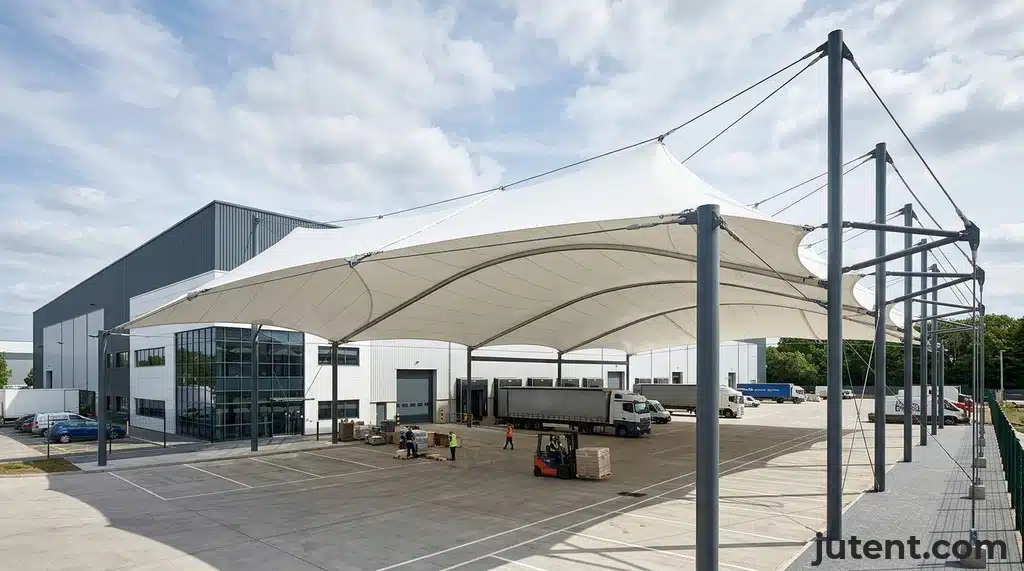

Architectural Storage Membrane Overview: How Do Forklift Clearances Work?

10 Mins Reading
A warehouse tensile canopy is a permanent tensile membrane structure designed for commercial applications. This guide explains how they work, what they cost, and what to specify.

When evaluating options for expanding storage capacity or protecting valuable assets, developers and contractors often face a critical decision: build a traditional brick-and-mortar warehouse, lease off-site space, or consider a more agile, cost-effective solution. A presents a compelling alternative, offering rapid deployment, significant cost savings, and adaptable functionality. This guide will clarify what a warehouse tensile canopy is, how it functions, its various types, typical costs, and when it represents the optimal choice for your project.

What a Warehouse Tensile Canopy Is and What It Isn't

A warehouse tensile canopy is a permanent tensile membrane structure specifically engineered for commercial and industrial storage applications. It consists of a high-strength fabric membrane tensioned over a reliable steel framework, creating a durable, weather-resistant enclosure. Unlike temporary tents or inflatable structures, a warehouse tensile canopy is designed for long-term use, meeting stringent structural integrity and safety standards. It provides a fully enclosed, protected space suitable for storing raw materials, finished goods, equipment, or vehicles.

What it isn't, however, is a flimsy, short-term solution. These structures are engineered to withstand local wind, snow, and seismic loads, offering comparable protection to conventional buildings for many applications. They are not typically designed for climate-controlled environments requiring precise temperature and humidity regulation unless specialized insulation and HVAC systems are integrated. Instead, they excel as efficient, adaptable, and cost-effective alternatives for projects where rapid expansion, flexibility, and budget optimization are key drivers. They represent a smart investment for businesses needing reliable, scalable storage.

How Warehouse Tensile Canopy Structures Work: Steel, Membrane, and Drainage

The fundamental principle behind a warehouse tensile canopy involves the interplay of a rigid steel frame and a flexible, pre-stressed membrane. The steel structure, typically fabricated from Q235B or Q355B grade steel, provides the primary support and defines the overall shape. This framework is treated with durable surface finishes such as epoxy zinc-rich primer with an acrylic or fluorocarbon topcoat, or hot-dip galvanizing, ensuring longevity and corrosion resistance. The membrane, commonly 1050 g/m² PVDF or PTFE, is then tensioned across this frame. This tensioning is crucial; it gives the fabric its structural rigidity, allowing it to resist external forces like wind uplift and snow load, and prevents fluttering.

Drainage is an integral design consideration. Tensile structures are inherently designed with specific curvatures and slopes to facilitate efficient rainwater runoff. The membrane's smooth, non-porous surface, combined with the structure's geometry, directs water to integrated gutter systems and downspouts, preventing ponding and ensuring the integrity of the stored assets below. This proactive drainage design is a hallmark of well-engineered tensile structures, making them highly suitable even for heavy rain environments. The combination of strong steel, durable membrane, and intelligent drainage ensures a reliable, long-lasting storage solution. Warehouse Tensile Canopy Guide

Types of Warehouse Tensile Canopy: Common Structural Forms

Warehouse tensile canopies come in several common structural forms, each offering distinct advantages in terms of span, aesthetics, and functionality. The choice of form often depends on the required clear span, site conditions, and specific operational needs.

  • Arch Structures: These feature a series of arched steel trusses over which the membrane is tensioned. Arch forms are excellent for creating large, clear spans without internal columns, maximizing usable floor space. They offer good snow shedding capabilities and a classic, reliable appearance.
  • Cone (or Conical) Structures: Characterized by a central mast supporting a membrane that slopes downwards to perimeter columns or ground anchors. Cone structures are often used for smaller to medium-sized storage areas and can be modularly combined to cover larger footprints. They provide excellent drainage and a distinctive architectural profile.
  • Barrel Vault Structures: Similar to arch structures but often with a more elongated, semi-cylindrical profile. Barrel vaults are effective for covering long, rectangular areas, providing consistent headroom across the span. They are efficient for linear storage requirements and can be easily extended.
  • Hypar (Hyperbolic Paraboloid) Structures: These forms utilize a saddle shape, where the membrane curves in opposite directions. Hypars are known for their architectural elegance and inherent structural stability due to their double curvature. While often seen in more aesthetic applications, they can be adapted for warehouse use, particularly for unique site requirements or where a distinctive look is desired.

Each type offers specific benefits, allowing for tailored solutions that optimize both function and form for diverse warehousing needs.

What a Warehouse Tensile Canopy Costs: A Realistic Range

Understanding the cost of a warehouse tensile canopy is crucial for project budgeting. Pricing is typically quoted on an EXW (Ex Works) basis per square meter (m²), with a minimum project scope often around 100 m². The cost can vary significantly based on the membrane type, structural complexity, and overall project size.

For a basic tensile membrane structure with minimal steel, such as a simple shade canopy, costs might range from $30–$50/m². However, for a fully enclosed warehouse tensile canopy, which requires more substantial steelwork and a reliable membrane:

  • PVDF membrane, simple form: Expect a range of $40–$70/m². This applies to common forms like simple arch or barrel vault structures.
  • PVDF membrane, complex form: For more intricate designs or larger spans, costs can increase to $60–$90/m².
  • PTFE membrane: If a PTFE membrane is selected for its superior longevity and self-cleaning properties, add approximately $20/m² to the PVDF ranges.

These figures are for the structure itself, EXW. Additional costs will include foundation work, shipping, installation (which can be guided remotely for free by Jutent, or with paid on-site supervision), and any optional features like lighting, ventilation, or specialized access points. Based on Jutent's experience across 400+ projects in 30+ countries, these ranges provide a realistic starting point for budgeting. Typical technical values should always be written conservatively and described as subject to project design.

When a Warehouse Tensile Canopy Makes Sense for Your Project

A warehouse tensile canopy is not a universal solution, but it offers distinct advantages that make it the optimal choice for specific project scenarios. Consider a tensile canopy when:

  • Rapid Deployment is Critical: Compared to conventional construction, tensile structures have significantly shorter design, fabrication, and installation timelines. This is ideal for projects requiring quick expansion of storage capacity to meet urgent operational demands or seasonal peaks.
  • Budget Optimization is a Priority: Generally, the initial capital expenditure for a warehouse tensile canopy is lower than that of a traditional brick-and-mortar building of comparable size. This makes it an attractive option for developers and contractors looking to maximize their investment efficiency.
  • Flexibility and Adaptability are Valued: Tensile structures can be designed for easy expansion or even relocation, offering a level of flexibility rarely found in conventional buildings. This is beneficial for businesses with evolving storage needs or those operating on leased land.
  • Temporary or Semi-Permanent Storage is Needed: While permanent, their relative ease of installation and deconstruction makes them suitable for projects that might have a defined lifespan, such as construction site storage, event logistics, or temporary overflow facilities.
  • Site Constraints Exist: Tensile structures can often be erected on sites that might be challenging for traditional construction due to soil conditions, access limitations, or existing infrastructure. Their lighter footprint can reduce foundation requirements.
  • Asset Protection is Key, but Climate Control is Secondary: If the primary need is protection from sun, rain, wind, and snow for goods or equipment that don't require precise temperature or humidity control, a tensile canopy provides excellent performance.

For export projects, Jutent can provide design drawings, calculations, material specifications, installation manuals, and free remote guidance, subject to project scope and contract terms, further streamlining the process for international clients.

FAQ

Q: How long does a warehouse tensile canopy last?
A: The lifespan of a warehouse tensile canopy is substantial, reflecting its permanent design. The PVDF membrane typically has a service life of 15–20 years, backed by a 10-year warranty. For PTFE membrane, the service life extends to 25+ years with a 15-year warranty. The reliable steel structure, treated with finishes like hot-dip galvanizing or epoxy zinc-rich primer with a fluorocarbon topcoat, is engineered to last 25–30 years, ensuring long-term asset protection.
Q: Is a warehouse tensile canopy suitable for heavy rain environments?
A: Absolutely. Tensile structures are meticulously designed with specific curvatures and integrated drainage systems to manage heavy rainfall efficiently. The membrane's smooth surface and the structure's geometry direct water to gutters and downspouts, preventing ponding and ensuring that the stored contents remain dry and protected. This proactive approach to water management makes them highly effective in regions prone to significant precipitation.

If you're considering a warehouse tensile canopy, send us your project brief for a free consultation.

Get a Warehouse Canopy Quote

Need a Technical Proposal?

Send us your site dimensions and our engineers will provide a free 3D design and quotation.
Inquiry Form Portfolio
Request a
Project Quote

Share your tensile architecture requirements with us. Our engineering specialists will review your project and provide a tailored preliminary solution within 24 hours.

Tell us about your project

Inquiry Form Pop Up

100% Secure & Confidential

×
Support
Support Team
               

Hello! 👋 How can we help you today?

WhatsApp
Call Us Now
Email Support
WhatsApp Call Inquiry Email