

“`html
Summer temperatures in Gulf cities routinely exceed 45°C, with UV indices hitting extreme levels by 10:00 AM. For any playground shade structure Middle East contractors specify, the primary goal is protecting children from these severe thermal loads and intense solar radiation. A heat resistant playground canopy in this region is not merely an architectural feature; it is critical safety infrastructure designed to prevent contact burns and heat exhaustion.
This guide covers the exact membrane grades, wind load standards, and clearance heights required for compliance and durability in the Gulf. Specifying these structures involves strict decisions regarding material selection, structural steel sizing, and safety clearances. Getting these numbers right before submitting a tender prevents permit rejections and ensures the facility operator receives a durable, compliant asset.
Gulf Climate: Why Standard Playground Shade Specs Don't Apply
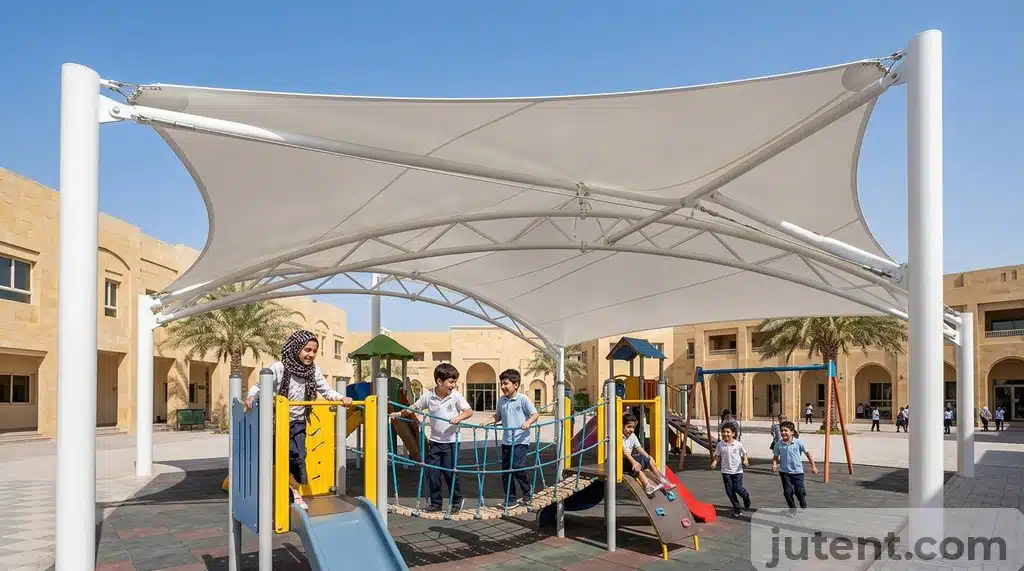
Standard shade specifications fail in the Gulf because they are engineered for temperate climates. A typical 340g/㎡ HDPE (High-Density Polyethylene) shade cloth degrades rapidly under the Middle Eastern sun, losing structural integrity within 24 to 36 months.

In the Gulf region, a Playground Shade must withstand continuous exposure to UV Index 11+ and ambient temperatures exceeding 45°C, which can push the surface temperature of the membrane itself past 70°C. At these extreme temperatures, standard PVC plasticizers migrate to the surface, causing the fabric to become brittle, discolor, and eventually tear under wind loads.
Contractors specifying a playground canopy UAE must shift from basic shade cloth to architectural-grade tensile membranes. The specification must mandate materials engineered specifically for high thermal loads and extreme UV radiation. This means upgrading to heavy-duty PVDF-coated fabrics that reflect solar radiation rather than absorbing it. Failing to specify the correct thermal and UV resistance at the tender stage guarantees premature failure, safety risks for children, and costly replacement cycles for the facility operator. The financial impact of replacing a failed membrane often exceeds the initial installation cost due to site access restrictions and operational downtime.
PVDF Membrane Grade Requirements for Gulf Playground UV and Heat Protection

Specify 1050g/m² PVDF-coated polyester membrane for Gulf playground projects. Lighter 650g/㎡ or 900g/㎡ PVC alternatives will not survive the thermal degradation cycle in this region.
Typical specifications use Q235B or Q355B steel, 1050 g/㎡ PVDF or PTFE membrane as standard, and SS304 stainless accessories, with higher grades available when the project requires them.

Corrosion protection and service life should be described according to the selected protection system, project environment, and maintenance conditions rather than as an unconditional lifespan guarantee.
Wind Load: UAE and Saudi Standards for Playground Shade Structures
The final technical values should be confirmed against the project-specific engineering requirements and local code conditions.
In Saudi Arabia, structural engineering must comply with the Saudi Building Code (SBC) 301 for loading. For a playground shade Qatar or UAE installation, local municipality standards (such as local municipality standards) strictly dictate wind load calculations. Because playground canopies often utilize hyperbolic paraboloid (hypar) or large conical forms, they generate significant uplift forces.
Company experience should be described through verified export experience and project support capability rather than unsupported project anecdotes.

Safety Considerations for Playground Shade in Extreme Heat
Clearance height and fire retardancy are the two most critical safety specifications for playground canopies.
First, the lowest point of the shade membrane (the eaves or perimeter edge) must maintain a minimum clearance of 3.0 meters above the finished play surface. This dimension prevents children from reaching the tensioning hardware or the membrane itself, while also allowing sufficient cross-ventilation to dissipate trapped heat. If the structure covers tall play equipment, the membrane must clear the highest platform by at least 2.5 meters to prevent thermal radiation from heating the plastic and metal play components.
Second, the membrane must meet strict fire safety standards. In the Gulf, civil defense authorities require materials to pass the NFPA 701 or DIN 4102 B1 fire retardancy tests. The fabric must be self-extinguishing and produce no flaming droplets.
Finally, all structural steel columns located within the fall zone of the playground must be fitted with high-density polyurethane crash pads. These pads should extend a minimum of 2.
“`


